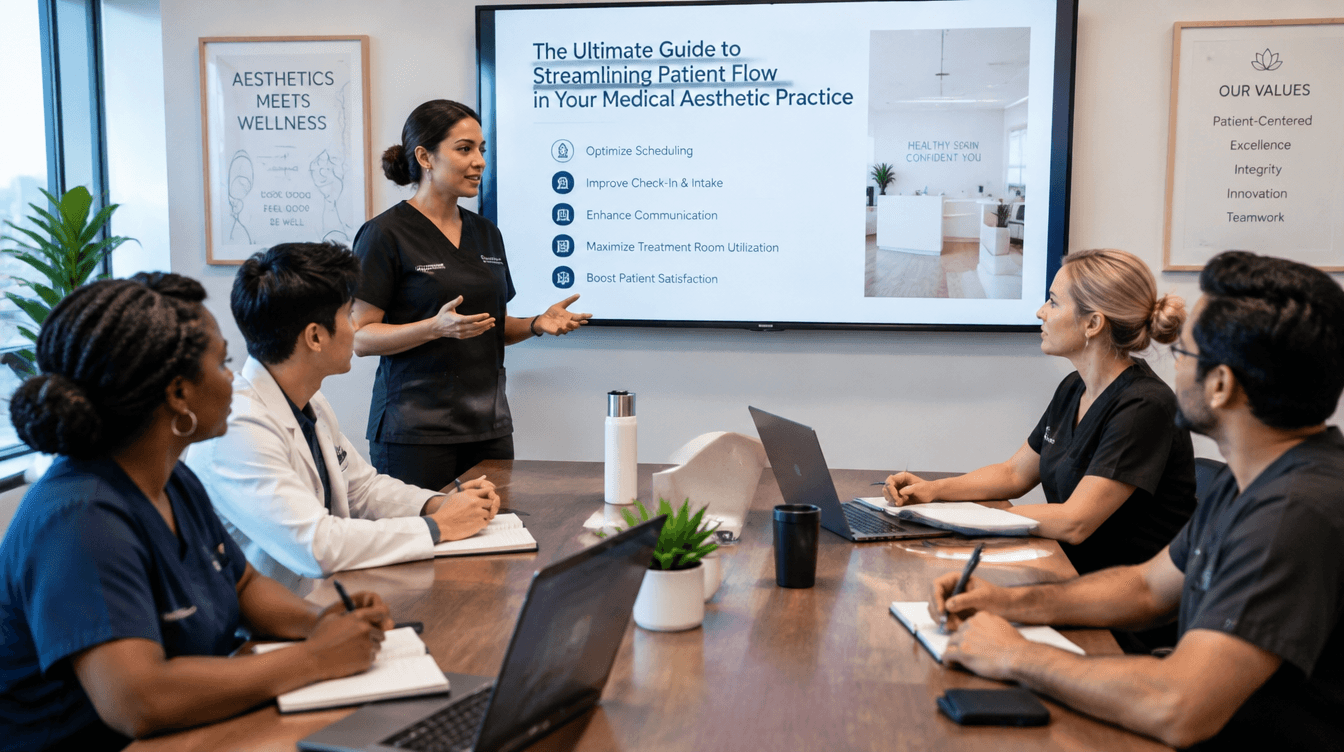
“In a busy medical aesthetic practice, patient flow can directly influence how efficiently the clinic operates and how patients perceive their overall experience. From booking an appointment to completing a treatment and scheduling follow-up care, every step should feel organized, timely, and effortless.
When patient flow is poorly managed, even a clinic with excellent practitioners can experience long wait times, scheduling conflicts, underused treatment rooms, frustrated staff, and missed revenue opportunities. On the other hand, a well-designed patient flow system allows teams to serve more patients without making the experience feel rushed or impersonal.” - Rhane Handisides
The Connection Between Patient Flow and Practice Efficiency
Patient flow refers to how patients move through different stages of their visit. This includes scheduling, check-in, consultation, treatment preparation, treatment delivery, checkout, and follow-up.
Efficient patient flow ensures that each stage happens at the right time and that the right team member is available when needed. Instead of providers waiting for patients, patients waiting for rooms, or staff searching for paperwork, the entire workflow operates according to a defined process.
For growing clinics, this is where clinic operations management becomes especially important. A structured approach helps identify bottlenecks, coordinate resources, and create repeatable processes that support both patient care and business growth.
How Inefficient Workflows Affect Patient Experience and Staff Productivity
A patient may not understand what is happening behind the scenes, but they quickly notice when a clinic is disorganized.
A patient who waits 30 minutes past their scheduled appointment, repeats information multiple times, or moves between rooms without clear instructions may begin to question the quality of the practice. Even when the treatment itself is excellent, operational friction can affect their perception of the entire brand.
The same problems affect employees. Front-desk coordinators may spend too much time handling scheduling changes manually, while providers may lose valuable treatment time waiting for rooms to become available.
Over time, these small inefficiencies can contribute to staff frustration and reduced productivity. A Clinic operations specialist can help identify where these breakdowns occur and develop standardized workflows to address them.
The Relationship Between Patient Flow, Appointment Capacity, and Revenue
Patient flow also affects how much productive capacity a clinic can use each day.
Consider a practice with several treatment rooms and multiple providers. If appointments are poorly scheduled, one provider may have gaps in their calendar while another is overloaded. A treatment room may remain unused while another room is needed. A short administrative delay can also create a chain reaction that pushes later appointments behind schedule.
Improving patient flow does not necessarily mean simply booking more appointments. It means making better use of the capacity the practice already has.
When rooms, staff, providers, and appointment times are coordinated effectively, clinics can potentially increase productive appointment capacity while maintaining appropriate time for consultation, treatment, cleaning, documentation, and patient communication.
Why Growing Medical Aesthetic Practices Need a Structured Patient Flow Strategy
As a clinic grows, informal processes become harder to manage.
What worked when a practice had one provider and a small patient base may no longer work when there are multiple providers, treatment rooms, services, and locations. Without standardized workflows, each employee may develop their own way of handling appointments and patient communication.
A structured patient flow strategy creates consistency. It gives employees clear responsibilities, establishes expectations for each stage of the patient journey, and makes it easier for management to identify problems before they become major operational issues.
For multi-location brands, this becomes even more important. Standardized clinic operations management can help create a consistent patient experience across branches while still allowing individual locations to adapt to their staffing and scheduling needs.
What Is Patient Flow in a Medical Aesthetic Practice?
Patient flow is the organized movement of a patient through every stage of their interaction with the clinic. It begins before the patient arrives and continues beyond the treatment itself.
An effective system connects administrative processes, clinical workflows, technology, staff responsibilities, and communication into one coordinated journey.
Defining Patient Flow
Patient flow is more than simply moving patients from the waiting room to a treatment room.
It includes everything that influences how smoothly patients progress through the practice. This can involve online booking, digital intake forms, appointment confirmation, check-in, consultation, treatment preparation, treatment delivery, checkout, documentation, and follow-up.
The goal is to make every transition predictable and efficient without sacrificing personalized care.
Understanding the Complete Patient Journey
A patient's journey typically begins when they first discover the practice. They may visit the website, submit an inquiry, call the clinic, or book an appointment online.
From there, they receive pre-visit communication, complete intake requirements, arrive at the clinic, meet with a provider, receive treatment, check out, and eventually return for follow-up care or another service.
Understanding this entire journey allows practice leaders to identify friction points that may otherwise go unnoticed.
Patient Flow vs. Patient Experience
Patient flow and patient experience are closely connected, but they are not the same.
Patient flow focuses on how efficiently patients move through the practice. Patient experience focuses more broadly on how patients feel about their interactions with the clinic.
A patient can move through a clinic quickly but still have a poor experience if communication is unclear or staff interactions feel impersonal.
The ideal approach combines operational efficiency with thoughtful patient communication. The objective is not simply to move patients faster but to create a smooth, professional, and comfortable journey.
The Core Goals of an Efficient Patient Flow System
An efficient patient flow system should aim to:
- Reduce unnecessary patient wait times
- Improve appointment scheduling accuracy
- Increase treatment room utilization
- Reduce administrative bottlenecks
- Improve staff productivity
- Create consistent patient communication
- Support accurate documentation
- Increase appointment capacity
- Make follow-up scheduling easier
- Create a more consistent patient experience
Ultimately, the system should make the clinic easier to operate while making the patient journey easier to navigate.
Mapping the Complete Medical Aesthetic Patient Journey
Before improving patient flow, clinic leaders need to understand what currently happens at every stage.
Mapping the patient journey helps identify where delays occur, who is responsible for each task, and which processes could be automated or standardized.
Appointment Scheduling and Pre-Visit Communication
The journey starts with scheduling. Patients should be able to understand available services, appointment requirements, expected duration, and preparation instructions.
Automated confirmations and reminders can reduce manual work while helping patients arrive prepared.
Patient Check-In and Registration
Check-in should be simple and efficient. Digital registration and intake forms can reduce paperwork and allow staff to collect essential information before the appointment.
This gives front-desk teams more time to focus on patient interaction instead of administrative data entry.
Consultation and Patient Assessment
The consultation stage allows the provider to understand the patient's goals, review relevant information, and determine an appropriate treatment plan.
Having patient information available before the consultation can help providers spend less time gathering basic information and more time engaging with the patient.
Treatment Preparation
Once the consultation is complete, the transition into treatment should be clear. Staff should know which room is required, what equipment or supplies are needed, and who is responsible for preparing the patient.
Standardized preparation checklists can help reduce delays and missed steps.
Treatment Delivery
Treatment delivery is the core clinical stage of the journey. Providers should have access to the information they need, while rooms and equipment should be ready when scheduled.
Good patient flow helps minimize interruptions without rushing the clinical process.
Checkout and Follow-Up Appointment Scheduling
Checkout is another opportunity to improve the patient journey. Staff can confirm treatment details, process payment, provide appropriate aftercare information, and schedule the next appointment when applicable.
Making follow-up scheduling part of the workflow can help reduce the chance that patients leave without a clear next step.
Post-Treatment Follow-Up
The journey continues after the patient leaves.
Follow-up messages, aftercare instructions, and appropriate check-ins can help maintain communication and reinforce the clinic's commitment to patient care. Automated workflows can assist with routine communications while allowing staff to intervene when a patient's situation requires personal attention.
Establish Patient Flow Metrics and KPIs
What gets measured can be easier to improve. Medical aesthetic practices should establish operational KPIs that reveal where patient flow is working and where bottlenecks exist.
Average Patient Wait Time
Track how long patients wait before their appointment begins. Increasing wait times may indicate scheduling problems, insufficient staffing, room availability issues, or delays earlier in the workflow.
Appointment Cycle Time
Measure the total time from patient arrival through completion of the visit. Comparing cycle times across appointment types can reveal opportunities for improvement.
Consultation and Treatment Duration
Track the actual duration of consultations and treatments against scheduled time blocks. This can help managers create more realistic appointment templates.
Treatment Room Utilization
Treatment rooms represent valuable clinic capacity. Measuring how frequently rooms are actively used can reveal whether capacity is being underutilized or overloaded.
Patient Throughput
Patient throughput measures how many patients the clinic can effectively serve during a defined period. The objective should be sustainable throughput that maintains appropriate standards of care and service.
Cancellation and No-Show Rates
Cancellations and no-shows can create unexpected gaps in the schedule. Monitoring these rates can help practices identify patterns and develop appropriate reminder and confirmation processes.
Provider and Staff Utilization
Track how providers and support staff spend their time. If clinicians are regularly performing administrative tasks or waiting for rooms, the workflow may need to be redesigned.
Optimize Appointment Scheduling and Capacity Planning
Once a clinic understands its current patient flow, the next step is optimizing the schedule.
Effective capacity planning considers more than the provider's calendar. It should account for treatment rooms, equipment, support staff, appointment duration, preparation time, and recovery or cleanup requirements.
Build a Smarter Appointment Scheduling System
A structured scheduling system should clearly define appointment types, expected durations, provider requirements, room requirements, and any necessary preparation.
Digital scheduling tools can make these rules easier to apply consistently and reduce reliance on manual processes.
Match Appointment Types With Appropriate Time Blocks
Not every treatment requires the same amount of time.
A consultation, injectable treatment, laser procedure, facial treatment, and follow-up appointment may require different time blocks. Scheduling each service according to its actual operational requirements can reduce unnecessary gaps and delays.
Use Strategic Scheduling Buffers
Buffers can provide flexibility when appointments occasionally run longer than expected.
Rather than filling every minute of the calendar, practices can strategically place short gaps between selected appointments to absorb minor delays and prevent one late appointment from disrupting the entire day.
Balance Provider, Room, and Equipment Capacity
A provider may be available, but that does not necessarily mean the clinic has the capacity to accept another appointment.
Scheduling should consider whether the appropriate treatment room, equipment, assistant, and support staff are also available. Coordinating these resources is a central part of effective clinic operations management.
Reduce Scheduling Errors and Double Booking
Double bookings and scheduling errors can create immediate disruption.
Using centralized scheduling rules, clear appointment categories, automated confirmations, and appropriate access controls can help reduce mistakes. Regular schedule reviews can also identify recurring conflicts and allow managers to adjust appointment templates.
For larger practices, a Clinic operations specialist can play an important role in reviewing scheduling patterns, identifying capacity issues, and helping standardize workflows across providers or locations.
Reduce Patient Waiting Times
Long patient wait times are one of the clearest signs that a medical aesthetic practice has opportunities to improve its workflow. Even when delays are unavoidable, consistently making patients wait can affect satisfaction, staff productivity, and the overall perception of the clinic.
Reducing wait times does not necessarily mean rushing consultations or treatments. Instead, it means identifying where time is being lost and improving the transitions between each stage of the patient journey.
Identify the Main Causes of Patient Delays
Start by determining where delays actually occur.
Is the front desk taking too long to complete registration? Are patients arriving without completing their intake forms? Are treatment rooms unavailable when patients are ready? Are providers spending too much time waiting for documentation or supplies?
Tracking these patterns can help management address the root causes rather than simply asking staff to work faster.
A Clinic operations specialist can review patient flow data, observe daily workflows, and identify recurring bottlenecks that may not be obvious during normal operations.
Improve Waiting Room Management
The waiting room should not become a holding area where patients sit without information.
Clear appointment schedules, efficient check-in procedures, comfortable seating, and timely communication can make the experience more organized. Staff should also know which patients have arrived, which are waiting for consultation, and which are ready for treatment.
When delays occur, keeping patients informed is often better than allowing them to wonder when they will be seen.
Introduce Digital Check-In
Digital check-in can remove several unnecessary administrative steps from the front desk.
Patients can complete registration information, forms, and other required documentation before or upon arrival using a mobile device or clinic tablet. This allows front-desk staff to verify information rather than manually enter everything from scratch.
Digital check-in can also help create a smoother transition from reception to the clinical team.
Communicate Delays Proactively
Even a well-managed clinic will occasionally experience unexpected delays.
A procedure may take longer than expected, a provider may need additional consultation time, or a treatment room may require additional preparation. Instead of leaving patients uninformed, staff should communicate delays as early as possible.
A simple update can make a significant difference. Patients generally appreciate knowing what is happening and receiving a realistic expectation for when they will be seen.
Create a Patient Delay Escalation Process
Not every delay requires the same response.
For example, a five-minute delay may require no intervention, while a 30-minute delay may require a front-desk update and provider notification. More significant delays may require rescheduling options or additional service recovery measures.
A documented escalation process gives staff clear guidance on when to communicate, who should be notified, and what options can be offered.
Digitize Patient Intake and Documentation
Paper-based processes can create unnecessary friction throughout the patient journey. Forms can be misplaced, handwriting may be difficult to interpret, and employees may have to enter the same information into multiple systems.
Digitizing intake and documentation can make information easier to collect, organize, access, and update while reducing repetitive administrative work.
Replace Paper-Based Intake With Digital Forms
Digital forms allow patients to complete required information before arriving at the clinic.
Instead of spending several minutes at reception completing paperwork, patients can submit their information ahead of time. Staff can then review the information before the appointment and address missing details before the patient reaches the consultation stage.
Standardize Consent and Treatment Documentation
Consistent documentation is important for maintaining organized clinical workflows.
Practices should establish standardized forms and documentation procedures appropriate to their services and applicable requirements. This helps ensure that staff know which documents are required for specific appointment types.
Standardization can also make onboarding new employees easier because they have a defined process to follow.
Reduce Duplicate Data Entry
One of the most inefficient administrative practices is entering the same patient information repeatedly.
Whenever appropriate and supported by the practice's systems, information should flow from intake into the relevant patient management or EHR systems rather than being manually copied between platforms.
Reducing duplicate entry saves time and can also reduce the risk of transcription errors.
Connect Patient Intake With Practice Management Systems
The greatest benefit of digital intake comes when it connects with the systems the clinic already uses.
Patient information, appointment details, forms, and documentation should ideally work together within the clinic's technology ecosystem. Before implementing an integration, practices should verify compatibility, security requirements, access controls, and applicable privacy obligations.
The goal is a connected workflow in which information moves efficiently without creating additional administrative steps.
Improve Communication Between Front Desk and Clinical Teams
Patient flow depends heavily on communication. The front desk may know when a patient arrives, while the clinical team knows when a room is ready. If these teams are not communicating effectively, small delays can quickly become larger bottlenecks.
Strong internal communication creates a shared understanding of where each patient is in the journey and what needs to happen next.
Define Clear Roles and Responsibilities
Every team member should understand their responsibilities.
Front-desk staff may manage scheduling and check-in, while clinical staff handle assessment and treatment preparation. However, there should also be clear expectations for shared responsibilities, such as patient handoffs, room readiness, and follow-up scheduling.
Clear ownership prevents tasks from being overlooked because everyone assumed someone else was responsible.
Create Standardized Patient Handoff Procedures
A patient handoff should not depend on informal communication alone.
A standardized process can define when the front desk notifies the clinical team that a patient has arrived, how the team confirms readiness, and how the patient is transferred into the next stage of care.
Simple handoff procedures can make the entire workflow more predictable.
Establish Internal Communication Protocols
Clinics should determine which communication channels should be used for different situations.
Routine updates, urgent issues, schedule changes, and patient-related escalations may require different communication methods. Establishing these expectations reduces confusion and prevents important information from being buried in unrelated messages.
Create Clear Escalation Procedures
Some situations require immediate attention.
For example, a patient may have a scheduling concern, a documentation issue, or a question that needs provider input. Staff should know when they can resolve an issue independently and when it needs to be escalated.
A clear escalation path helps employees respond quickly without unnecessarily interrupting providers.
Standardize Medical Aesthetic Practice SOPs
Standard operating procedures, or SOPs, provide the foundation for consistent patient flow.
In a growing medical aesthetic practice, SOPs help transform individual employee habits into repeatable processes. Instead of relying on one experienced employee to remember every step, the clinic can document how key workflows should operate.
Why SOPs Are Essential for Patient Flow
Without documented procedures, processes can vary from one employee to another.
One front-desk coordinator may handle check-in differently from another. One provider may have different room preparation expectations. These inconsistencies can create delays and confusion.
SOPs create a common operational standard while giving employees a reliable reference when questions arise.
Essential Patient Flow SOPs to Document
A clinic should consider documenting SOPs for:
- Appointment booking
- Appointment confirmation
- Patient check-in
- Digital intake
- Consultation preparation
- Treatment preparation
- Room turnover
- Patient checkout
- Follow-up scheduling
- Post-treatment communication
- Cancellation and no-show handling
- Patient delay escalation
- Internal patient handoffs
The exact SOP library should reflect the services, staffing model, and operational requirements of the practice.
Standardize Check-In and Consultation Procedures
Check-in should follow a consistent sequence.
For example, staff can verify patient information, confirm required forms, identify the appointment type, and notify the appropriate clinical team member. A standardized process helps reduce unnecessary back-and-forth.
Consultation preparation should also follow defined steps so providers have the information they need before meeting the patient.
Standardize Treatment Preparation and Room Turnover
Room turnover is a major component of patient flow.
The process should define what needs to happen between patients, including cleaning, restocking, equipment preparation, documentation, and readiness confirmation.
A consistent room turnover checklist can help staff complete these tasks without relying on memory.
Standardize Checkout and Follow-Up Procedures
Checkout should be more than simply processing payment.
Depending on the patient's treatment and clinic workflow, staff may need to provide appropriate aftercare information, confirm documentation, schedule follow-up appointments, and answer routine questions.
Having a standard checkout process helps ensure important steps are not missed during busy periods.
Keep SOPs Current and Accessible
An SOP is only useful if employees can easily access and trust it.
Processes should be reviewed periodically, particularly when the practice introduces new services, technology, equipment, or workflows.
For multi-location practices, maintaining a centralized SOP system can help ensure that each branch is working from the same operational standards while allowing location-specific procedures where necessary.
This is an important area of clinic operations management because standardized processes become increasingly difficult to maintain as a practice expands.
Use Technology to Automate Administrative Work
Technology can help medical aesthetic practices reduce repetitive administrative work and give staff more time to focus on patients.
The objective is not to automate every human interaction. Instead, practices should automate predictable, repetitive tasks while allowing employees to focus on situations that require judgment, empathy, or personal attention.
Automate Appointment Scheduling
Online scheduling can allow patients to view available appointment options and book services without requiring a phone call for every appointment.
Scheduling rules can also help ensure that the correct provider, appointment duration, room, and service type are selected.
For practices with multiple providers or locations, centralized scheduling technology can provide greater visibility into available capacity.
Automate Patient Appointment Reminders
Automated reminders can reduce the amount of manual follow-up required from front-desk teams.
Depending on the system, reminders can be sent before appointments through appropriate communication channels. Patients can also receive instructions about arrival times, forms, preparation requirements, or other relevant information.
Automate Pre-Visit and Post-Treatment Communication
Communication before and after an appointment can also be incorporated into structured workflows.
Pre-visit messages can remind patients about forms or preparation requirements. Post-treatment communication can support routine follow-up processes and direct patients to appropriate instructions or resources.
Automated communication should complement—not replace—personal interaction when a patient needs individual assistance.
Automate Routine Administrative Tasks
Many repetitive tasks can potentially be automated, including appointment confirmations, form notifications, internal task assignments, follow-up reminders, and certain reporting processes.
The key is to identify tasks that are predictable and rules-based.
Automating these activities can reduce administrative workload and allow staff to spend more time on patient-facing responsibilities.
Connect Workflow and Patient Management Systems
The real value of technology comes from connecting processes rather than adding more disconnected tools.
Scheduling, digital intake, EHR or patient records, communication systems, and reporting tools should work together where appropriate.
Before connecting systems, practices should evaluate data security, user permissions, interoperability, vendor capabilities, and applicable regulatory requirements.
When implemented thoughtfully, technology becomes part of the clinic's operational infrastructure rather than another source of complexity.
For a growing practice, combining technology with clear SOPs and effective clinic operations management can create a patient flow system that is more consistent, measurable, and scalable.
Improve Patient Communication Before the Appointment
Patient flow begins before a patient walks through the clinic's doors. In a modern medical aesthetic practice, effective pre-appointment communication can prevent confusion, reduce administrative work, and help patients arrive prepared.
A patient who knows what to expect is less likely to call repeatedly with basic questions, arrive late because of unclear instructions, or discover at check-in that an important form has not been completed. A well-designed communication process therefore supports both the patient experience and the clinic's operational efficiency.
Set Clear Pre-Appointment Expectations
Patients should receive clear information about what will happen before their appointment.
Depending on the service, this may include the appointment date and time, expected visit duration, arrival instructions, required forms, payment information, and any relevant preparation requirements.
Consistent communication also helps establish a professional experience before the patient even arrives. Instead of relying on staff to explain the same information repeatedly, clinics can create standardized pre-appointment messages.
Provide Treatment Preparation Instructions
Different aesthetic treatments may require different preparation steps. Patients should receive appropriate instructions well before their appointment so they have enough time to prepare.
These instructions should be clear, concise, and consistent with the clinic's approved protocols. Digital communication can make it easier to deliver the right information based on the appointment type.
The goal is to reduce avoidable problems at check-in and ensure that patients understand what they need to do before arriving.
Reduce Last-Minute Patient Questions
Many calls and messages received by front-desk teams are predictable.
Patients may ask where to park, when to arrive, whether they need to complete forms, how long an appointment will take, or what preparation is required. Providing this information proactively can reduce repetitive inquiries.
A well-organized FAQ, automated reminder sequence, or pre-appointment information page can address common questions before they become administrative interruptions.
Reduce No-Shows and Late Arrivals
Late arrivals can disrupt the schedule not only for one patient but for everyone booked afterward.
Automated appointment reminders, confirmation messages, and clear arrival instructions can help reduce preventable scheduling disruptions. Practices can also establish consistent policies for late arrivals and communicate them before the appointment.
The objective is to create accountability without making the patient experience feel unnecessarily rigid.
Make Rescheduling Simple and Convenient
Patients sometimes need to change their appointments. Making the process unnecessarily difficult can create additional work for staff and increase the likelihood of missed appointments.
Where appropriate, online rescheduling options can allow patients to select another available time without requiring a lengthy phone exchange.
A flexible but structured rescheduling process can help protect appointment capacity while making the experience more convenient for patients.
Use Remote Support to Reduce Administrative Bottlenecks
As a medical aesthetic practice grows, front-desk and administrative teams can become overwhelmed by repetitive tasks. Remote administrative support can provide additional capacity without requiring every task to be handled by an in-house employee.
The key is to define which responsibilities can be handled remotely and establish clear boundaries between administrative support and clinical responsibilities.
Administrative Tasks That Can Be Supported Remotely
Many non-clinical activities can potentially be performed remotely, depending on the practice's systems, privacy requirements, and internal policies.
These may include appointment coordination, reminder management, lead follow-up, basic administrative communication, data organization, scheduling support, and routine patient inquiries.
Moving appropriate administrative tasks away from the in-house team can allow employees at the clinic to focus more directly on patients physically present in the practice.
What a Virtual Medical Assistant Can Handle
A virtual medical assistant can support selected administrative workflows such as appointment scheduling, confirmation calls, calendar management, patient communication, and administrative follow-up.
The specific responsibilities should be clearly defined by the practice. Clinical decisions, diagnosis, treatment recommendations, and other regulated responsibilities should remain with appropriately qualified professionals.
For aesthetic practices, specialized administrative support can also be useful because the assistant can become familiar with the clinic's services, scheduling rules, terminology, and communication standards.
Integrating a Virtual Medical Assistant With Your In-House Team
Remote support works best when it operates as an extension of the existing team rather than as a completely separate operation.
The practice should define who handles scheduling, who manages in-person check-in, who responds to specific patient questions, and when issues should be escalated to a provider or manager.
Shared calendars, task management systems, standardized scripts, SOPs, and communication channels can help remote and in-house employees work from the same information.
Establish Communication and Escalation Procedures
Remote administrative support needs clear communication rules.
For example, the team should know which issues can be resolved independently, which require front-desk involvement, and which must be escalated to a clinical professional.
A documented escalation process helps prevent delays and reduces the risk of administrative staff attempting to address questions outside their role.
Benefits of Specialized Medical Aesthetic Administrative Support
Specialized support can provide several operational benefits when implemented correctly.
It can help reduce front-desk workload, improve appointment responsiveness, support lead follow-up, and provide additional administrative coverage during busy periods.
A Clinic operations specialist can help determine which tasks are suitable for remote support and design the workflow around the clinic's existing processes.
The objective is not simply to add another person to the workflow. It is to create a better division of responsibilities so that each team member can focus on the work they are best positioned to perform.
Common Patient Flow Mistakes to Avoid
Improving patient flow is not simply about buying new software or hiring additional employees. Practices need to understand the underlying process before deciding which resources are actually required.
Avoiding common operational mistakes can save time, reduce unnecessary costs, and create a stronger foundation for growth.
Adding Staff Before Fixing Broken Processes
Hiring more people may appear to be the fastest way to solve operational problems.
However, if the underlying workflow is inefficient, adding employees can simply increase the number of people working within the same broken process.
Before hiring, identify where the bottleneck actually exists. The problem may be unclear responsibilities, inefficient scheduling, excessive manual work, or poor communication rather than insufficient staffing.
Relying Too Heavily on Manual Processes
Manual work becomes increasingly difficult to manage as patient volume grows.
Repeatedly entering patient information, manually sending every appointment reminder, or maintaining disconnected spreadsheets can consume valuable staff time.
Automation should be considered for repetitive and predictable tasks where it can improve consistency and reduce administrative workload.
Failing to Standardize Workflows
When every employee handles the same process differently, consistency becomes difficult.
Standardized workflows and SOPs give teams a shared operating framework. They also make training easier and allow managers to identify where a process is breaking down.
Ignoring Communication Gaps
A scheduling issue can quickly become a patient experience issue when the front desk and clinical team are not communicating.
Regular communication protocols, clear handoffs, and escalation procedures can prevent information from being lost between departments.
Measuring Revenue Without Measuring Operational Efficiency
Revenue is an important business metric, but it does not tell the entire operational story.
A practice may generate strong revenue while still experiencing excessive wait times, low room utilization, high cancellation rates, or significant staff downtime.
Operational KPIs provide additional visibility into how efficiently the clinic is using its available resources.
Implementing Technology Without Proper Staff Training
Technology cannot solve a workflow problem if employees do not understand how to use it.
Before introducing a new platform, clinics should document the intended workflow, train employees, provide practical examples, and establish a process for addressing questions.
A Clinic operations specialist can help coordinate implementation and ensure that technology supports the workflow rather than creating another layer of complexity.
A Practical 30-Day Patient Flow Improvement Plan
A clinic does not necessarily need to redesign every process at once. A focused 30-day improvement plan can provide a practical starting point.
The objective is to identify the highest-impact problems, improve the most important workflows, introduce appropriate technology, and establish a measurement process.
Week 1 — Audit the Current Patient Journey
Start by documenting the patient journey from booking through post-treatment follow-up.
Observe where patients wait, where employees repeat tasks, where information is transferred manually, and where scheduling conflicts occur.
Collect baseline data for metrics such as wait time, appointment cycle time, cancellations, no-shows, room utilization, and provider utilization.
Week 2 — Standardize High-Impact Workflows
Focus on the processes creating the greatest operational friction.
Document check-in, patient handoffs, treatment preparation, room turnover, checkout, and follow-up procedures.
Keep SOPs practical and easy for employees to follow. The objective is to make the desired workflow clear rather than creating unnecessary documentation.
Week 3 — Implement Technology and Automation
Once workflows are defined, determine where technology can provide meaningful support.
This may include digital intake forms, automated reminders, online scheduling, centralized communication tools, or integrations between practice management systems and patient records.
Technology should be introduced based on a defined operational need rather than simply because a new tool is available.
Week 4 — Train, Measure, and Optimize
Train the team on the updated workflows and technology.
Then compare the new performance data with the baseline collected during Week 1. Look for measurable changes in wait times, scheduling efficiency, staff utilization, room turnover, cancellations, and patient throughput.
The first 30 days should establish a foundation for continuous improvement rather than represent the end of the project.
How to Build a Scalable Patient Flow Strategy
A patient flow strategy should work not only for today's patient volume but also for the practice you expect to operate in the future.
Growth can introduce additional providers, treatment rooms, services, employees, and locations. Without scalable processes, operational complexity can grow faster than patient volume.
Design Workflows That Support Increasing Patient Volume
Build processes around clear rules rather than individual employee preferences.
Appointment types, scheduling requirements, handoffs, documentation, room preparation, and follow-up should all have defined workflows that can accommodate higher demand.
Prepare for Additional Providers and Treatment Rooms
When adding providers or rooms, consider how the change affects the entire workflow.
More treatment capacity may require additional front-desk coverage, clinical support, equipment, room turnover procedures, and scheduling coordination.
Capacity should therefore be planned as an interconnected system rather than as isolated resources.
Standardize Operations Across Multiple Locations
Multi-location aesthetic brands need consistency.
Patients should receive a similar level of communication and service regardless of which branch they visit. Centralized SOPs, training materials, technology standards, and reporting frameworks can help maintain operational consistency.
At the same time, location-specific differences can be documented where necessary.
Use Technology Without Sacrificing Personalized Care
Automation should remove repetitive administrative friction—not eliminate the human element of the patient experience.
A patient may appreciate an automated appointment reminder, but they may need a real person when they have a unique concern or question.
The most effective technology strategy combines automation for routine tasks with human interaction where empathy, judgment, and personalization matter.
Build Processes That Scale With Practice Growth
Scalable clinic operations management means creating systems that can adapt as the practice changes.
Regular KPI reviews, SOP updates, employee training, technology evaluations, and workflow audits can help ensure that operational processes evolve alongside the business.
For growing practices, the role of a Clinic operations specialist can become increasingly valuable in coordinating these improvements, identifying bottlenecks, and maintaining consistency across teams.
Ultimately, scalable patient flow is about creating an operating system for the practice—one that allows employees to know what to do, technology to handle appropriate repetitive work, providers to focus on patient care, and patients to move through their journey with less friction.
Summary: Creating a Faster, Smoother, Patient-Centered Practice
An efficient patient flow system is not simply about moving more patients through a clinic. It is about creating a coordinated experience where patients receive timely attention, staff understand their responsibilities, providers can focus on care, and the practice makes better use of its available resources.
For a growing medical aesthetic practice, patient flow should be treated as an ongoing operational priority rather than a one-time project. As appointment volume, services, providers, and locations increase, workflows need to evolve with the business.
Identify and Eliminate Patient Flow Bottlenecks
The first step is understanding where delays and inefficiencies occur.
Look at the entire patient journey, from appointment booking and digital intake to check-in, consultation, treatment, checkout, and follow-up. Tracking wait times, appointment cycle times, room utilization, cancellations, and staff utilization can reveal where the greatest bottlenecks exist.
Fixing these bottlenecks can help the practice improve capacity without immediately relying on additional staff or resources.
Standardize Workflows With Clear SOPs
Standard operating procedures give employees a consistent framework for completing important tasks.
From check-in and patient handoffs to treatment preparation, room turnover, checkout, and follow-up, documented SOPs can reduce variation and make expectations easier to understand.
For multi-location practices, centralized SOPs can also help create a more consistent operational experience across branches.
Use Technology and Automation to Improve Efficiency
Technology can eliminate many repetitive administrative tasks.
Digital intake forms, online scheduling, automated appointment reminders, electronic health records, workflow platforms, and communication systems can reduce manual work and improve information flow.
The goal is not to automate every interaction. Instead, practices should use technology where it can remove administrative friction while preserving personal communication when patients need human support.
Invest in Continuous Staff Training
Even the best workflow will not perform consistently if employees are not properly trained.
Staff should understand not only what they are expected to do but also why each step matters. Regular training can help employees understand SOP updates, technology changes, communication protocols, and patient flow expectations.
A Clinic operations specialist can also support ongoing process improvement by identifying training gaps and helping teams adapt to new workflows.
Monitor KPIs and Continuously Improve Patient Flow
Patient flow should be measured regularly.
Important metrics can include average patient wait time, appointment cycle time, treatment room utilization, patient throughput, cancellation and no-show rates, and provider utilization.
These metrics give practice leaders a clearer view of operational performance and help them make improvements based on actual data rather than assumptions.
Effective clinic operations management is ultimately a continuous process: measure, identify problems, improve the workflow, train the team, and measure again.
Frequently Asked Questions About Patient Flow in Medical Aesthetic Practices
What Is Patient Flow in a Medical Aesthetic Practice?
Patient flow is the movement of a patient through every stage of their interaction with a clinic. It typically includes appointment scheduling, pre-visit communication, check-in, registration, consultation, treatment preparation, treatment delivery, checkout, follow-up scheduling, and post-treatment communication.
The goal is to make each transition organized and efficient while maintaining appropriate standards of patient care.
Why Is Patient Flow Important for a Medical Aesthetic Practice?
Patient flow affects both operational efficiency and the patient experience.
Poor flow can contribute to long wait times, scheduling conflicts, staff downtime, room utilization problems, and administrative bottlenecks. A structured approach can help a practice make better use of its available people, rooms, and technology while creating a more consistent patient journey.
How Can a Medical Aesthetic Practice Reduce Patient Wait Times?
Start by identifying where delays occur.
Review scheduling, check-in, intake, room availability, provider schedules, treatment preparation, and checkout. Digital forms, automated reminders, better appointment templates, standardized handoffs, and room turnover procedures can all help reduce unnecessary delays.
It is also important to communicate proactively when unavoidable delays occur.
What Are the Most Important Patient Flow KPIs to Track?
Common patient flow KPIs include:
- Average patient wait time
- Appointment cycle time
- Consultation duration
- Treatment duration
- Treatment room utilization
- Patient throughput
- Cancellation rate
- No-show rate
- Provider utilization
- Staff utilization
The right KPIs will depend on the practice's size, services, staffing model, and operational goals.
How Can Technology Improve Patient Flow?
Technology can automate repetitive administrative tasks and improve information sharing.
Online scheduling can simplify appointment booking, digital intake can reduce paperwork, automated reminders can support appointment attendance, and connected patient management systems can reduce duplicate data entry.
When implemented correctly, technology allows staff to spend less time on repetitive administrative work and more time on patient-facing responsibilities.
Can AI Help Medical Aesthetic Practices Manage Patient Flow?
AI can potentially support certain administrative and operational workflows.
For example, AI-enabled tools may assist with scheduling, communication, data analysis, task management, or identifying patterns in operational data, depending on the capabilities of the platform.
However, AI should be implemented with appropriate privacy, security, access controls, human oversight, and regulatory considerations. It should support staff rather than replace appropriate professional judgment or clinical decision-making.
How Can SOPs Improve Patient Flow?
SOPs establish consistent procedures for recurring activities.
When employees follow the same process for check-in, patient handoffs, treatment preparation, room turnover, checkout, and follow-up, there is less room for unnecessary variation.
SOPs also make employee training easier and provide managers with a reference point when evaluating workflow performance.
How Can Medical Aesthetic Practices Reduce Appointment No-Shows?
Practices can use several strategies, including automated reminders, appointment confirmations, clear pre-visit communication, convenient scheduling, and simple rescheduling options.
Patients should understand the appointment date and time, arrival requirements, preparation instructions, and relevant clinic policies before their appointment.
Tracking no-show patterns can also help practices determine whether particular appointment types, time slots, or patient communication processes require attention.
What Role Does Staff Training Play in Patient Flow?
Staff training ensures that employees understand how the patient flow system is supposed to work.
Training should cover SOPs, scheduling procedures, communication protocols, technology, patient handoffs, escalation processes, and other responsibilities relevant to each role.
Ongoing training is particularly important when a practice introduces new services, technology, providers, or locations.
Can a Virtual Medical Assistant Help Improve Patient Flow?
Yes, a virtual medical assistant can potentially support appropriate administrative tasks such as appointment coordination, confirmation, scheduling support, patient communication, and routine follow-up.
This can reduce the administrative workload placed on in-house staff.
The practice should establish clear responsibilities, communication channels, privacy safeguards, and escalation procedures so the virtual team works as an extension of the in-house operation.
How Often Should a Medical Aesthetic Practice Review Its Patient Flow?
There is no single review schedule that works for every practice.
A growing practice may benefit from more frequent operational reviews, particularly after significant changes such as adding providers, rooms, services, technology, or locations.
At a minimum, practices should regularly review their KPIs and workflow performance and conduct a more detailed process audit whenever persistent bottlenecks appear.
What Is the First Step Toward Improving Patient Flow?
Start by mapping the complete patient journey.
Document what happens from the moment a patient books an appointment through post-treatment follow-up. Then identify where patients wait, where employees perform repetitive tasks, where information is transferred manually, and where scheduling or communication problems occur.
Once the bottlenecks are identified, the practice can prioritize the workflows that will have the greatest operational impact.
How Can V-Assist Help With Patient Flow in a Medical Aesthetic Practice?
Improving patient flow does not always require hiring a larger in-house administrative team.
V-Assist can help medical aesthetic practices offload appropriate administrative responsibilities to trained virtual support, allowing in-house teams to focus more on patients physically present in the clinic.
Depending on the practice's needs, virtual support can assist with appointment coordination, scheduling, patient communication, follow-up tasks, administrative organization, and other non-clinical workflows.
This can be particularly valuable for growing practices that need additional administrative capacity without adding more work to an already busy front desk.
More importantly, virtual support can be integrated into an existing workflow rather than operating separately from the practice. With clear SOPs, communication procedures, scheduling rules, and escalation processes, remote support can become an extension of the clinic's operations team.
For practices focused on improving efficiency, the objective is simple: reduce administrative friction, keep the patient journey moving, and give your clinical team more time to focus on delivering excellent care.
Ready to Streamline Your Patient Flow?
If your team is spending too much time managing schedules, answering repetitive administrative requests, coordinating appointments, or handling routine follow-ups, V-Assist can help.
Explore how specialized virtual support can help your medical aesthetic practice improve administrative efficiency, support your in-house team, and create a smoother patient journey.