
“Growing a healthcare practice requires more than attracting new patients and hiring additional providers. It requires reliable systems that keep daily operations organized, maintain quality care, and support increasing demand. Clinic operations management helps healthcare leaders coordinate people, processes, technology, and resources so their practices can grow without sacrificing patient satisfaction or operational efficiency.
Whether you manage a private medical practice, dermatology clinic, dental office, or medical spa, a scalable operational structure allows you to serve more patients while controlling costs and maintaining consistent service standards.” - Rhane Handisides
Understanding the Role of Clinic Operations Management in Healthcare
Clinic operations management involves overseeing the administrative and operational activities that keep a healthcare facility running smoothly. This includes appointment scheduling, patient registration, staff coordination, documentation, resource allocation, billing workflows, and performance monitoring.
Effective management connects these activities into a coordinated system. Instead of relying on individual employees to remember procedures or resolve recurring problems, practice leaders establish clear workflows and measurable performance standards.
For growing practices, this structure becomes increasingly important. A clinic operations specialist can help evaluate existing processes, identify inefficiencies, and implement improvements that support expansion. With the right operational foundation, providers can dedicate more time to patient care while administrative teams work more efficiently.
Common Operational Challenges That Prevent Clinics From Scaling
Many clinics encounter operational problems as patient volume increases. Processes that work for a small team may become difficult to manage when additional providers, services, or locations are introduced.
Common challenges include:
- Inefficient scheduling: Poor appointment coordination creates unused time slots, overbooked schedules, and longer patient wait times.
- Administrative backlogs: Manual documentation, registration, and follow-up tasks consume staff time and delay essential workflows.
- Unclear responsibilities: Employees may duplicate work or overlook important tasks when ownership is not clearly defined.
- Limited resource planning: Insufficient coordination of staff, treatment rooms, and equipment restricts patient capacity.
- Inconsistent procedures: Different employees or locations may follow different processes, affecting service quality and compliance.
These issues can limit revenue growth even when patient demand is strong. Addressing them early helps clinics build the operational capacity needed to expand sustainably.
How Efficient Operations Improve Patient Experience, Staff Productivity, and Profitability
Efficient operations create benefits across the entire practice. When appointments run on schedule, registration is straightforward, and follow-ups happen consistently, patients experience a more organized and reliable service.
Staff members also benefit from clearer responsibilities, fewer repetitive tasks, and less time spent correcting preventable errors. These improvements can reduce frustration and help prevent burnout, particularly in busy outpatient and specialty clinics.
Financially, better operational coordination can increase the number of appointments a clinic can accommodate without automatically increasing overhead at the same rate. Fewer scheduling gaps, more consistent billing workflows, and improved resource utilization can support stronger cash flow.
Clinic Operations Support can further improve efficiency by helping manage administrative workloads, coordinate patient communications, and maintain routine processes. The objective is not simply to do more work, but to create a system that delivers consistent results as demand grows.
The Difference Between Managing a Single Clinic and Scaling a Multi-Location Practice
Managing a single clinic often involves direct supervision, informal communication, and decisions made by a small leadership team. These approaches may work initially, but they become less effective when a practice expands.
Multi-location operations require standardized procedures, centralized performance reporting, consistent training, and clear decision-making authority. Leaders must maintain brand standards and service quality while accounting for differences in staffing, patient demand, and local operating conditions.
A scalable model combines centralized oversight with appropriate local flexibility. Shared systems establish consistent expectations, while clinic managers retain the authority to address location-specific needs.
For practice owners planning expansion, documenting processes and establishing accountability before opening additional locations can prevent operational inconsistencies from multiplying.
Assessing Your Clinic's Current Operational Performance
Before investing in expansion, healthcare leaders should understand how their current operations perform. A thorough assessment reveals where resources are being wasted, which workflows need improvement, and whether the practice can accommodate additional patients without compromising care.
Evaluating Existing Workflows, Administrative Processes, and Clinical Support Systems
Start by mapping the patient journey, from the initial inquiry and appointment booking to check-in, consultation, payment, and post-visit follow-up.
Examine how information moves between front-desk employees, providers, billing teams, and other support personnel. Identify processes that depend heavily on manual data entry, repeated communication, or individual employees' knowledge.
Review the technology supporting these activities, including practice management software, electronic health records, scheduling tools, and billing systems. Determine whether these platforms work together effectively or require staff to transfer information between disconnected systems.
This assessment provides a practical picture of how work gets done and where improvements can have the greatest impact.
Identifying Operational Bottlenecks and Recurring Inefficiencies
An operational bottleneck occurs when one part of a workflow cannot keep pace with the rest. For example, a clinic may have sufficient provider availability but lose appointment capacity because registration and documentation take too long.
Look for recurring issues such as:
- Patients waiting excessively before consultations.
- Unprocessed records or unfinished documentation.
- Frequent appointment rescheduling and no-shows.
- Delays in insurance verification or billing.
- Uneven workloads across administrative employees.
- Treatment rooms or equipment sitting unused.
Rather than addressing every problem simultaneously, prioritize bottlenecks according to their impact on patient safety, service quality, staff workload, and revenue.
A clinic operations specialist can help analyze these patterns and recommend practical improvements based on workflow data rather than assumptions.
Establishing Baseline Performance Metrics Before Expanding
Clinics need measurable starting points to determine whether operational changes are working. Without baseline data, leaders may increase spending or staffing without understanding the actual source of inefficiency.
Useful metrics include:
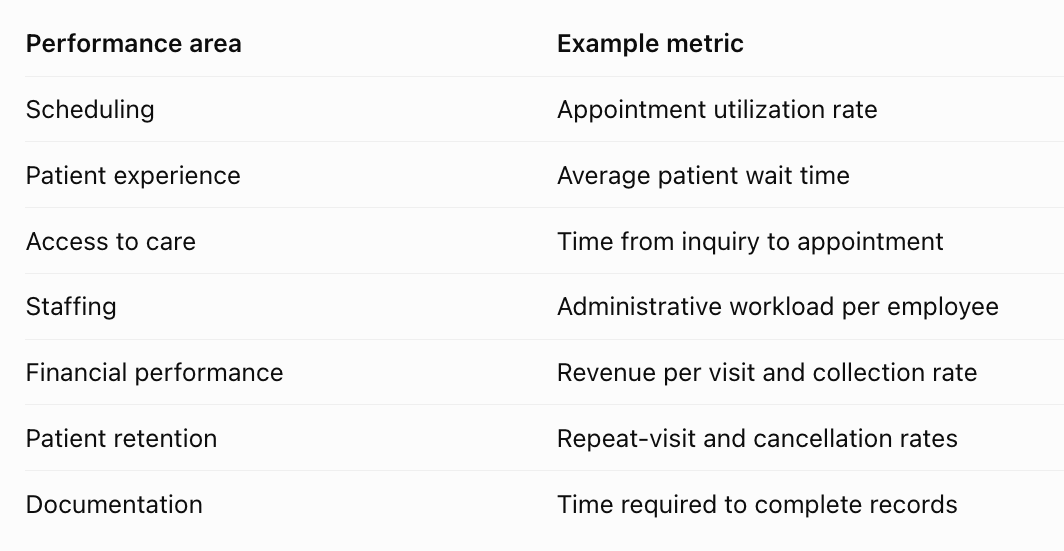
Establish consistent measurement methods and review trends over time. Targets should reflect the clinic's specialty, patient population, and operational priorities rather than relying on arbitrary industry benchmarks.
These measurements can help leadership determine whether the practice is ready to expand or needs to strengthen its current operating model first.
Gathering Feedback From Patients, Providers, and Administrative Staff
Performance metrics explain what is happening, but feedback often reveals why it is happening.
Patients may identify confusing booking procedures, long waiting times, or communication gaps. Providers may highlight scheduling conflicts, incomplete patient records, or delays in clinical support. Administrative employees can point out repetitive tasks, unclear instructions, and software limitations that management may not see.
Gather feedback through patient surveys, staff discussions, workflow observations, and regular operational reviews. Look for recurring themes rather than reacting to isolated complaints.
Involving employees in improvement decisions also encourages ownership. Staff members are more likely to support new procedures when they understand the problem and have an opportunity to contribute practical solutions.
Standardizing Clinic Workflows and Standard Operating Procedures
Once operational gaps are identified, the next step is to create repeatable processes. Standard operating procedures (SOPs) help clinics maintain consistency, reduce avoidable errors, and make it easier to train employees as the practice grows.
Documenting Standard Operating Procedures for Recurring Clinic Tasks
Document the recurring tasks that keep the clinic running, including appointment management, patient registration, record handling, payment processing, inventory checks, and follow-up communications.
Each SOP should explain the purpose of the task, who is responsible, the steps to follow, the systems required, and how completion is verified. Use clear language and practical checklists so employees can apply the instructions during daily work.
Clinical procedures should be developed and approved by appropriately qualified clinical leadership. Administrative SOPs should also respect privacy requirements, organizational policies, and applicable regulations.
Creating Consistent Protocols for Patient Intake, Scheduling, and Follow-Up
Patient intake, scheduling, and follow-up are particularly important because they influence both the patient experience and the clinic's capacity.
Establish consistent protocols for collecting patient information, confirming appointments, preparing records, communicating delays, and coordinating post-visit instructions. Define how staff should handle cancellations, urgent inquiries, incomplete forms, and missed appointments.
Consistent protocols reduce confusion and help patients receive a predictable level of service regardless of which employee assists them.
Standardizing Clinical Support and Administrative Responsibilities
Clearly defined responsibilities prevent duplicated work and missed tasks. Create role descriptions that distinguish clinical decision-making from administrative coordination.
For example, administrative personnel may manage appointment confirmations and organize records, while licensed clinicians remain responsible for clinical assessments and treatment decisions.
Clinic Operations Support can assist with appropriate administrative workloads, including scheduling coordination, routine patient communications, and task tracking. Delegation should always account for qualifications, privacy requirements, and organizational policies.
Reducing Process Variations Across Multiple Clinic Locations
Multi-location practices need shared operational standards to protect service quality and brand consistency.
Use centralized SOP libraries, standardized training materials, common reporting definitions, and consistent quality reviews. Allow local managers to adapt implementation details when necessary, but require approval for changes affecting safety, compliance, or core service standards.
This balance enables individual locations to respond to local needs without creating unnecessary differences in how the organization operates.
Establishing a System for Reviewing and Updating SOPs
SOPs should evolve alongside the practice. Outdated instructions can create confusion, particularly when new services, software, regulations, or staffing structures are introduced.
Assign an owner to each procedure, establish review schedules, and record revisions with clear version histories. Train affected employees when important changes occur and verify that they understand the updated process.
Regular reviews turn SOPs into practical management tools rather than documents that employees rarely consult.
Optimizing Appointment Scheduling and Patient Flow
Scheduling determines how effectively a clinic converts available provider time into completed visits. Improving patient flow can reduce unnecessary delays, increase appointment capacity, and create a more predictable daily workload.
Using Scheduling Rules to Reduce Appointment Gaps and Overbooking
Develop scheduling rules based on appointment type, expected duration, provider availability, and treatment requirements. Reserve appropriate time for complex consultations and procedures instead of assigning identical appointment lengths to every patient.
Monitor gaps between appointments and establish clear rules for handling urgent requests, late arrivals, and cancellations. Avoid excessive overbooking, which can create delays throughout the day and increase staff stress.
Review scheduling patterns regularly to identify recurring periods of underutilization or excessive demand.
Streamlining Patient Check-In, Intake, and Rooming Processes
Prepare patients before arrival whenever possible. Digital registration forms, appointment reminders, and advance collection of required information can reduce front-desk congestion.
Establish a consistent check-in sequence and coordinate rooming based on provider readiness and room availability. Ensure staff can identify missing information early rather than discovering problems immediately before a consultation.
Digital tools can simplify these processes, but workflows should remain accessible to patients who need assistance completing forms or using online systems.
Coordinating Provider Availability, Treatment Rooms, and Equipment
Appointment scheduling should account for more than provider calendars. Clinics must also coordinate room availability, equipment, support personnel, and preparation or cleaning time.
Use shared scheduling systems and resource calendars to prevent conflicting bookings. For procedure-heavy specialties, coordinate the entire appointment sequence so rooms and equipment are ready when needed.
This approach helps clinics improve utilization without creating unsafe time pressures or compromising required preparation and cleaning procedures.
Reducing Patient Wait Times and Preventing Appointment Bottlenecks
Track wait times at different stages, including check-in, rooming, consultation, and checkout. Determine whether delays originate from scheduling, incomplete documentation, provider availability, or resource constraints.
Use the findings to adjust appointment templates, improve handoffs, and redistribute appropriate administrative responsibilities.
Communicate delays honestly and provide patients with realistic expectations. Small improvements across several stages can make the overall experience significantly smoother.
Implementing Reminder Systems to Reduce No-Shows and Cancellations
Automated reminders through approved text, email, or patient communication systems can help patients remember appointments and confirm attendance.
Provide clear instructions for rescheduling and make cancellation procedures straightforward. Monitor no-show rates by appointment type, time, and location to identify patterns that require attention.
Use appropriate privacy safeguards when communicating with patients. Reminder systems should support timely care and efficient scheduling without exposing unnecessary sensitive information.
Improving Administrative Efficiency and Task Management
Administrative inefficiency often becomes more noticeable as a practice grows. By simplifying routine work, clarifying ownership, and delegating appropriate responsibilities, clinics can increase capacity without placing every additional task on existing employees.
Identifying Repetitive Administrative Tasks That Slow Down Clinic Operations
Review daily activities to identify tasks that are repetitive, time-consuming, and suitable for automation or delegation. These may include appointment confirmations, routine reminders, data entry, document organization, and follow-up coordination.
Estimate how much staff time each task consumes and prioritize improvements that can deliver meaningful operational benefits.
Simplifying Patient Registration, Documentation, and Record Management
Use integrated systems, standardized forms, and digital document workflows to reduce duplicate data entry and misplaced records.
Establish clear procedures for record access, documentation completion, data correction, and secure information handling. Automation should reduce administrative effort without replacing required clinical review or professional judgment.
Creating Clear Task Ownership and Accountability
Every recurring task should have an assigned owner, a completion deadline when appropriate, and a clear escalation process.
Task management systems can help supervisors monitor outstanding work, distribute assignments, and identify delays before they affect patient service. Regular reviews reinforce accountability without requiring constant manual supervision.
Using Administrative Checklists to Improve Consistency
Checklists help employees complete routine processes consistently, particularly during busy periods or staff transitions.
Create practical checklists for opening and closing procedures, appointment preparation, documentation reviews, and end-of-day reconciliation. Keep them concise, accessible, and updated as workflows change.
Delegating Nonclinical Tasks to Qualified Support Staff
Not every administrative responsibility needs to remain with an in-house employee. Qualified support personnel can assist with scheduling, appointment reminders, data organization, routine inquiries, and other appropriate nonclinical tasks.
Clinic Operations Support can provide additional administrative capacity when patient volume increases, while helping existing employees focus on higher-priority responsibilities. Practice leaders should establish clear access controls, confidentiality expectations, supervision, and performance standards for all support arrangements.
The goal is to build an operating model in which each team member contributes where they add the most value, allowing the clinic to scale efficiently while maintaining reliable patient care.
Implementing the Right Clinic Management Technology
Technology plays a central role in effective clinic operations management. The right tools help healthcare practices reduce administrative workloads, improve coordination, and make informed decisions as patient volume increases. However, adding more software does not automatically improve efficiency. Practice leaders should prioritize systems that solve existing problems, integrate with current workflows, and support long-term growth.
Evaluating Practice Management Software for Scheduling and Billing
Practice management software helps clinics coordinate appointments, manage patient information, organize billing activities, and monitor administrative workflows. When evaluating platforms, consider ease of use, reporting capabilities, integration options, scalability, and total ownership costs.
For growing practices, the software should accommodate additional providers, services, and locations without requiring a complete system replacement. It should also support scheduling rules, appointment tracking, and billing workflows that match the clinic's operational needs.
Involve both clinical and administrative employees in the selection process. Their feedback can reveal practical requirements that may not be obvious during a product demonstration.
Integrating Electronic Health Records With Existing Clinic Systems
Electronic health records (EHRs) help providers document patient encounters and access relevant clinical information. Integrating EHRs with scheduling, billing, and other approved systems can reduce duplicate data entry and improve information flow.
Before implementing an integration, map how information moves between platforms and determine which system serves as the authoritative source for each data type. Confirm that integrations preserve data accuracy, appropriate access permissions, and auditability.
Successful integration should simplify work for staff while protecting the integrity and confidentiality of patient records.
Automating Appointment Reminders, Intake Forms, and Routine Communications
Automation can reduce the time employees spend on repetitive administrative activities. Appointment reminders, digital intake forms, confirmation messages, and routine follow-up notifications can often be scheduled through approved software.
For example, automated reminders can prompt patients to confirm appointments, while digital forms allow them to submit required information before arrival. Staff can then focus on exceptions, complex inquiries, and patients who need additional assistance.
Set clear rules for message timing, escalation, and patient communication preferences. Automation should make interactions more convenient without making the clinic feel impersonal.
Using Dashboards to Monitor Operational Performance
Operational dashboards give practice leaders a consolidated view of performance. Depending on the systems available, dashboards can display appointment utilization, cancellation rates, patient wait times, outstanding documentation, staffing levels, and financial indicators.
These insights help managers identify emerging problems before they disrupt daily operations. For example, an increase in appointment gaps may indicate scheduling inefficiencies, while a growing documentation backlog may suggest that workloads need to be redistributed.
Establish a regular reporting schedule and assign responsibility for reviewing key metrics. Data becomes valuable when it informs specific operational decisions rather than simply generating reports.
Assessing When Automation Can Replace Manual Processes—and When It Cannot
Not every task should be automated. Repetitive, rules-based activities with predictable outcomes are often good candidates, including routine reminders, appointment confirmations, and administrative notifications.
Tasks involving clinical judgment, sensitive exceptions, complex patient concerns, or professional decision-making require appropriate human oversight. Automation should support qualified employees, not replace responsibilities that depend on clinical expertise or contextual understanding.
Start with a small number of high-impact processes, measure the results, and refine the workflow before expanding automation across the practice.
Protecting Patient Data Through Appropriate Access Controls and Security Practices
As clinics adopt more digital tools, protecting patient information becomes an essential operational responsibility.
Use role-based access controls so employees can view only the information necessary for their responsibilities. Apply multifactor authentication where available, maintain audit logs, review access regularly, and establish procedures for reporting and responding to security incidents.
Evaluate technology vendors for their security practices, contractual responsibilities, and ability to meet applicable privacy requirements. In the United States, covered entities and business associates must follow applicable HIPAA requirements, including relevant safeguards for electronic protected health information.
Security should be built into technology selection, employee training, and daily workflows rather than treated as an afterthought.
Building a High-Performing Clinic Team
Technology and standardized procedures can improve efficiency, but people remain central to successful clinic operations. A high-performing team understands its responsibilities, communicates effectively, and has the capacity to manage patient demand without compromising care quality.
Defining Roles, Responsibilities, and Reporting Structures
Clearly defined roles help employees understand what they own, who they report to, and when they should escalate a problem. Without this clarity, tasks may be duplicated, overlooked, or passed between departments without resolution.
Create role descriptions that distinguish clinical responsibilities from administrative coordination. Define decision-making authority, handoff procedures, and accountability for recurring tasks.
As a practice grows, revisit the reporting structure to ensure managers can supervise their teams effectively without becoming bottlenecks themselves.
Aligning Staffing Levels With Patient Demand and Appointment Volume
Staffing decisions should reflect actual workload rather than relying exclusively on historical headcount or intuition.
Review appointment volume, peak hours, provider schedules, administrative workload, and seasonal demand. Determine whether the clinic needs additional full-time employees, flexible staffing arrangements, workflow improvements, or administrative support.
Forecasting demand helps prevent two common problems: understaffing that creates delays and overtime, and overstaffing that increases expenses without improving service capacity.
Improving Communication Between Clinical and Administrative Teams
Poor communication can lead to missing records, scheduling conflicts, delayed patient follow-ups, and unnecessary interruptions for providers.
Establish consistent communication channels, structured handoffs, and brief operational check-ins. Define how urgent issues should be escalated and where routine updates should be documented.
Shared task systems and clear communication protocols help teams coordinate without relying on scattered messages or informal conversations.
Establishing Performance Expectations and Accountability Standards
Employees perform more consistently when expectations are clear and measurable. Establish role-specific standards for responsibilities such as appointment accuracy, documentation timeliness, patient communication, and task completion.
Use performance reviews to discuss results, identify barriers, and agree on improvements. Metrics should encourage quality and reliability rather than reward speed at the expense of patient safety.
Accountability works best when managers combine clear expectations with appropriate training, resources, and constructive feedback.
Preventing Staff Burnout Through Workload Balancing and Effective Delegation
Growing clinics can place considerable pressure on employees, particularly when administrative work expands faster than staffing capacity.
Monitor overtime, task backlogs, repeated interruptions, and employee feedback to identify signs of unsustainable workloads. Redistribute tasks where appropriate, improve inefficient processes, and establish realistic expectations for daily output.
Clinic Operations Support can help absorb appropriate administrative responsibilities, allowing in-house teams to focus on tasks requiring their direct involvement. The goal is to increase capacity without expecting employees to continually do more with fewer resources.
Using Virtual Assistants for Appropriate Administrative Support
Virtual assistants can support clinic operations by managing suitable administrative tasks remotely. Depending on their training, authorization, and the clinic's requirements, responsibilities may include appointment coordination, reminder management, routine inquiries, data organization, and follow-up scheduling.
A virtual medical assistant arrangement may be particularly useful when patient communications and scheduling tasks are consuming significant in-house staff time.
Before delegating work, establish documented procedures, confidentiality requirements, approved system access, supervision, and performance expectations. Virtual support should complement the clinic's team while preserving appropriate boundaries around clinical decisions and regulated activities.
Developing a Structured Staff Training and Onboarding Program
As practices add employees, inconsistent training can lead to service variations, avoidable errors, and longer onboarding periods. A structured training program helps new and existing employees understand clinic procedures, perform their responsibilities confidently, and maintain consistent standards across departments and locations.
Creating Role-Based Training Plans for New and Existing Employees
Training should reflect the responsibilities of each position. Front-desk employees may need instruction in scheduling, registration, and patient communication, while clinical staff require role-appropriate training in clinical protocols, equipment, documentation, and safety.
Develop learning plans that combine written instructions, demonstrations, supervised practice, and competency assessments. Existing employees should also receive refresher training when procedures, systems, or responsibilities change.
Standardizing Onboarding Across Departments and Locations
A consistent onboarding process ensures every new employee receives essential information regardless of their department or work location.
Create a standard onboarding checklist covering organizational policies, system access, role expectations, privacy requirements, emergency procedures, and relevant SOPs. Assign a supervisor or designated trainer to monitor progress and answer questions.
For multi-location practices, centralized onboarding materials help preserve organizational standards while allowing additional training for location-specific workflows.
Using a Learning Management System (LMS) to Centralize Training Materials
A learning management system (LMS) provides a centralized location for training materials, learning assignments, assessments, and completion records.
An LMS can help practice leaders assign courses by role, deliver updates to multiple locations, and monitor whether employees have completed required training. It also reduces dependence on informal instruction or disconnected files that may become outdated.
Choose a platform that fits the clinic's size, training requirements, reporting needs, and budget. A well-managed LMS makes employee development easier to organize as the practice expands.
Verifying Staff Competency Before Assigning Specialized Responsibilities
Completing a training module does not necessarily demonstrate practical competence. Employees should show that they can apply relevant procedures correctly before independently performing specialized tasks.
Depending on the role, verification may include observed demonstrations, knowledge assessments, supervised practice, or documented sign-offs by qualified personnel.
Clinical duties must be assigned according to applicable licensing, credentialing, and supervision requirements. Competency verification helps protect patients while giving managers greater confidence in staff readiness.
Reinforcing Compliance, Patient Communication, and Service Standards
Training should cover more than job-specific tasks. Employees also need to understand privacy obligations, appropriate patient communication, complaint escalation, and organizational service standards.
Provide refresher training when policies change or recurring issues emerge. Use practical scenarios to help employees understand how procedures apply in real situations.
Consistent reinforcement helps protect the clinic's reputation and reduces the risk of employees relying on outdated assumptions.
Tracking Training Completion and Identifying Knowledge Gaps
Maintain records of assigned training, completion dates, assessment results, and required renewals. Use these records to identify overdue learning, recurring knowledge gaps, and teams that may need additional support.
Review training outcomes alongside operational indicators, such as documentation errors or patient communication complaints. This helps determine whether training is improving performance or whether the underlying process also needs to change.
Strengthening Patient Experience and Communication
Operational efficiency matters most when it helps patients receive timely, consistent, and respectful care. A strong patient experience strategy coordinates communication across every stage of the relationship, from the first inquiry to post-visit follow-up.
Mapping the Patient Journey From First Contact to Post-Visit Follow-Up
Map each stage of the patient journey, including initial inquiries, appointment booking, registration, consultation, payment, and follow-up.
Identify unnecessary steps, repeated information requests, unclear instructions, and points where patients frequently experience delays. This mapping exercise helps leaders prioritize improvements that make the process easier for patients and staff alike.
Improving Communication Before, During, and After Appointments
Patients benefit from clear instructions before visits, realistic expectations during appointments, and appropriate follow-up afterward.
Use reminders to communicate appointment details and preparation requirements. During visits, keep patients informed about delays when possible. After consultations, ensure follow-up instructions and next steps are communicated through approved channels.
Clear communication can reduce confusion, missed appointments, and avoidable calls to the front desk.
Establishing Consistent Service Standards Across Patient Touchpoints
Create service standards for phone calls, messages, check-in, waiting-room communication, and complaint handling. Define expectations for professionalism, response times, and escalation.
For multi-location practices, common standards help ensure patients receive a consistent experience even when different teams deliver the service.
Collecting Patient Feedback and Addressing Complaints Effectively
Use surveys, feedback forms, and structured complaint reviews to understand patient concerns. Establish a process for acknowledging complaints, assigning responsibility, investigating issues, and communicating appropriate resolutions.
Look for recurring themes and use them to improve scheduling, communication, and service delivery. Feedback should lead to operational changes when the evidence supports them.
Personalizing Patient Engagement Without Creating Additional Administrative Burdens
Personalized communication can make patients feel supported, but it does not need to involve extensive manual work.
With appropriate consent, privacy safeguards, and communication preferences, clinics can use approved systems to send relevant reminders and follow-up messages. Staff should remain available to address individual questions and situations that automated messages cannot resolve.
Measuring Patient Satisfaction and Retention
Monitor patient satisfaction, complaint trends, appointment completion, repeat visits, and cancellation patterns where relevant. Interpret these indicators alongside clinical quality measures and patient feedback.
No single metric fully represents patient experience. Reviewing multiple indicators gives leaders a more balanced understanding of how well their processes meet patient needs.
Managing Revenue Cycle and Financial Performance
Growth is sustainable only when clinical activity translates into reliable financial performance. Strong revenue cycle management helps clinics reduce avoidable losses, maintain cash flow, and allocate resources responsibly as operations expand.
Improving Billing Accuracy and Reducing Revenue Leakage
Revenue leakage occurs when services are delivered but not billed correctly, charges are missed, or preventable errors delay payment.
Establish consistent documentation and charge-capture workflows. Review common billing errors, verify required information, and reconcile completed services against submitted charges where appropriate.
For practices offering elective treatments, ensure that pricing, service documentation, and payment policies are clearly communicated and consistently applied.
Streamlining Claims Submission and Payment Collection Where Applicable
For practices that bill insurers, establish procedures for checking claim information, submitting claims promptly, and resolving rejections or denials. Analyze recurring denial reasons to identify issues with documentation, coding, eligibility verification, or workflow design.
For self-pay and elective-care practices, maintain clear estimates, payment policies, and collection procedures. All billing practices should comply with applicable laws, payer contracts, and professional requirements.
Monitoring Accounts Receivable and Outstanding Patient Balances
Track outstanding balances by age, payer, and responsible team. Review accounts receivable regularly to identify delayed claims, unresolved denials, and overdue patient balances.
Assign clear ownership for follow-up and establish escalation procedures for unresolved accounts. Consistent monitoring helps identify cash-flow risks before they become more difficult to manage.
Evaluating Service Profitability and Treatment Utilization
Revenue alone does not show whether a service is financially sustainable. Assess service-level revenue alongside staffing costs, supplies, equipment expenses, room utilization, and appointment duration.
Compare actual utilization with available capacity and patient demand. These insights can help leaders identify scheduling improvements, adjust resource allocation, or reconsider services that consistently underperform financially.
Clinical appropriateness and patient needs must remain central to treatment decisions. Financial analysis should support responsible resource planning, not encourage unnecessary care.
Creating Budgets for Staffing, Equipment, Software, and Expansion
Prepare budgets that account for both recurring operating expenses and expansion-related investments. Include staffing, training, technology, equipment maintenance, facilities, and additional administrative support.
Model different growth scenarios and estimate how changes in patient volume may affect costs and cash flow. Include contingency reserves for unexpected expenses or slower-than-anticipated growth.
A disciplined budgeting process helps leaders determine whether expansion is financially viable before committing significant resources.
Using Financial KPIs to Support Better Operational Decisions
Financial key performance indicators (KPIs) help connect operational activity with business outcomes. Relevant measures may include collection rate, operating margin, revenue per visit, accounts receivable days, labor cost as a percentage of revenue, and service-level profitability.
Review these metrics alongside operational indicators such as appointment utilization, patient wait times, and staffing capacity. For example, rising revenue accompanied by increasing overtime and worsening wait times may signal that the current operating model is under strain.
The objective is to use financial and operational data together to guide staffing decisions, technology investments, process improvements, and responsible expansion.
Maintaining Regulatory Compliance and Risk Management
As healthcare practices grow, regulatory compliance becomes more complex. Additional employees, providers, services, and locations create more opportunities for inconsistent procedures and preventable errors. Effective clinic operations management integrates compliance and risk prevention into everyday workflows rather than treating them as occasional administrative tasks.
Establishing Procedures for Patient Privacy and Confidentiality
Patient privacy should be built into every process involving personal and medical information. Establish clear policies for accessing, sharing, storing, and disposing of patient records, and ensure employees understand their responsibilities.
For practices operating in the United States, applicable HIPAA requirements govern the protection of protected health information for covered entities and business associates. Clinics should also assess relevant state privacy laws and contractual obligations.
Use role-based access controls, secure communication channels, and appropriate safeguards when working with external administrative support providers. Review access permissions regularly, particularly when employees change roles or leave the organization.
Maintaining Accurate Medical Records and Documentation
Accurate documentation supports continuity of care, billing integrity, and regulatory accountability. Establish consistent procedures for recording patient encounters, correcting errors, completing documentation, and retaining records.
Define who is responsible for each documentation step and when records must be completed. Use approved electronic health record systems to reduce duplication and improve information accessibility.
Administrative staff may assist with permitted documentation workflows, but clinical entries, assessments, and decisions must remain under the appropriate professional's responsibility.
Standardizing Infection Prevention, Safety, and Emergency Procedures
Clinics should maintain documented procedures for infection prevention, equipment safety, emergency response, and other risks relevant to their services.
Procedures must reflect the clinic's specialty, applicable regulations, and guidance from qualified clinical leadership. For example, dermatology practices, dental offices, and medical spas may have different equipment, sterilization, and treatment-related requirements.
Provide employees with practical instructions, appropriate protective equipment, and role-specific training. Review procedures whenever services, equipment, facilities, or regulatory requirements change.
Training Employees on Applicable Healthcare Regulations and Workplace Policies
Compliance training should be part of onboarding and continuing staff development. Topics may include patient confidentiality, secure data handling, workplace safety, incident reporting, documentation standards, and relevant clinical or administrative policies.
Training should reflect each employee's responsibilities rather than relying on a single generic presentation. A learning management system (LMS) can help distribute updated materials, assign required courses, and track completion across departments and locations.
However, completion records alone do not establish compliance. Managers should also verify understanding and ensure employees apply the procedures correctly.
Conducting Regular Compliance Audits and Risk Assessments
Regular audits help identify gaps before they develop into more serious problems. Review areas such as record access, documentation completeness, staff training, incident logs, billing processes, and required equipment or safety checks.
Prioritize findings according to their likelihood and potential impact. Assign an owner and deadline to each corrective action, then verify whether the issue has been resolved.
For multi-location practices, centralized reporting can reveal recurring problems that may be difficult to identify when each clinic operates independently.
Managing Incident Reporting, Corrective Actions, and Policy Updates
Employees should understand how to report incidents, near misses, privacy concerns, and safety issues without unnecessary delays. Establish a clear process for documenting events, escalating urgent risks, investigating causes, and implementing corrective actions.
Focus on identifying why an incident occurred rather than simply assigning blame. For example, a repeated documentation error may indicate inadequate training or a confusing workflow.
Update policies when investigations reveal weaknesses, and communicate changes to affected employees. This approach helps the practice learn from operational problems and strengthen its safeguards over time.
Creating a Scalable Operating Model for Multi-Location Clinics
Opening additional locations can expand patient access and revenue, but it also increases management complexity. A scalable operating model establishes which decisions should be made centrally, which require local oversight, and how every location will maintain consistent standards.
Deciding Which Functions to Centralize and Which to Keep Local
Centralization can improve consistency and reduce duplicated effort. Functions such as vendor management, technology administration, training coordination, financial reporting, and SOP development may benefit from shared oversight.
Other responsibilities, including daily patient flow, local staffing adjustments, and immediate service recovery, may be better handled by individual clinic managers.
The right structure depends on the practice's size, specialty, and operating model. The goal is to centralize activities that benefit from consistency while preserving local flexibility where it improves responsiveness.
Establishing Standard Operating Standards Across All Locations
Create a shared operating framework covering scheduling, patient communication, documentation, administrative responsibilities, and quality monitoring.
Each location should follow the same core procedures, performance definitions, and reporting expectations. Where local requirements differ, document approved variations rather than allowing informal workarounds to develop.
A clinic operations specialist can help evaluate operational differences, identify inconsistent practices, and coordinate the adoption of standardized processes across locations.
Implementing Centralized Training and Policy Management
Centralized training and policy management help ensure that employees receive consistent information regardless of location.
Maintain a shared repository of approved SOPs, training materials, policy updates, and role-specific learning paths. Assign responsibility for reviewing each document and communicating revisions.
A centralized LMS can help corporate teams distribute training and monitor completion across the organization. This is particularly valuable when new locations hire employees at different times or introduce new services.
Maintaining Brand Consistency While Accommodating Local Needs
Patients should experience the same core service standards at every location. This includes consistent communication, appointment procedures, staff professionalism, and complaint-handling practices.
However, clinics may need flexibility to address local patient demand, staffing availability, or applicable regional requirements.
Establish clear boundaries between mandatory organizational standards and locally adaptable procedures. This allows individual locations to respond to their communities without weakening the overall brand experience.
Building a Repeatable Framework for Opening New Locations
A repeatable opening process reduces the risk of overlooking essential operational requirements during expansion.
Develop a launch checklist covering facility readiness, equipment, staffing, technology configuration, policy implementation, training, vendor arrangements, and compliance reviews.
Define milestones and assign accountable owners before the opening date. Test essential workflows before accepting patients, and establish early performance reviews to identify problems quickly.
A documented launch framework allows the organization to apply lessons from previous openings rather than rebuilding its processes for every new location.
Coordinating Regional Managers, Clinic Managers, and Corporate Teams
Clear communication between corporate leadership and local teams helps prevent inconsistent decisions and delayed problem-solving.
Define reporting relationships, decision-making authority, escalation procedures, and meeting schedules. Regional managers can monitor performance across locations, clinic managers can oversee daily execution, and corporate teams can provide shared resources and strategic direction.
Use common dashboards and reporting formats so everyone evaluates performance using consistent information. This structure supports accountability without requiring corporate leaders to supervise every daily task.
Managing Change During Clinic Expansion
Expansion often requires employees to adopt new systems, procedures, and responsibilities. Even well-designed improvements can fail when teams do not understand why the changes are happening or lack the support needed to implement them.
Communicating Operational Changes to Employees and Stakeholders
Explain what is changing, why the change is necessary, how it affects daily work, and when it will take effect.
Communicate early with employees, providers, managers, and other affected stakeholders. Provide opportunities for questions and clarify how the change supports patient care or operational performance.
Consistent communication reduces uncertainty and helps employees understand their role in the transition.
Introducing New Workflows Through Phased Implementation
Avoid introducing too many changes simultaneously when a phased approach is practical.
Start with a manageable workflow or pilot location, establish clear expectations, and provide support during implementation. Once the process is working reliably, expand it to other teams or locations.
Phased implementation makes it easier to identify problems, refine procedures, and reduce disruption to patient services.
Addressing Staff Resistance and Training Gaps
Employees may resist changes because they are unfamiliar with the new process, concerned about additional workload, or uncertain about its benefits.
Listen to these concerns before assuming that resistance reflects unwillingness to cooperate. Provide demonstrations, practical training, written instructions, and access to support.
Where employees identify genuine workflow problems, use their feedback to improve the implementation. Successful change management combines clear expectations with practical assistance.
Testing New Systems Before Rolling Them Out Across Locations
Test new software, scheduling procedures, and administrative workflows before implementing them organization-wide.
Evaluate whether the system works as intended, integrates with existing tools, protects patient information, and supports real-world tasks. Include employees who will use the system daily and document any issues they encounter.
Resolve significant problems before expanding the rollout. Testing reduces the risk of introducing errors or unnecessary delays across multiple locations.
Gathering Feedback and Refining Processes After Implementation
Implementation should not be treated as the end of the improvement process.
Collect feedback from employees and patients where appropriate, monitor performance metrics, and review whether the new workflow achieves its intended results.
For example, if a new scheduling system reduces administrative work but increases patient wait times, investigate the underlying cause and adjust the process.
Regular reviews help clinics improve their operating model as patient demand, staffing, and service requirements evolve.
Creating a Practical 90-Day Clinic Operations Improvement Plan
A structured 90-day plan helps clinic leaders turn operational priorities into manageable actions. Instead of attempting to fix every issue simultaneously, divide improvements into phases with clear deliverables, responsible owners, and measurable outcomes.
Days 1–30: Audit Existing Workflows and Establish Performance Baselines
Begin by reviewing the patient journey, scheduling processes, documentation, staffing, technology, and financial workflows.
Identify recurring bottlenecks and gather feedback from providers, administrative employees, and patients. Establish baseline metrics such as appointment utilization, average wait time, documentation backlogs, no-show rates, and accounts receivable days.
At the end of the first month, prioritize the problems that create the greatest operational, financial, compliance, or patient-experience risks.
Days 31–60: Standardize Processes and Address High-Impact Bottlenecks
Use the assessment findings to improve the most important workflows.
Document or update SOPs, clarify task ownership, refine scheduling rules, and address avoidable administrative duplication. Introduce practical checklists and establish consistent procedures for recurring tasks.
If several improvements are needed, prioritize those that can deliver meaningful benefits without disrupting essential patient services. Confirm that staff members understand the updated procedures before making them standard practice.
Days 61–90: Implement Technology, Train Staff, and Measure Results
During the final month, introduce appropriate technology improvements and reinforce the revised workflows through staff training.
This may include automating reminders, improving task tracking, integrating existing software, or centralizing training materials. Select technology based on the problems identified during the audit rather than purchasing tools without a defined purpose.
Compare current performance with the original baseline. Review which changes improved efficiency, which require further adjustment, and whether the practice is better prepared for additional patient volume or expansion.
Assigning Owners, Deadlines, and Success Metrics to Each Initiative
Every improvement initiative needs a clear owner, deadline, and definition of success.
For example, a scheduling improvement project might assign responsibility to the practice manager, establish a 30-day implementation period, and track appointment utilization and patient wait times.
Document dependencies, required resources, and escalation procedures. Regular progress reviews help leadership identify delays and provide support before initiatives lose momentum.
Evaluating Results and Preparing for the Next Phase of Growth
At the end of the 90 days, review outcomes against the original objectives. Determine which improvements should become permanent operating standards and which require additional work.
Assess whether the practice has sufficient staffing, technology, financial stability, and documented processes to support the next stage of growth.
The 90-day plan should establish a repeatable improvement cycle rather than serve as a one-time project. As the clinic grows, new operational priorities will emerge and require ongoing attention.
Common Clinic Operations Management Mistakes to Avoid
Even clinics with strong patient demand can struggle to scale when operational decisions are reactive. Recognizing common mistakes helps leaders protect service quality, financial performance, and staff capacity.
Expanding Before Establishing Repeatable Processes
Opening additional locations before documenting core workflows can multiply existing inefficiencies. Establish consistent procedures, reporting standards, and accountability structures before expanding wherever possible.
Investing in Technology Without Fixing Broken Workflows
New software cannot automatically resolve unclear responsibilities or poorly designed processes. Evaluate the underlying workflow first, then choose technology that addresses a defined operational problem.
Overlooking Staff Training and Change Management
Employees need time and support to adopt new procedures. Provide role-specific training, communicate expectations clearly, and verify that staff can apply the changes correctly.
Measuring Revenue Without Monitoring Patient Experience
Revenue growth does not necessarily indicate healthy operations. Monitor patient satisfaction, wait times, complaints, and retention alongside financial metrics to identify problems that may undermine long-term performance.
Relying on Informal Knowledge Instead of Documented SOPs
When procedures exist only in employees' memories, performance becomes vulnerable to staff turnover and inconsistent training. Document essential workflows and maintain an accessible, updated source of approved procedures.
Ignoring Compliance Risks and Data Security
Rapid expansion can create gaps in access controls, documentation, training, and policy enforcement. Integrate compliance reviews, security practices, and corrective actions into routine operational management.
Scaling Administrative Workloads Without Reviewing Staffing Capacity
Increasing patient volume often creates additional scheduling, documentation, billing, and communication work. Evaluate workload before expanding, and consider process improvements, automation, and qualified Clinic Operations Support to maintain sustainable capacity.
The most successful clinics scale deliberately. By standardizing workflows, strengthening teams, adopting appropriate technology, and monitoring performance, practice leaders can build operations that support growth without compromising patient care or organizational stability.
Summary: Building Efficient and Scalable Clinic Operations
Effective clinic operations management provides the foundation for sustainable healthcare practice growth. Whether you operate a single specialty clinic or oversee multiple locations, success depends on building reliable systems that support patient care, staff productivity, financial performance, and regulatory compliance.
Standardize Workflows Before Expanding Your Practice
Document essential procedures before increasing patient volume or opening additional locations. Standardized workflows reduce confusion, minimize errors, and help employees deliver consistent service. Establishing these processes early also makes onboarding and expansion easier to manage.
Combine Technology, Training, and Clear Accountability
Use appropriate technology to simplify scheduling, documentation, reporting, and routine communications. Combine these tools with structured employee training, clearly defined responsibilities, and measurable performance expectations. Technology delivers the greatest value when employees understand how to use it within well-designed workflows.
Use Operational and Financial KPIs to Guide Decisions
Monitor key performance indicators (KPIs), including appointment utilization, no-show rates, patient wait times, staff productivity, patient retention, and operating margins. Reviewing these metrics together helps leaders identify bottlenecks, allocate resources effectively, and determine whether operational improvements are producing meaningful results.
Protect Patient Experience and Compliance as Your Clinic Grows
Growth should never come at the expense of patient safety, confidentiality, or service quality. Maintain appropriate access controls, document procedures, provide regular training, and conduct compliance reviews. Continue collecting patient feedback to ensure that operational changes improve the experience rather than simply increase capacity.
Build Repeatable Systems That Support Sustainable, Long-Term Growth
A scalable clinic relies on processes that can be repeated, measured, and improved. By combining standardized procedures, capable teams, appropriate technology, and qualified Clinic Operations Support, practice leaders can expand their capacity without creating unnecessary administrative complexity.
The objective is to build an operation that can accommodate growth while maintaining consistent care, manageable workloads, and financial stability.
Frequently Asked Questions About Clinic Operations Management
1. What Is Clinic Operations Management?
Clinic operations management is the coordination of the administrative, staffing, scheduling, financial, and support functions required to run a healthcare facility efficiently. It includes managing patient flow, optimizing resources, standardizing workflows, monitoring performance, and maintaining appropriate compliance procedures.
2. Why Is Clinic Operations Management Important for Practice Growth?
Effective clinic operations management helps practices accommodate more patients, reduce administrative inefficiencies, control operating costs, and improve patient satisfaction. Standardized processes also make it easier to onboard employees, introduce new services, and expand into additional locations without unnecessarily increasing operational complexity.
3. What Are the Most Important Clinic Operations KPIs?
Important KPIs include appointment utilization, no-show rates, patient wait times, staff productivity, patient retention, revenue per visit, and operating margins. Clinics may also monitor documentation backlogs, accounts receivable days, and patient satisfaction. The most useful metrics depend on the practice's specialty, goals, and operating model.
4. How Can a Clinic Reduce Administrative Workload?
Clinics can reduce administrative workload by standardizing recurring tasks, simplifying registration and documentation, automating appropriate communications, and delegating nonclinical responsibilities. Qualified administrative support teams can also help manage scheduling, reminders, and routine follow-ups, allowing in-house employees to focus on higher-priority responsibilities.
5. What Role Does Technology Play in Clinic Operations?
Technology helps clinics coordinate activities, reduce repetitive work, and make better operational decisions. Practice management software supports scheduling and billing, electronic health records organize clinical information, dashboards track performance, and automation tools manage routine communications. Integration, usability, privacy, and security should guide technology selection.
6. How Can Clinics Standardize Operations Across Multiple Locations?
Clinics can standardize operations through centralized SOPs, shared performance metrics, consistent training materials, common reporting procedures, and clear management responsibilities. A central framework establishes organizational standards while allowing approved local adjustments for staffing, patient demand, and applicable regional requirements.
7. How Can Staff Training Improve Clinic Efficiency?
Structured training helps employees understand their responsibilities and follow established procedures consistently. Role-based learning, standardized onboarding, competency verification, and regular refresher training reduce avoidable errors and improve coordination. An LMS can centralize learning materials and help managers monitor training completion across departments and locations.
8. How Can Clinic Managers Improve Patient Flow?
Clinic managers can improve patient flow by optimizing appointment lengths, reducing scheduling gaps, preparing patients before arrival, coordinating provider and room availability, and streamlining check-in and rooming. Automated reminders and consistent follow-up procedures can also reduce missed appointments and administrative delays.
9. When Should a Clinic Consider Hiring a Virtual Assistant?
A clinic should consider a virtual assistant when administrative tasks consume significant staff time, appointment volume increases, or additional support is needed without immediately expanding in-house headcount.
Appropriate responsibilities may include appointment coordination, routine patient communications, scheduling follow-ups, and administrative task tracking. Delegation must account for employee qualifications, patient privacy, applicable regulations, and organizational policies. Clinical decisions and other restricted responsibilities must remain with appropriately qualified professionals.
10. How Can Clinics Maintain Compliance While Scaling?
Clinics should maintain documented procedures, provide role-specific compliance training, review access permissions, conduct regular audits, and establish incident-reporting and corrective-action processes. Requirements vary by jurisdiction, specialty, and service, so practices should evaluate applicable privacy, workplace safety, licensing, documentation, and other regulatory obligations as they expand.
11. What Is the Difference Between Clinic Operations Management and Practice Management?
The terms overlap, and their precise meaning varies by organization. Clinic operations management often emphasizes daily workflows, patient flow, staffing coordination, resource utilization, and service delivery. Practice management may encompass these responsibilities while placing additional emphasis on broader business administration, financial performance, billing, and the overall commercial sustainability of a healthcare practice.
12. How Long Does It Take to Improve Clinic Operations?
Initial improvements may be achievable within 30–90 days, particularly when addressing scheduling inefficiencies, documenting SOPs, or clarifying task ownership. More complex initiatives involving software integration, staffing changes, or multiple locations may take longer. Sustained results depend on the clinic's starting point, implementation resources, employee adoption, and ongoing performance reviews.
How Can V-Assist Help With Clinic Operations Management?
Scaling a healthcare practice requires more than increasing appointment volume. It requires the administrative capacity to coordinate schedules, maintain organized workflows, communicate with patients, and support employees as operational demands grow.
V-Assist can help clinics strengthen their administrative operations through qualified virtual assistance, giving practice owners and managers more time to focus on patient care, team leadership, and business development.
Depending on your requirements, virtual assistants can support activities such as:
- Appointment coordination: Managing scheduling requests, confirmations, and rescheduling according to established clinic procedures.
- Routine patient communications: Sending approved reminders and coordinating nonclinical follow-ups through authorized channels.
- Administrative organization: Helping maintain organized records, track outstanding tasks, and coordinate documentation workflows within approved access permissions.
- Workflow support: Following documented SOPs, maintaining checklists, and helping teams complete recurring administrative responsibilities.
- Operational capacity: Providing additional administrative support as patient demand grows, helping clinics manage workloads without immediately expanding every in-house function.
With clear procedures, appropriate supervision, and suitable technology, virtual assistance can become a practical part of a clinic's broader growth strategy. Clinics should define responsibilities carefully and ensure that all patient information is handled in accordance with applicable privacy and security requirements.
Ready to make your clinic operations more efficient?