
“Expanding a healthcare organization involves more than opening new clinics and attracting more patients. It requires an operational structure that can support growing demand without allowing administrative expenses to consume profitability. Remote medical practice operations offer a scalable approach by allowing healthcare groups to centralize administrative responsibilities, coordinate multiple locations, and reduce their dependence on traditional in-house staffing models.” - Rhane Handisides
For multi-site medical groups, MSOs, and growing specialty practices, the goal is to expand patient access while maintaining operational efficiency. Remote support teams can help achieve this by managing essential non-clinical workflows across the healthcare network.
The Growing Operational Complexity of Managing Multiple Healthcare Locations
Every new clinic introduces additional responsibilities. Healthcare organizations must coordinate appointment scheduling, patient registration, insurance verification, billing, provider calendars, and administrative reporting.
When these responsibilities are handled independently by each location, operational complexity increases. Regional managers may struggle to monitor performance, while individual clinic teams may develop different procedures.
Without centralized coordination, expansion can create fragmented workflows that make it difficult to maintain consistent service quality.
Why Traditional In-House Staffing Models Become Expensive During Expansion
Opening another clinic often means hiring additional receptionists, administrative assistants, billing personnel, and practice support staff.
These expenses extend beyond salaries. Healthcare organizations must also consider recruitment, onboarding, employee benefits, equipment, workspace, and ongoing training.
As the organization expands, repeating this staffing structure across every location can increase fixed overhead and put pressure on profit margins.
A remote operations model provides another option by allowing shared administrative teams to support multiple clinics without requiring every branch to maintain a complete administrative workforce.
The Hidden Administrative Challenges That Limit Multi-Site Clinic Growth
Administrative inefficiencies can become significant barriers to expansion.
Missed patient calls, incomplete insurance information, delayed billing processes, and inconsistent follow-ups can affect both patient experience and financial performance.
These problems are particularly challenging when leadership has limited visibility into what is happening across individual locations.
Without standardized processes and clear accountability, adding more clinics can multiply existing administrative problems instead of creating sustainable growth.
How Healthcare Remote Operations Create a More Scalable Expansion Strategy
Healthcare remote operations allow organizations to move appropriate administrative responsibilities into a centralized support structure.
Remote teams can assist with scheduling, patient communication, insurance verification, billing support, and other non-clinical workflows.
This approach helps healthcare groups distribute administrative resources more efficiently while allowing on-site employees to focus on patient-facing responsibilities and clinical coordination.
Instead of rebuilding an entire administrative team every time a new clinic opens, organizations can extend existing remote support capabilities to additional locations.
What Are Healthcare Remote Operations?
Healthcare remote operations refer to the management and coordination of administrative and operational activities through distributed teams, centralized systems, and digital workflows.
Rather than requiring every administrative function to be performed inside each clinic, organizations can assign selected responsibilities to remote employees or specialized support teams.
This model helps multi-location healthcare groups improve consistency, manage costs, and support expansion.
Defining Remote Operations in Modern Healthcare Organizations
Remote operations involve performing approved healthcare administrative tasks outside the physical clinic environment.
These activities may include:
- Appointment scheduling and calendar management.
- Patient registration and administrative intake.
- Insurance eligibility and benefits verification.
- Billing and revenue cycle support.
- Patient follow-ups and appointment reminders.
- Referral coordination and documentation support.
- Administrative reporting and data management.
The objective is to create a coordinated operational structure that supports multiple locations through shared resources and standardized processes.
How Remote Operations Support Multi-Site Clinic Management
Remote teams can provide administrative assistance to several clinic locations through centralized workflows and approved technology platforms.
For example, a remote scheduling team may coordinate appointment requests for five clinics instead of requiring each location to manage every inquiry independently.
Similarly, centralized billing support can help standardize administrative processes across different branches.
This creates greater flexibility because healthcare organizations can allocate support resources according to patient volume, workload, and operational priorities.
The Difference Between Remote Healthcare Administration and Clinical Care Delivery
It is important to distinguish remote healthcare administration from clinical care delivery.
Remote operations primarily focus on non-clinical responsibilities that support the delivery of healthcare services. These include scheduling, registration, billing, insurance verification, and administrative follow-ups.
Clinical care delivery, on the other hand, involves activities requiring appropriate clinical qualifications, professional judgment, or direct patient care.
Remote administrative personnel should not independently diagnose conditions, make clinical decisions, or perform tasks outside their training and authorization.
Clear responsibilities and escalation procedures help maintain patient safety while allowing administrative workflows to operate efficiently.
Understanding Centralized, Decentralized, and Hybrid Healthcare Operating Models
Healthcare organizations can structure remote operations in different ways.
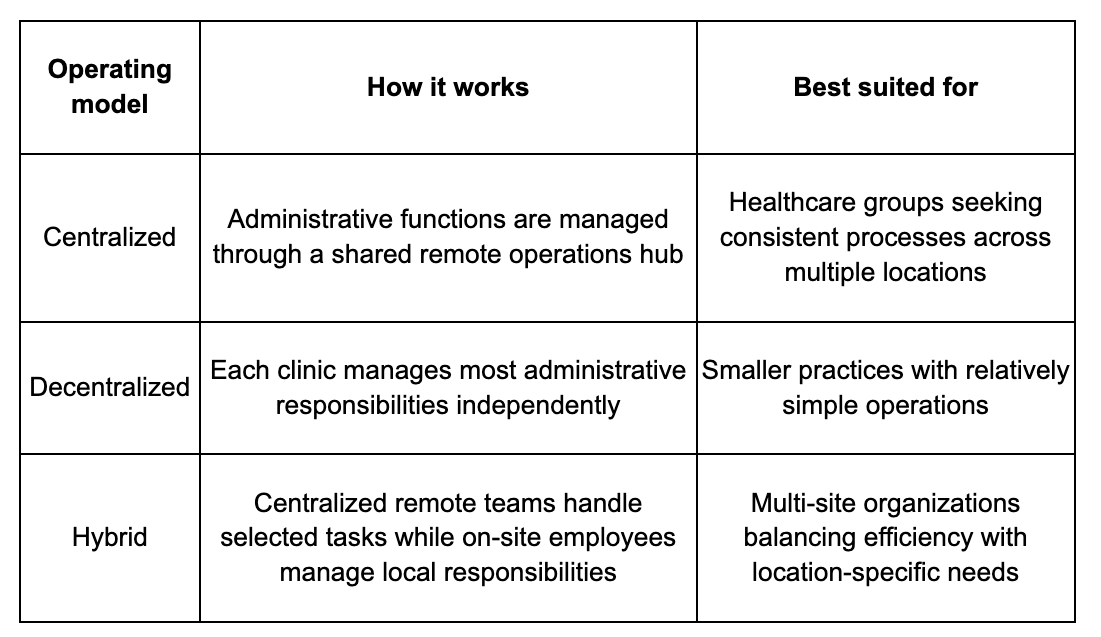
A hybrid model is often practical for expanding healthcare networks.
For example, remote teams may handle appointment coordination and insurance verification, while on-site employees manage patient check-in and immediate clinic needs.
Why Remote Operations Are Becoming Important for Growing Healthcare Groups
As healthcare organizations expand, they need operating models that can accommodate additional patient volume without increasing overhead at the same rate.
Remote operations provide access to shared administrative resources, allowing leadership to distribute work across locations more efficiently.
They can also help organizations address local recruitment challenges and maintain consistent workflows during acquisitions or regional expansion.
For MSOs and private equity-backed healthcare groups, this creates opportunities to develop repeatable operating structures that can be extended to newly acquired practices.
The Biggest Operational Challenges of Scaling Multi-Site Clinics
Expanding a healthcare network creates operational demands that may not be immediately visible during the planning stage.
As additional locations open, leadership must ensure that administrative teams, systems, and processes can keep pace with organizational growth.
Increasing Administrative Costs With Every New Clinic Location
Every new location introduces additional administrative responsibilities.
Without shared resources, healthcare organizations may need to hire separate employees for reception, scheduling, billing, and other support functions.
These expenses can accumulate quickly, particularly when several locations open within a short period.
Centralized remote operations can help reduce unnecessary duplication by allowing qualified administrative personnel to support multiple branches.
Maintaining Consistent Patient Experiences Across Different Locations
Patients expect a consistent experience regardless of which clinic they visit.
However, independently managed locations may develop different procedures for answering inquiries, scheduling appointments, processing patient information, and handling follow-ups.
Standardized workflows and shared administrative support help create more predictable patient interactions.
Managing Scheduling and Patient Communication Across Multiple Sites
Scheduling becomes more complicated when providers work across multiple locations and patients can choose between different branches.
Disconnected calendars and inconsistent communication can lead to missed appointments, booking errors, and delayed responses.
Centralized scheduling and remote patient communication teams can help coordinate appointment requests while maintaining visibility across the network.
Coordinating Employees, Providers, and Administrative Teams Remotely
Remote operations require clear communication between centralized support personnel and on-site clinical teams.
For example, a remote receptionist must know when a provider's schedule changes, while the clinic team must understand how to escalate appointment requests that require clinical review.
Defined responsibilities, shared communication channels, and documented procedures help prevent misunderstandings.
Maintaining Operational Visibility as the Healthcare Organization Expands
Leadership needs accurate information about what is happening across every clinic.
Without consolidated reporting, executives may struggle to identify administrative delays, staffing inefficiencies, or declining patient retention.
Centralized workflows and reporting dashboards can help management monitor operational performance and identify areas that require attention.
Preventing Workflow Fragmentation and Administrative Bottlenecks
When each location uses different systems and procedures, administrative work becomes fragmented.
Employees may repeatedly enter the same information, manually transfer records, or contact other branches to confirm basic details.
Healthcare groups should establish shared systems, standardized SOPs, and clear communication procedures to reduce unnecessary administrative bottlenecks.
Why Traditional In-House Staffing Models Can Limit Healthcare Expansion
Traditional staffing models can provide valuable local support, but relying entirely on separate administrative teams at every location can make expansion expensive and difficult to manage.
The Financial Burden of Hiring Full Administrative Teams for Every Location
Maintaining a complete administrative workforce at every clinic creates recurring expenses.
These may include salaries, benefits, recruitment fees, training, office equipment, and other employment-related costs.
A shared remote support model can help organizations distribute selected responsibilities across multiple locations, reducing the need to duplicate every administrative role.
Recruitment and Training Challenges During Rapid Clinic Expansion
Opening multiple clinics requires hiring employees who understand the organization's systems, procedures, and service expectations.
Recruitment can become a bottleneck when several branches need administrative personnel simultaneously.
Remote support teams with established training processes can help provide administrative coverage while local teams focus on clinic readiness and patient-facing responsibilities.
Administrative Workloads That Fluctuate Across Different Clinic Locations
Not every clinic experiences the same administrative workload.
One location may receive a high volume of appointment inquiries, while another may have fewer daily requests.
Hiring separate full-time employees for every branch can make it difficult to match staffing levels with actual demand.
Shared remote teams provide more flexibility by allowing organizations to allocate administrative resources based on changing workloads.
Employee Turnover and Its Impact on Multi-Site Operational Continuity
Employee turnover can disrupt scheduling, patient communication, and administrative processes.
When an experienced receptionist or administrator leaves, the clinic may need to recruit and train a replacement before normal operations fully recover.
Documented SOPs, centralized knowledge resources, and cross-trained remote support personnel can help maintain continuity when staffing changes occur.
The Difficulty of Replicating Experienced Administrative Teams Across New Branches
As healthcare groups expand, they need to replicate successful operating practices across new locations.
However, building an experienced administrative team from scratch at every branch takes time and resources.
A centralized support structure makes it easier to extend established workflows and trained personnel to newly opened clinics.
This helps organizations maintain consistency while reducing the administrative effort required to launch additional locations.
How Healthcare Remote Operations Create a Scalable Multi-Site Business Model
Healthcare remote operations allow organizations to separate administrative growth from physical clinic expansion.
Instead of duplicating every support function at every location, healthcare groups can build shared teams that provide consistent administrative services across the network.
Centralizing Administrative Functions Without Expanding On-Site Headcount
Centralization allows selected non-clinical responsibilities to be managed outside individual clinics.
For example, appointment scheduling, insurance verification, billing support, and outbound patient follow-ups can be assigned to remote personnel.
This reduces the need to expand on-site administrative headcount proportionally with every new clinic.
Building Shared Remote Support Teams for Multiple Clinic Locations
Healthcare organizations can establish specialized remote teams based on operational functions.
A shared team may focus on appointment scheduling, while another handles insurance verification or billing support.
This structure allows employees to develop expertise in specific workflows while supporting several locations.
Organizations can also use a Remote receptionist wellness clinic model to coordinate incoming inquiries, appointment requests, and administrative communication for wellness practices operating across multiple branches.
Standardizing Administrative Workflows Across the Healthcare Network
Standardization is essential when multiple locations share administrative resources.
Healthcare groups should develop documented SOPs for scheduling, patient intake, insurance verification, billing support, and communication.
These procedures help remote and on-site employees follow consistent processes regardless of the clinic location.
They also make it easier to train new personnel and integrate acquired practices into the existing operating structure.
Improving Resource Allocation Through Centralized Operations
Centralized operations allow management to allocate administrative resources according to actual workload.
For example, a clinic experiencing higher appointment demand may receive additional scheduling support during peak periods.
This flexibility can improve workforce utilization while reducing unnecessary staffing duplication.
Supporting New Clinic Openings Without Rebuilding the Entire Administrative Structure
When a healthcare group opens another location, it can extend existing remote workflows to support the new branch.
The organization still needs appropriate local clinical personnel, facilities, and patient-facing coverage. However, it may not need to recreate every administrative function from the beginning.
This can simplify expansion planning and help new locations become operational more efficiently.
Creating Operational Flexibility as Patient Demand and Business Needs Change
Patient volume, seasonal demand, and business priorities can change across locations.
A flexible remote operations structure allows healthcare groups to adjust administrative coverage without constantly restructuring individual clinic teams.
By combining centralized support, standardized procedures, and appropriate technology, organizations can build an operating model that grows alongside the business.
Which Healthcare Operations Can Be Managed Remotely?
Not every healthcare responsibility needs to be handled inside a physical clinic. Many administrative workflows can be performed remotely through secure systems, standardized procedures, and trained support personnel.
For multi-site healthcare groups, identifying which functions can be centralized is an important step toward building a scalable operating model.
Patient Scheduling and Appointment Coordination
Appointment scheduling is one of the most practical functions to manage remotely. Remote administrative teams can coordinate bookings, rescheduling requests, cancellations, and appointment confirmations across multiple clinic locations.
With access to approved scheduling platforms, remote personnel can review provider availability and help patients find suitable appointment options.
Centralizing this responsibility also makes it easier to monitor scheduling performance and identify opportunities to improve appointment utilization.
Medical Reception and Patient Inquiry Management
Remote receptionists can support incoming calls, respond to general administrative inquiries, and direct patients to the appropriate departments.
For example, a Remote receptionist wellness clinic arrangement can help wellness and medical aesthetics networks manage appointment inquiries across several branches without requiring every location to maintain a large front-desk team.
Remote receptionists should follow approved communication scripts and escalation procedures, especially when patients raise clinical concerns that require qualified healthcare personnel.
Patient Intake and Registration Support
Patient intake involves collecting and organizing information before appointments.
Remote support personnel can assist with administrative registration, updating demographic details, organizing intake forms, and checking whether required documentation has been submitted.
These tasks can help reduce the administrative workload of on-site employees while ensuring that patient information is available before scheduled visits.
Insurance Eligibility Verification and Prior Authorization Coordination
Insurance-related administrative work can also be supported remotely.
Trained personnel can help verify insurance eligibility, review benefits information, organize supporting documentation, and track prior authorization requests.
These activities require accurate information and clear procedures because incomplete verification can contribute to claim delays and unexpected patient billing issues.
Medical Billing and Revenue Cycle Administrative Support
Remote teams can support selected revenue cycle management activities, including billing preparation, claims documentation, payment posting, and accounts receivable follow-ups.
Centralizing these responsibilities can help healthcare groups establish consistent billing workflows across different locations.
However, organizations should ensure that remote personnel receive appropriate training and access only the information required for their assigned responsibilities.
Patient Follow-Ups, Recall Campaigns, and Appointment Reminders
Patient communication should not end after an appointment is booked.
Remote administrative teams can help manage appointment reminders, follow-up requests, recall campaigns, and outreach to patients who need to schedule future visits.
These workflows help maintain communication and encourage patients to remain engaged with the healthcare organization.
Referral Coordination and Medical Records Requests
Referral coordination involves tracking incoming requests, organizing supporting documentation, and following up on incomplete administrative requirements.
Remote teams can help monitor referral status and coordinate communication between authorized departments.
They can also assist with medical records requests by following established identity verification, authorization, and secure information-release procedures.
Provider Calendar Management and Administrative Assistance
Remote administrative personnel can help maintain provider calendars, coordinate schedule changes, and organize administrative commitments.
For providers working across several clinic locations, centralized calendar management can reduce scheduling confusion and improve coordination.
Credentialing Documentation and Renewal Tracking
Healthcare groups must maintain accurate provider credentialing records and monitor renewal deadlines.
Remote support teams can assist with organizing documentation, tracking expiration dates, preparing renewal reminders, and maintaining administrative records.
Clinical credentialing decisions and approvals should remain with appropriately authorized personnel.
Operational Reporting and Administrative Data Management
Remote teams can also support reporting activities by organizing operational data, updating administrative records, and preparing recurring performance reports.
This gives regional managers and executives better visibility into scheduling, patient inquiries, administrative workload, and other operational indicators.
The Role of Healthcare Virtual Assistants in Multi-Site Clinic Expansion
Healthcare virtual assistants can provide the administrative support needed to coordinate daily operations across multiple locations.
Instead of hiring separate employees for every administrative responsibility, healthcare groups can assign specific workflows to trained remote personnel.
What Does a Healthcare Virtual Assistant Do for a Growing Clinic Group?
A healthcare virtual assistant supports non-clinical administrative responsibilities that help clinics operate efficiently.
Depending on training, authorization, and the organization's requirements, tasks may include appointment scheduling, patient communication, insurance verification, referral follow-ups, and administrative documentation.
For expanding medical groups, virtual assistants can provide flexible support without requiring every employee to work physically inside a clinic.
Managing Administrative Workloads Across Multiple Locations
Virtual assistants can support several clinic locations through shared scheduling systems, communication platforms, and documented procedures.
For example, one assistant may coordinate appointment requests for two or more branches, depending on inquiry volume and workflow complexity.
This allows management to allocate administrative resources based on actual workload instead of maintaining identical staffing structures at every location.
Providing Consistent Patient Communication and Appointment Support
Consistent communication is essential when patients interact with different branches of the same healthcare network.
Virtual assistants can follow standardized scripts, appointment procedures, and communication guidelines to help maintain a predictable experience.
They can also assist with appointment reminders, confirmation requests, and administrative follow-ups.
Supporting Clinic Managers With Daily Operational Tasks
Clinic managers often balance several responsibilities, including staff coordination, scheduling oversight, reporting, and patient service management.
Virtual assistants can help reduce administrative pressure by managing routine tasks and maintaining organized records.
This gives managers more time to focus on local operations, employee performance, and patient experience.
Coordinating Scheduling, Intake, and Follow-Up Workflows
A virtual assistant can help connect different stages of the patient administrative journey.
For example, after receiving an appointment request, the assistant may coordinate scheduling, confirm whether required intake forms have been submitted, and send approved reminders.
This creates a more organized process and helps reduce incomplete administrative requests.
Reducing Administrative Pressure on On-Site Healthcare Employees
When remote teams handle repetitive administrative responsibilities, on-site employees can dedicate more time to patients who need direct assistance.
Front-desk personnel may focus on check-in and in-person concerns, while clinical staff can concentrate on patient care.
This division of responsibilities can improve workflow efficiency without removing the importance of local clinic support.
Building a Dedicated Virtual Assistant Team as the Organization Grows
As patient volume increases, healthcare groups may develop dedicated remote support teams for different operational functions.
For example, an organization could establish separate teams for scheduling, patient intake, insurance verification, and billing support.
A structured team model makes it easier to assign responsibilities, measure productivity, and extend administrative coverage as additional clinics open.
Centralized Scheduling and Patient Coordination Across Multiple Clinic Locations
Scheduling is one of the most important functions to centralize when expanding a healthcare network.
A coordinated scheduling process allows patients to access available appointments across participating locations while helping management monitor provider capacity.
Creating a Unified Appointment Management System Across All Sites
A unified scheduling system provides authorized employees with visibility into appointment availability across multiple branches.
Rather than maintaining disconnected calendars, teams can use a shared platform to coordinate bookings and schedule changes.
This makes it easier to identify suitable appointment options and maintain consistent scheduling procedures.
Preventing Double-Bookings and Scheduling Conflicts
Centralized scheduling helps reduce preventable double-bookings by connecting appointment calendars and applying consistent booking rules.
Features such as real-time synchronization, conflict detection, and booking controls can prevent multiple representatives from reserving the same appointment slot.
Organizations should also establish procedures for handling integration errors and schedule changes.
Distributing Patient Appointments Based on Provider and Location Availability
A patient may initially request an appointment at one location, but another branch may have earlier availability.
Remote scheduling teams can review participating locations and offer appropriate alternatives based on provider qualifications, appointment requirements, and patient preferences.
This helps balance patient demand while making better use of existing clinical capacity.
Managing Appointment Confirmations, Cancellations, and Rescheduling Requests
Remote teams can manage routine appointment changes through standardized workflows.
They can send confirmations, process authorized cancellations, coordinate rescheduling, and communicate relevant updates to patients.
These activities help maintain accurate calendars and reduce the administrative burden on individual clinics.
Reducing Missed Calls and Unanswered Patient Inquiries
Missed calls can result in lost appointment opportunities.
A centralized remote reception team can help manage incoming inquiries across multiple locations and provide additional administrative coverage during busy periods.
Organizations should establish clear escalation procedures for urgent concerns and clinical questions that cannot be handled by administrative personnel.
Using Centralized Waitlists to Recover Canceled Appointment Opportunities
When a patient cancels, the newly available appointment slot may be offered to another patient waiting for an earlier appointment.
Centralized waitlist management helps remote teams identify these opportunities across the healthcare network.
This can reduce unused appointment capacity and improve access for patients who are willing to accept earlier bookings.
Improving Patient Access Through Coordinated Scheduling Teams
Coordinated scheduling teams make it easier for patients to navigate a multi-location healthcare network.
By combining shared calendars, standardized booking procedures, and consistent communication, organizations can reduce unnecessary delays and provide more convenient appointment options.
Streamlining Revenue Cycle Management Through Remote Healthcare Operations
Revenue cycle management (RCM) involves the administrative and financial processes that support payment collection for healthcare services.
For multi-site organizations, managing these activities independently across every location can create inconsistent procedures and limited financial visibility.
Healthcare remote operations offer an opportunity to centralize selected RCM responsibilities.
Centralizing Billing Administration Across Multiple Clinic Locations
A centralized billing support team can help process administrative billing tasks across different branches.
This includes organizing billing documentation, reviewing claim information for completeness, and coordinating follow-ups with relevant departments.
Standardized processes can help reduce inconsistencies and make billing administration easier to monitor.
Coordinating Insurance Eligibility Verification Before Patient Visits
Verifying insurance eligibility before appointments helps identify potential coverage issues earlier.
Remote personnel can assist with checking eligibility information, documenting verification results, and flagging discrepancies for review.
This allows clinic teams to address administrative issues before they create unnecessary delays or billing complications.
Supporting Prior Authorization and Claims Documentation
Prior authorization and claims documentation can involve several administrative steps.
Remote support personnel can help track authorization requests, organize supporting documents, monitor submission status, and follow up on outstanding requirements.
Clinical information and medical necessity determinations should be reviewed by appropriately qualified personnel.
Managing Payment Posting and Accounts Receivable Follow-Ups
Remote RCM teams can assist with payment posting, accounts receivable tracking, and administrative follow-ups.
These processes help healthcare groups maintain more organized financial records and identify outstanding balances requiring attention.
Tracking Denied Claims and Outstanding Patient Balances
Denied claims can create delays in reimbursement and additional administrative work.
Centralized teams can help categorize denials, track outstanding documentation, and coordinate follow-ups with the appropriate billing or clinical personnel.
They can also support patient balance communication using approved procedures and privacy safeguards.
Identifying Revenue Leakage Across Different Healthcare Locations
Revenue leakage may occur when claims are not followed up, patient balances remain unresolved, or billing documentation is incomplete.
Consolidated remote support can help identify recurring issues across locations.
Management can then investigate whether the underlying problems involve documentation, insurance verification, workflow gaps, or inconsistent billing procedures.
Improving Financial Visibility Through Consolidated Revenue Cycle Reporting
Centralized reporting gives executives a broader view of financial performance across the healthcare network.
Useful indicators include days in accounts receivable, denial rates, clean claim rates, collection performance, and cost-to-collect.
By comparing these indicators across locations, leadership can identify operational weaknesses and prioritize improvements.
Standardizing Patient Experience Across Every Clinic Location
As healthcare groups expand, maintaining a consistent patient experience becomes increasingly important.
Patients should receive the same level of administrative support whether they visit the original clinic or a newly opened branch.
Remote operations can help establish this consistency through shared communication standards, documented procedures, and centralized administrative support.
Creating Consistent Patient Communication Standards
Healthcare organizations should establish clear guidelines for how administrative teams communicate with patients.
These standards may cover call handling, appointment confirmations, follow-ups, response times, and escalation procedures.
Remote and on-site employees should follow the same communication expectations to maintain a consistent experience.
Establishing Uniform Appointment Booking and Registration Procedures
Different clinics should follow standardized procedures for booking appointments and registering patients.
This includes collecting required information, confirming appointment details, and explaining relevant administrative requirements.
Uniform procedures help reduce confusion and make it easier to train employees across multiple locations.
Standardizing Patient Intake and Follow-Up Workflows
Patient intake and follow-up processes should be documented so that employees understand their responsibilities at every stage.
For example, remote personnel may coordinate registration forms before appointments, while on-site teams verify information during check-in.
Clear handoffs help ensure that administrative tasks are completed without unnecessary duplication.
Maintaining Consistent Service Expectations Across Different Branches
Healthcare groups should define service expectations for every location.
These may include response standards, appointment communication procedures, and administrative follow-up responsibilities.
Regular performance reviews can help determine whether each branch is meeting the organization's expectations.
Using Patient Feedback to Identify Operational Gaps
Patient feedback provides valuable insight into how administrative workflows affect the overall experience.
Healthcare groups can review surveys, complaints, missed communication, and recurring scheduling issues to identify areas for improvement.
Remote operations teams can support this process by organizing feedback records and tracking follow-up actions.
Balancing Centralized Service Standards With Local Patient Needs
Standardization should not eliminate flexibility.
Different clinic locations may serve different patient populations or provide specialized services that require unique administrative procedures.
A successful remote operations model combines consistent organization-wide standards with approved local adjustments.
This balance helps healthcare groups maintain a recognizable patient experience while responding to the specific needs of each community.
Technology and Software Infrastructure for Managing Multi-Site Healthcare Operations
Technology is the foundation of an effective remote operations model. When healthcare organizations manage several locations, they need connected systems that allow authorized employees to access accurate information, coordinate administrative tasks, and monitor performance.
The right technology infrastructure helps remote and on-site teams work together without relying on disconnected spreadsheets, manual updates, or constant back-and-forth communication.
Implementing Centralized Electronic Health Records (EHR) Systems
A centralized Electronic Health Record (EHR) system helps healthcare organizations maintain consistent patient information across participating locations.
Authorized employees can access relevant records based on their responsibilities, reducing unnecessary duplication and improving administrative coordination.
For example, when a patient visits a different branch within the same healthcare network, authorized personnel may be able to retrieve relevant information through the connected EHR environment.
Healthcare groups should establish consistent documentation procedures, access permissions, and data governance policies to maintain record accuracy and protect patient information.
Using Practice Management Software Across Multiple Locations
Practice management software helps healthcare organizations coordinate administrative activities such as scheduling, registration, billing, and reporting.
Using a shared platform across multiple branches allows management to monitor operational activities without requiring every location to maintain separate administrative systems.
It also gives remote support personnel a more organized environment for completing assigned tasks.
Integrating Scheduling, Billing, and Patient Communication Platforms
Disconnected applications can create unnecessary administrative work.
For example, appointment information may need to be entered into separate scheduling and billing systems, increasing the risk of inconsistent records.
Integrating scheduling, billing, and patient communication platforms can reduce duplicate data entry and improve information flow.
Healthcare organizations should evaluate integration reliability, synchronization frequency, and error-handling procedures before connecting critical systems.
Implementing Secure Cloud-Based Collaboration Tools
Cloud-based collaboration tools allow remote and on-site employees to communicate, share approved documents, and coordinate daily responsibilities.
These tools can support team discussions, task assignments, workflow updates, and operational reporting.
However, healthcare organizations should use appropriately configured platforms with suitable security controls. Patient information should only be shared through approved systems and according to organizational privacy policies.
Using Workflow Automation to Reduce Repetitive Administrative Tasks
Workflow automation can reduce the time employees spend on repetitive administrative activities.
For example, an automated process may notify a remote employee when a patient submits an intake form or flag an appointment request that requires follow-up.
Other applications include task assignments, appointment reminders, document status notifications, and recurring administrative reports.
Automation helps teams focus on tasks that require attention rather than repeatedly checking disconnected systems.
Building Centralized Reporting Dashboards for Operational Visibility
Executives and regional managers need reliable information to evaluate performance across locations.
Centralized dashboards can bring together important indicators such as appointment volume, scheduling conversion, patient retention, billing performance, and administrative turnaround times.
These reports help leadership identify differences between clinics and determine where additional support may be required.
For multi-site healthcare groups, consolidated reporting also makes it easier to evaluate whether expansion is improving organizational performance.
Ensuring Remote Employees Have Secure and Role-Based System Access
Remote employees need access to the systems required for their assigned responsibilities, but unrestricted access creates unnecessary security risks.
Role-based permissions help ensure that employees only access relevant information and functions.
For example, a scheduling assistant may need access to appointment calendars, while a billing support employee may require access to specific financial and claims-related information.
Healthcare organizations should regularly review permissions, use strong authentication measures, and promptly revoke access when responsibilities change.
How AI and Automation Improve Remote Healthcare Operations
As healthcare organizations expand, administrative workloads become more demanding. AI and automation can help remote teams manage repetitive processes, improve coordination, and identify operational inefficiencies.
These technologies can strengthen Healthcare remote operations by supporting faster workflows and more consistent administrative execution.
Automating Routine Patient Communication and Appointment Reminders
Automated communication tools can send appointment confirmations, reminders, and approved follow-up messages.
For example, patients may receive reminders before scheduled consultations and instructions for contacting the clinic if they need to reschedule.
Automation can also flag unanswered inquiries or incomplete appointment requests so that remote employees can follow up.
This helps healthcare organizations maintain communication across multiple locations without requiring employees to manually send every message.
Using AI-Assisted Scheduling to Improve Appointment Coordination
AI-assisted scheduling tools can help identify suitable appointment options based on provider availability, appointment type, location, and scheduling preferences.
For example, a patient requesting a consultation at a fully booked branch may be offered an alternative location with available capacity.
These tools can also help identify recurring scheduling patterns and potential capacity issues.
However, appointment recommendations should follow approved clinical and operational rules. AI should not independently make clinical triage or medical suitability decisions.
Applying Automation to Patient Intake and Administrative Documentation
Patient intake often involves collecting forms, checking submitted information, and organizing documentation before appointments.
Automation can help identify missing fields, send form completion reminders, and route submitted information to the appropriate administrative workflow.
Remote employees can then review exceptions and follow up on incomplete submissions.
This reduces repetitive administrative work while helping clinics prepare for upcoming patient visits.
Using AI Tools to Support Billing Follow-Ups and Revenue Cycle Workflows
AI-assisted tools can help organize billing tasks, categorize outstanding accounts, and identify claims that require additional attention.
For example, an automated workflow may flag claims that have remained unresolved beyond a defined period.
Remote billing personnel can review these records, coordinate documentation requests, and follow established follow-up procedures.
AI-generated recommendations should be reviewed by qualified personnel before important billing or financial decisions are made.
Identifying Operational Bottlenecks Through Data Analytics
Analytics tools can help healthcare groups identify patterns that affect operational efficiency.
By reviewing scheduling data, administrative turnaround times, patient inquiries, and billing performance, organizations can identify locations experiencing recurring delays.
For example, one clinic may consistently take longer to process intake requests than other branches.
These insights allow managers to investigate the underlying causes and introduce targeted improvements.
Improving Remote Team Productivity With Intelligent Workflow Management
Intelligent workflow management tools can organize tasks according to priority, deadlines, and assigned responsibilities.
Remote employees can receive notifications when tasks are assigned, monitor pending requests, and update their progress.
Managers can use these systems to review workloads and identify tasks that require additional support.
This creates greater visibility and accountability across distributed teams.
Maintaining Human Oversight for Clinical and Sensitive Administrative Decisions
Automation should support healthcare employees, not replace the judgment required for sensitive decisions.
Clinical questions, urgent patient concerns, complex authorization issues, and decisions involving medical necessity may require review by appropriately qualified professionals.
Remote administrative personnel should follow clear escalation procedures and avoid relying solely on automated recommendations.
A balanced approach combines the efficiency of automation with human oversight, professional expertise, and established healthcare policies.
Maintaining HIPAA Compliance and Data Security With Remote Healthcare Teams
Remote operations introduce additional considerations for protecting patient information.
When employees access healthcare systems from outside physical clinic locations, organizations must establish appropriate safeguards to maintain privacy and security.
For healthcare groups operating in the United States, HIPAA compliance must be incorporated into remote workforce policies, technology decisions, and vendor management procedures.
Understanding HIPAA Responsibilities in Remote Healthcare Administration
HIPAA establishes requirements for protecting protected health information (PHI) handled by covered entities and their business associates.
Healthcare organizations remain responsible for managing their compliance obligations when administrative activities are performed remotely.
This includes evaluating access permissions, implementing appropriate safeguards, maintaining policies, and ensuring that employees understand their responsibilities.
Outsourcing administrative work does not transfer away the healthcare organization's responsibility to oversee appropriate privacy and security practices.
Protecting Patient Information During Remote Access and Communication
Remote employees may need to access appointment details, patient records, billing information, and other sensitive data.
Organizations should require the use of approved systems and secure communication channels.
Employees should avoid downloading patient information to personal devices or sharing sensitive records through unauthorized messaging applications.
Secure remote access policies help reduce the risk of accidental disclosure and unauthorized information sharing.
Implementing Role-Based Access Controls and Multi-Factor Authentication
Role-based access controls limit employees to the information needed for their assigned responsibilities.
Multi-factor authentication adds another layer of protection by requiring additional identity verification during system access.
Healthcare organizations should also establish procedures for password management, account reviews, and access removal when employees leave the organization or change roles.
Establishing Secure Remote Workstations and Device Management Policies
Remote employees should use approved workstations and devices that meet organizational security requirements.
Policies may include:
- Device encryption.
- Automatic screen locking.
- Updated operating systems and security software.
- Secure network connections.
- Endpoint protection.
- Restrictions on unauthorized applications.
- Clear procedures for reporting lost or compromised devices.
Organizations should also consider centralized device management to monitor security configurations and maintain consistent standards across the remote workforce.
Using Business Associate Agreements With Third-Party Service Providers
When an external service provider qualifies as a business associate under HIPAA, an appropriate Business Associate Agreement (BAA) must be in place before it handles PHI on behalf of a covered entity.
The agreement should define the provider's responsibilities for protecting information and addressing applicable privacy and security obligations.
Healthcare groups should conduct vendor due diligence and evaluate how external providers manage employee access, subcontractors, incident reporting, and data protection.
A BAA alone does not guarantee compliance. Both parties must follow the required safeguards and responsibilities.
Maintaining Audit Trails and Monitoring Access to Patient Records
Audit logs help healthcare organizations monitor activity involving patient information.
They may record who accessed a system, when the access occurred, and what actions were performed.
Regular reviews can help identify unusual access patterns, investigate potential security incidents, and verify whether employees are following established procedures.
Monitoring should be supported by clear policies that define responsibilities and appropriate responses to potential violations.
Training Remote Employees on Patient Privacy and Information Security
Technology cannot protect patient information without employees who understand how to use it responsibly.
Remote staff should receive training on HIPAA requirements, confidentiality, secure communication, password protection, and incident reporting.
Training should take place during onboarding and continue through regular refresher sessions.
Employees should also understand which requests must be escalated rather than handled independently.
Training and Onboarding Remote Teams for Multi-Site Healthcare Operations
A remote operations model is only as effective as the people managing its daily workflows.
Healthcare organizations must ensure that remote employees understand their responsibilities, systems, and procedures before assigning them to support multiple locations.
Standardized training helps maintain consistency while making it easier to onboard additional personnel as the organization grows.
Creating Standardized Onboarding Programs for Remote Healthcare Employees
A structured onboarding program introduces new employees to the organization's operations, communication standards, security requirements, and administrative expectations.
It should explain how the healthcare network operates and how remote personnel coordinate with on-site teams.
A consistent onboarding process also helps newly acquired clinics integrate into the organization's operating model.
Developing Role-Based Training for Different Administrative Functions
Different administrative responsibilities require different knowledge and skills.
Scheduling employees need to understand appointment management systems and booking procedures. Billing support personnel need training in claims documentation and revenue cycle workflows.
Role-based training ensures that employees receive instruction relevant to their actual responsibilities rather than relying on generic administrative orientation.
Using SOPs to Maintain Consistent Workflows Across Locations
Standard Operating Procedures (SOPs) provide employees with clear instructions for completing recurring tasks.
Healthcare groups should document procedures for scheduling, patient intake, insurance verification, billing support, and administrative follow-ups.
These SOPs should be accessible to authorized remote and on-site employees.
When processes change, documentation should be updated so that every location follows the latest approved procedures.
Implementing a Centralized Learning Management System for Employee Training
A Learning Management System (LMS) can help healthcare organizations organize and deliver employee training across multiple locations.
Through a centralized learning platform, employees can access onboarding materials, SOP-based lessons, compliance training, and role-specific learning paths.
Managers can also monitor training completion and identify employees who need additional instruction.
For growing healthcare networks, an LMS provides a repeatable way to train new remote personnel and maintain consistent operational knowledge.
Training Remote Teams on Healthcare Software and Communication Protocols
Remote employees must understand how to use the organization's EHR, scheduling software, practice management platforms, and communication tools.
Training should include practical exercises that reflect actual administrative workflows.
Employees should also learn how to communicate with clinic managers, providers, and on-site personnel, including when and how to escalate requests.
Monitoring Employee Performance and Training Completion
Training should be evaluated through measurable outcomes rather than completion records alone.
Healthcare organizations can monitor task accuracy, turnaround times, productivity, and adherence to SOPs.
Managers should also review training completion reports and provide additional coaching when employees struggle with specific responsibilities.
Building Continuous Learning Programs as the Healthcare Organization Expands
As healthcare groups add locations and services, administrative workflows will naturally evolve.
Continuous learning helps employees stay informed about new systems, updated policies, and changing operational requirements.
Regular refresher training, updated SOPs, and performance feedback help maintain consistency across the organization.
How to Maintain Quality Control and Accountability Across Multiple Clinics
Centralizing administrative support does not mean giving up operational control.
Healthcare leaders need clear standards, reporting processes, and accountability measures to ensure that remote and on-site teams consistently meet organizational expectations.
Establishing Centralized Operational Standards and Performance Expectations
Healthcare groups should define organization-wide standards for administrative quality, communication, task completion, and service delivery.
These expectations should apply across all participating locations and remote support teams.
Clear performance standards help employees understand their responsibilities and give managers a consistent basis for evaluating results.
Monitoring Administrative Workflows Across Every Clinic Location
Centralized dashboards and workflow management tools allow managers to monitor administrative activities across the healthcare network.
They can review pending tasks, appointment requests, patient follow-ups, billing workflows, and other operational responsibilities.
This makes it easier to identify delays and provide additional support before minor issues become larger operational problems.
Creating Standardized Quality Assurance and Internal Audit Processes
Quality assurance helps confirm whether employees are following approved procedures.
Healthcare groups can conduct regular reviews of administrative records, scheduling accuracy, documentation completeness, and communication quality.
Internal audits can also identify recurring issues involving data entry, workflow compliance, or access permissions.
The findings should be used to improve procedures and provide targeted employee training.
Tracking Remote Employee Productivity and Task Completion
Remote teams should have clearly defined responsibilities and measurable performance indicators.
Managers can monitor completed tasks, turnaround times, pending requests, and workflow accuracy.
However, productivity should not be measured by task volume alone. Quality, patient experience, accuracy, and compliance are equally important.
Identifying Performance Gaps Between Different Clinic Locations
Comparing operational performance across locations can reveal differences that require attention.
For example, one branch may consistently experience longer appointment processing times, while another has stronger patient follow-up completion.
These comparisons help management identify successful practices and determine where additional training or process improvements may be needed.
Establishing Clear Escalation and Issue Resolution Procedures
Not every administrative request can be resolved by a remote employee.
Healthcare groups should define escalation procedures for urgent patient concerns, clinical questions, scheduling exceptions, billing disputes, and technical issues.
Each escalation should have an assigned owner and an appropriate response process.
This helps prevent requests from being overlooked and ensures that sensitive issues reach the correct personnel.
Maintaining Local Accountability With Centralized Operational Oversight
The most effective multi-site operating model combines centralized visibility with local responsibility.
Remote teams can handle shared administrative workflows, while clinic managers remain accountable for local operations, staff coordination, and patient-facing requirements.
Regional leaders can monitor performance across locations and ensure that centralized processes are being followed.
This balance allows healthcare groups to scale their administrative infrastructure without losing the operational oversight needed to maintain quality.
Remote Operations vs. Traditional In-House Administration: Which Model Is Better for Growing Clinics?
As healthcare organizations expand, deciding how to manage administrative responsibilities becomes an important operational decision. Traditional in-house teams offer direct, on-site support, while remote operations provide access to centralized administrative resources that can serve multiple locations.
The best approach depends on each clinic's workload, patient volume, staffing requirements, and operational priorities. For many growing healthcare groups, a hybrid model offers the flexibility of remote support without losing the benefits of local staff.
Comparing Staffing Costs and Administrative Overhead
Hiring a full administrative team for every clinic can increase payroll, recruitment, training, and employee management costs. These expenses become more significant as organizations open additional locations.
Remote operations allow healthcare groups to share administrative resources across multiple branches. Instead of hiring separate teams for every location, organizations can assign remote personnel to support common functions such as scheduling, patient communication, and billing administration.
This approach can help control overhead while maintaining the administrative capacity needed to serve patients.
Evaluating Operational Flexibility and Scalability
In-house staffing is often structured around the needs of one location. However, patient demand can vary between branches and change throughout the day.
Remote teams offer greater flexibility because administrative workloads can be distributed according to operational demand. A centralized team may support several clinics, helping organizations respond to appointment surges, seasonal changes, and new location openings without rebuilding their staffing structure.
Comparing Employee Availability and Administrative Coverage
A clinic's administrative workload does not always fit neatly within standard office hours. Patient inquiries, appointment changes, and follow-up requests can create additional demands.
Remote support can extend administrative coverage based on agreed schedules and service requirements. This can help reduce missed calls and delayed responses, provided responsibilities and escalation procedures are clearly established.
Assessing Patient Experience and Service Consistency
Local administrative employees understand the needs and routines of their individual clinics. However, different locations may develop inconsistent processes for appointment booking, registration, and patient communication.
Centralized remote operations can help establish common service standards. With documented procedures and consistent training, patients can receive a more predictable experience regardless of which branch they visit.
Understanding Management Control and Performance Visibility
Traditional in-house teams provide direct supervision, but managing several separate teams can make performance comparisons difficult.
A centralized remote operations model can support consolidated reporting across locations. Healthcare leaders can monitor scheduling activity, response times, administrative task completion, and other operational indicators through standardized reports.
Why a Hybrid Healthcare Operations Model May Deliver the Best Results
A hybrid model combines local clinic personnel with centralized remote administrative support.
On-site employees can focus on patient-facing responsibilities that require physical presence, while remote teams handle appropriate administrative tasks across multiple locations.
This arrangement can improve resource allocation without removing the local knowledge and personal interaction that contribute to a positive patient experience.
Determining Which Administrative Functions Should Remain On-Site
Not every responsibility should be transferred to a remote team. Tasks involving physical patient assistance, clinical assessments, procedures, and direct coordination of care generally require qualified on-site personnel.
Healthcare organizations should evaluate each workflow based on its complexity, privacy requirements, and need for physical presence. Clinical judgment and patient-care decisions must remain with appropriately qualified healthcare professionals.
How Healthcare Remote Operations Support New Clinic Openings and Acquisitions
Opening a new clinic or acquiring an existing practice creates more than a real estate and staffing challenge. Healthcare organizations must also establish administrative processes, communication systems, and operational standards that allow the new location to function effectively.
Healthcare remote operations can provide a shared administrative foundation that supports expansion while reducing the need to build separate back-office teams for every new branch.
Preparing Administrative Infrastructure Before Opening a New Location
Before opening a clinic, leadership should identify the administrative workflows needed to support daily operations.
These may include appointment scheduling, patient registration, inquiry management, insurance verification coordination, and billing administration. A centralized remote team can help prepare these processes using established procedures and communication standards.
Planning these responsibilities before launch helps prevent administrative confusion once patients begin booking appointments.
Coordinating Patient Scheduling and Registration During Clinic Launch
New locations need an organized process for handling appointment requests and patient information.
Remote administrative personnel can assist with scheduling, registration coordination, appointment confirmations, and general patient inquiries. They can also help ensure that patients receive accurate information about the new location, available services, and appointment procedures.
This allows local clinic employees to concentrate on preparing the facility and supporting in-person operations.
Supporting Provider Credentialing and Administrative Documentation
New clinic openings and acquisitions may involve provider documentation, credentialing records, licenses, and renewal requirements.
Remote administrative support can help organize documentation, track deadlines, and coordinate follow-ups with the appropriate internal teams.
However, credentialing approvals and regulatory determinations must remain with the authorized individuals or organizations responsible for those decisions.
Standardizing Workflows When Integrating Newly Acquired Practices
Acquired practices may have different administrative procedures, software systems, and communication habits.
Without a clear integration plan, these differences can create inconsistent patient experiences and reporting challenges.
A centralized operations team can help document existing workflows, identify process gaps, and introduce standardized procedures. The goal is to create consistency while allowing reasonable adjustments for each clinic's specialties and local requirements.
Consolidating Billing and Patient Communication Across Newly Added Locations
As healthcare groups acquire more practices, billing administration and patient communication can become fragmented.
Centralized support can help coordinate billing documentation, payment follow-ups, appointment reminders, and general patient inquiries. Consolidating these administrative activities can also make it easier for management to identify recurring issues across locations.
Training New Employees on Existing Operational Standards
New employees need to understand how the organization handles patient registration, appointment management, documentation, and internal communication.
Standardized onboarding materials and documented SOPs help new staff learn established procedures. Remote trainers or administrative team leaders can also support training coordination and monitor completion.
Using Centralized Remote Teams to Accelerate Operational Readiness
A shared remote team can help new clinics establish essential administrative workflows without waiting for every back-office position to be recruited and trained.
By preparing scheduling procedures, communication processes, and administrative documentation in advance, healthcare organizations can create a more consistent launch experience.
The Future of Healthcare Remote Operations: Building a Scalable and Technology-Driven Clinic Network
The future of multi-site healthcare management will likely involve closer coordination between people, digital platforms, automation, and centralized administrative teams.
As healthcare groups expand, they will need operating models that support efficiency without compromising patient experience, privacy, or clinical quality.
The Growing Role of Virtual Healthcare Administrative Teams
Virtual healthcare administrative teams are becoming an important option for organizations seeking flexible operational support.
These teams can assist with scheduling, patient inquiries, intake coordination, documentation, and other non-clinical responsibilities. Their role is particularly valuable when several clinic locations share similar administrative requirements.
How AI-Powered Operations Will Transform Multi-Site Clinic Management
AI and automation can help reduce repetitive administrative work. Examples include appointment reminders, routine communication, workflow notifications, and administrative data organization.
However, automation should support rather than replace human oversight. Sensitive patient concerns, exceptions, and clinical decisions should be escalated to qualified personnel.
The Shift Toward Centralized Healthcare Administration and Shared Services
Growing healthcare organizations may increasingly adopt shared-services models for functions that do not need to be performed independently at every location.
Centralized scheduling, billing administration, and patient communication can create more consistent workflows while allowing local teams to focus on clinic-specific responsibilities.
Using Predictive Analytics to Improve Staffing and Resource Allocation
Operational data can help healthcare leaders identify patterns in appointment demand, cancellations, administrative workload, and staffing requirements.
With reliable reporting, organizations can make better-informed decisions about where additional support is needed and how to distribute available resources across locations.
Building Connected Healthcare Networks Through Integrated Digital Platforms
Connected platforms can improve coordination between scheduling systems, electronic health records, billing tools, and communication channels.
Healthcare groups should prioritize secure integrations, accurate data synchronization, appropriate access permissions, and clear procedures for handling system errors.
Technology should make workflows easier to manage rather than introduce additional complexity.
Preparing Healthcare Organizations for Sustainable Multi-Location Expansion
Sustainable expansion requires more than adding locations. Healthcare leaders need repeatable processes, trained employees, secure technology, and reliable administrative support.
Organizations that establish these foundations early can make future expansion more manageable and reduce the operational disruption that often accompanies rapid growth.
Conclusion: Scaling Healthcare Clinics Without Scaling Administrative Complexity
Expanding a healthcare organization should create new opportunities to serve patients, develop providers, and strengthen business performance. However, growth can become difficult when administrative processes are not designed to support multiple locations.
Remote operations offer a practical way to build a more flexible administrative structure while preserving the importance of local clinical teams.
Why Operational Infrastructure Must Grow Alongside Clinic Locations
Every new clinic introduces additional scheduling, communication, documentation, and administrative requirements. Without a scalable operating structure, these responsibilities can overwhelm existing employees.
Building centralized processes helps healthcare groups prepare for expansion before operational challenges become difficult to manage.
How Remote Operations Reduce Administrative Costs and Improve Efficiency
Remote administrative teams can help organizations share resources across multiple locations instead of duplicating every administrative role.
This can reduce staffing pressure, improve task distribution, and support more consistent workflows. Actual savings will depend on service scope, staffing arrangements, technology, and patient volume.
The Importance of Combining Remote Support With Local Clinical Expertise
Remote operations work best when they complement, rather than replace, local healthcare professionals.
On-site teams remain essential for clinical care and physical patient support, while remote personnel can manage appropriate administrative responsibilities. Clear communication and escalation procedures help both groups work together effectively.
Building a Flexible Operating Model That Supports Long-Term Healthcare Expansion
A scalable healthcare operating model combines standardized SOPs, secure technology, centralized administrative support, and measurable performance expectations.
This foundation allows organizations to adjust resources as patient demand changes and new locations become part of the network.
Taking the Next Step Toward Scalable Multi-Site Clinic Management
Healthcare leaders should begin by evaluating their current administrative workflows, identifying repetitive tasks, and determining which responsibilities can be centralized.
From there, they can introduce remote support gradually, establish performance indicators, and refine the model as the organization grows.
Frequently Asked Questions About Healthcare Remote Operations and Multi-Site Clinic Expansion
1. What Are Healthcare Remote Operations?
Healthcare remote operations refer to the management of non-clinical administrative functions through remote employees, centralized teams, and digital systems. Common responsibilities include scheduling, patient communication, intake coordination, billing administration, and operational reporting.
2. How Can Remote Operations Help Scale Multi-Site Clinics?
Remote operations allow healthcare groups to share administrative resources across multiple locations. This can reduce duplicated staffing requirements, standardize workflows, improve patient communication, and support new clinic openings without creating a separate back-office team for every branch.
3. What Tasks Can Healthcare Virtual Assistants Handle for Multiple Clinic Locations?
Healthcare virtual assistants can support appointment scheduling, patient inquiries, registration coordination, appointment reminders, referral follow-ups, documentation organization, and other approved administrative tasks. Their responsibilities should be clearly defined and aligned with applicable privacy and security requirements.
4. Can Remote Healthcare Teams Manage Scheduling for Multiple Clinics?
Yes. Remote teams can coordinate appointments across several locations using shared scheduling systems and documented procedures. They can help manage provider availability, appointment confirmations, cancellations, and rescheduling requests.
5. How Do Remote Operations Reduce Administrative Costs for Healthcare Groups?
Remote operations can reduce the need to duplicate administrative positions across every clinic. Organizations can distribute work among shared teams and adjust support according to patient volume and operational demand.
6. Are Healthcare Remote Operations HIPAA-Compliant?
Remote operations can be structured to support HIPAA compliance, but using remote employees does not automatically make an organization compliant. Healthcare groups must implement appropriate safeguards, including role-based access, secure devices, multi-factor authentication, employee training, and audit monitoring. Business Associate Agreements are also required when applicable.
7. What Is the Difference Between Remote Healthcare Administration and Outsourcing?
Remote healthcare administration describes where and how administrative work is performed. Outsourcing refers to assigning certain responsibilities to an external service provider. A healthcare organization can use its own remote employees, an outsourced team, or a combination of both.
8. How Can Healthcare Groups Maintain Consistent Patient Experiences Across Multiple Locations?
Organizations can establish standardized SOPs for scheduling, registration, communication, and follow-ups. Centralized training, quality monitoring, and shared service standards help ensure that patients receive consistent administrative support across different branches.
9. What Healthcare Software Is Needed to Manage Remote Operations?
Common tools include electronic health record systems, practice management software, scheduling platforms, secure communication tools, billing systems, and reporting dashboards. The specific technology stack depends on the organization's workflows, security requirements, and existing infrastructure.
10. Can Remote Teams Support Medical Billing and Revenue Cycle Management?
Yes. Remote administrative teams can assist with billing documentation, insurance eligibility verification, claims follow-ups, payment posting coordination, and accounts receivable tracking. Final billing decisions and other specialized responsibilities should remain with appropriately qualified personnel.
11. Should Multi-Site Clinics Replace In-House Administrative Staff With Virtual Assistants?
Not necessarily. A hybrid model is often more practical. Virtual assistants can handle appropriate administrative tasks, while on-site employees continue managing responsibilities that require physical presence or direct patient interaction.
12. How Do You Measure the ROI of Healthcare Remote Operations?
Healthcare groups can evaluate performance using indicators such as administrative cost per location, cost-to-collect, scheduling conversion, missed-call rates, appointment utilization, patient retention, and task completion times. Comparing these indicators before and after implementation can help determine whether the operating model is delivering value.
13. How Many Remote Employees Does a Multi-Location Healthcare Group Need?
There is no universal staffing number. Requirements depend on the number of locations, patient volume, operating hours, administrative workload, and complexity of services. Organizations should assess actual task volume and service expectations before determining team size.
14. When Should a Healthcare Practice Start Implementing Remote Operations?
A practice can begin evaluating remote operations before opening another location, when administrative workloads become difficult to manage, or when existing employees spend too much time on repetitive administrative responsibilities. Starting with a small, well-defined workflow can make implementation easier.
15. Can Remote Operations Support Healthcare Franchise Expansion?
Yes. Remote operations can help healthcare franchises standardize administrative processes across franchise locations. Shared scheduling support, documented SOPs, centralized training coordination, and consistent communication procedures can make it easier to maintain operational standards as the network grows.
How Can V-Assist Help With Healthcare Remote Operations and Multi-Site Clinic Expansion?
Scaling multiple healthcare locations requires dependable administrative support, consistent processes, and a team that can adapt as business needs change. However, hiring and managing separate administrative employees for every location can create additional pressure on growing healthcare organizations.
V-Assist can help healthcare businesses explore a more flexible approach through virtual administrative support. Depending on the agreed scope of work, remote assistants can help with tasks such as appointment coordination, patient communication, administrative follow-ups, and other non-clinical workflows.
By delegating appropriate administrative responsibilities, clinic managers and healthcare leaders can dedicate more attention to patient experience, team development, and expansion planning.
For healthcare groups planning to open new branches or improve existing operations, the important first step is identifying which administrative tasks can be supported remotely and establishing clear procedures for managing them.
Ready to explore how remote administrative support can help your healthcare organization scale?