
“For growing healthcare organizations, managing appointments across multiple locations can quickly become complicated. A Healthcare clinic operations consultant understands that scheduling problems are not simply administrative inconveniences. Disconnected calendars, inconsistent booking procedures, and missed patient inquiries can create operational bottlenecks that affect revenue, provider productivity, and patient satisfaction.” - Rhane Handisides
As healthcare groups expand, relying on individual clinic teams to manage appointments independently can make it harder to maintain visibility across the organization. Double-bookings, unused appointment slots, and patients seeking care elsewhere may become recurring problems.
Centralized scheduling offers a more coordinated approach. By connecting appointment availability, provider schedules, and patient booking requests through a shared system, healthcare groups can improve operational control while making it easier for patients to access care.
The Growing Complexity of Appointment Scheduling Across Multiple Healthcare Locations
Managing one clinic's appointment calendar is already demanding. Managing several locations introduces additional challenges.
Healthcare groups may have providers working across different facilities, shared medical equipment, varying appointment durations, and different operating hours. Patients may also prefer a specific location, while another branch has earlier availability.
Without a coordinated scheduling process, staff members may struggle to identify the best appointment option. A patient could be told that a provider is fully booked at one clinic, even though the same provider has available appointments at another location.
As organizations grow, these small scheduling gaps can become significant operational problems.
How Disconnected Scheduling Systems Create Operational Bottlenecks
When each clinic maintains its own calendar and booking procedures, information becomes fragmented.
Front desk employees may need to call another location to confirm provider availability. Contact center representatives may have limited access to clinic schedules, while practice managers may rely on manual reports to understand appointment capacity.
These disconnected processes slow down booking and create unnecessary administrative work.
They can also make it difficult for leadership to understand how efficiently providers and locations are being utilized.
Why Double-Bookings and Revenue Leakage Often Go Unnoticed
Double-bookings and revenue leakage are not always immediately visible. A scheduling conflict might only become apparent when a patient arrives and discovers that another appointment has already been assigned to the same provider or resource.
Revenue leakage can be even harder to identify. It may happen when a patient cannot reach the clinic, a referral is not followed up, or an available appointment slot remains unused because staff members cannot see openings at another location.
Individually, these incidents may seem minor. Across a multi-location healthcare network, however, they can affect patient acquisition, operational efficiency, and revenue opportunities.
The Business Case for Centralized Scheduling in Modern Healthcare Organizations
Centralized scheduling gives healthcare groups a more consistent way to manage appointments across their locations.
Instead of operating separate booking processes, teams work from a coordinated scheduling environment with standardized rules and better visibility into availability.
For executives, this can support more informed capacity planning. For practice managers, it can reduce administrative confusion. For patients, it can create a smoother booking experience.
The goal is not simply to move appointment scheduling into one department. It is to create a reliable process that connects people, technology, and operational policies.
What Is Centralized Scheduling for Healthcare Groups?
Centralized scheduling is an appointment management approach in which booking activities are coordinated through a shared system or central team.
Rather than having each clinic manage its calendar independently, healthcare organizations use a unified process to coordinate provider availability, appointment types, location capacity, and patient requests.
This model is especially useful for medical groups, specialty practices, and multi-site healthcare organizations that need consistent scheduling visibility.
Defining Centralized Scheduling in a Multi-Location Healthcare Environment
In a multi-location environment, centralized scheduling allows authorized staff to access appointment availability across participating clinics through a shared scheduling platform.
For example, a patient requesting a consultation at one branch may be offered an earlier appointment at another nearby location, provided the provider, appointment type, and clinical requirements are appropriate.
The central scheduling team can also follow standardized procedures for booking, rescheduling, cancellations, and referral coordination.
This creates a more consistent experience while helping the organization make better use of its available capacity.
How a Centralized Scheduling System Connects Providers, Locations, and Appointment Availability
An effective centralized scheduling system connects several important operational elements:
- Provider calendars: Shows working hours, availability, leave schedules, and location assignments.
- Clinic locations: Displays operating hours, appointment capacity, and location-specific scheduling rules.
- Appointment types: Defines consultation durations, preparation requirements, and appropriate booking categories.
- Rooms and equipment: Accounts for resources that must be available before an appointment can be confirmed.
- Patient requests: Organizes incoming calls, online bookings, referrals, and other appointment inquiries.
When these elements are coordinated, scheduling teams can make decisions using more complete information instead of relying on separate calendars or manual confirmation.
Centralized Scheduling vs. Decentralized Scheduling: Understanding the Key Differences
The main difference between centralized and decentralized scheduling is how appointment information and booking responsibilities are managed.
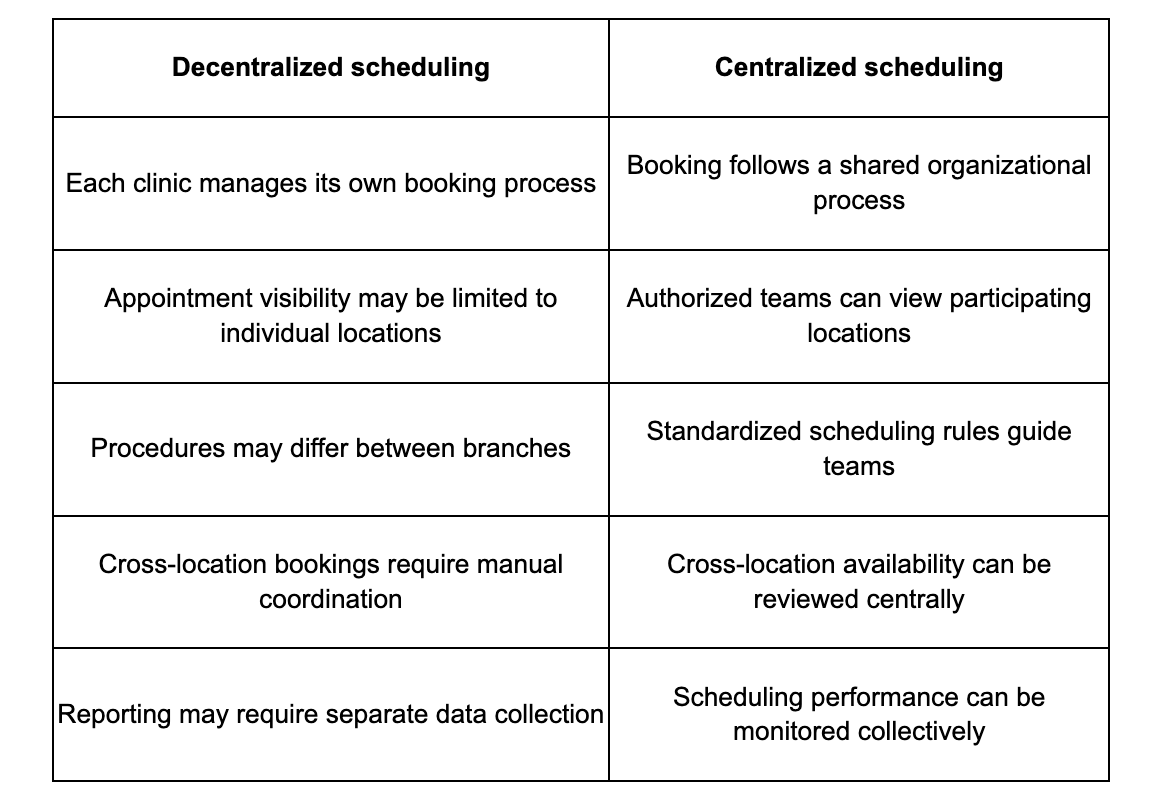
Decentralized scheduling may work for smaller practices with limited operational complexity. However, as a healthcare group expands, centralized scheduling can provide the visibility and consistency needed to manage growing appointment demand.
The Role of Real-Time Data Synchronization in Healthcare Appointment Management
Real-time data synchronization helps ensure that appointment changes are reflected across connected scheduling systems as quickly as possible.
For example, when a patient books an available appointment, that time slot should become unavailable to other authorized users. Similarly, when an appointment is canceled, the newly available slot should become visible to the appropriate scheduling teams.
Integration with an Electronic Health Record (EHR) or practice management system can support this process.
However, healthcare groups should verify how their systems exchange information. Some integrations may operate with delays, and technical failures can prevent updates from appearing immediately. Reliable synchronization therefore requires integration monitoring, clear exception-handling procedures, and regular system testing.
Why Traditional Healthcare Scheduling Systems Struggle to Support Growing Practice Groups
Traditional scheduling processes are often designed around individual clinics rather than the needs of an expanding healthcare network.
As organizations add providers, locations, and services, the limitations of fragmented systems become more noticeable.
Fragmented Appointment Calendars Across Clinics and Departments
Separate appointment calendars make it difficult to understand the organization's overall capacity.
A provider may have available appointments at one location while another branch appears fully booked. Without shared visibility, staff members may not know that an alternative appointment is available.
This can lead to unnecessary delays and missed opportunities to serve patients within the same healthcare network.
Manual Scheduling Processes and Their Impact on Administrative Efficiency
Manual scheduling often involves repeated phone calls, emails, spreadsheet updates, and appointment confirmations.
Although these processes may be manageable for a small practice, they become harder to maintain as appointment volume increases.
Administrative employees spend more time checking availability and resolving scheduling conflicts instead of supporting patients and other operational responsibilities.
Healthcare groups can reduce this burden by introducing standardized workflows and appropriate automation.
Limited Visibility Into Provider Availability and Appointment Capacity
Without a consolidated view of provider schedules, managers may struggle to identify underutilized appointment blocks or uneven demand between locations.
For instance, one branch may have a long waiting list while another has available consultation slots. Limited visibility makes it harder to redistribute appointment demand effectively.
Centralized scheduling helps leadership identify these gaps and make better use of existing provider capacity.
Inconsistent Scheduling Policies Across Healthcare Locations
Different clinics may develop their own booking procedures over time.
One location may allow certain appointment types to be booked online, while another requires staff confirmation. Cancellation policies, appointment durations, and patient intake requirements may also vary.
These inconsistencies can confuse patients and make it difficult to maintain predictable operations.
Standardized scheduling SOPs help establish consistent expectations while allowing approved exceptions for location-specific or clinical requirements.
Communication Gaps Between Front Desk Teams, Call Centers, and Clinical Staff
Scheduling requires coordination between several groups. Front desk employees, contact center representatives, providers, and clinical staff all contribute information that may affect appointment availability.
When communication is fragmented, important updates can be missed.
For example, a provider's schedule may change, but the contact center may continue offering appointments based on outdated information.
A centralized workflow gives teams a shared process for communicating schedule changes, escalating exceptions, and confirming appointment details.
Understanding Double-Bookings in Multi-Location Healthcare Organizations
Double-booking happens when two or more patients are assigned to the same appointment time despite the provider, room, or required resource being unable to accommodate them simultaneously.
Although some healthcare organizations intentionally use overbooking policies, preventable scheduling conflicts are different. They occur when systems or processes fail to recognize existing reservations and resource limitations.
What Causes Double-Bookings in Healthcare Appointment Scheduling?
Several issues can contribute to double-bookings, including:
- Separate calendars that do not synchronize properly.
- Manual appointment entries that are not immediately reflected elsewhere.
- Staff members booking the same available slot simultaneously.
- Outdated provider availability information.
- Incorrect appointment durations or resource assignments.
- Unclear scheduling responsibilities between departments.
These problems become more likely when multiple locations share providers or clinical resources.
How Simultaneous Booking Requests Create Scheduling Conflicts
Consider a healthcare group with two scheduling representatives booking appointments for the same specialist.
Both representatives see an available 10:00 a.m. appointment. If the scheduling system does not reserve the slot when the first representative begins the booking process, the second representative may confirm the same time.
This creates a conflict that could have been prevented through transaction controls and real-time availability updates.
A centralized system should verify the appointment slot again before confirming the reservation.
The Risks of Outdated Provider Calendars and Delayed System Updates
Provider schedules can change because of leave, emergencies, location transfers, or adjustments to clinic hours.
If these changes are not communicated across connected systems, staff members may continue offering appointments that are no longer available.
Healthcare groups should establish clear procedures for updating provider calendars and monitoring synchronization issues.
How Shared Providers and Equipment Increase Scheduling Complexity
Some providers work across multiple clinics, while certain procedures require specialized rooms or equipment.
For example, booking a specialist for a consultation may require more than checking the provider's calendar. The appropriate room, equipment, and support staff must also be available.
A centralized scheduling process should account for these resource dependencies before confirming an appointment.
The Impact of Double-Bookings on Patient Satisfaction and Provider Productivity
Double-bookings can result in longer waiting times, appointment delays, rescheduling, and frustrated patients.
They can also disrupt provider workflows. Clinical staff may need to adjust schedules unexpectedly, while administrative employees spend time contacting affected patients and resolving conflicts.
Preventing these issues helps protect the patient experience and allows providers to work within more predictable schedules.
How Centralized Scheduling Eliminates Preventable Double-Bookings
Centralized scheduling reduces preventable conflicts by giving authorized teams a coordinated view of appointment availability and applying consistent booking controls.
Creating a Single Source of Truth for Appointment Availability
A shared scheduling environment helps ensure that teams refer to the same appointment information.
Rather than checking separate calendars, authorized representatives can review available slots across participating locations.
This reduces confusion and makes it easier to identify suitable appointments without unnecessary back-and-forth communication.
Using Real-Time Calendar Synchronization to Prevent Overlapping Appointments
When a booking is confirmed, connected calendars should update so that other users can no longer select the same unavailable slot.
Healthcare organizations should test synchronization across all relevant systems, including EHRs, practice management platforms, and approved scheduling tools.
If an integration fails, teams need a clear process for identifying and resolving conflicting records.
Implementing Automated Scheduling Rules and Conflict Detection
Automated scheduling rules can prevent bookings that violate established requirements.
For example, a system may restrict certain appointment types to qualified providers, require specific appointment durations, or prevent bookings outside a provider's approved working hours.
Conflict detection can also flag overlapping reservations before confirmation.
These safeguards reduce reliance on staff members remembering every scheduling requirement manually.
Managing Provider Availability Across Multiple Healthcare Locations
Centralized scheduling makes it easier to coordinate providers who work at different branches.
A scheduling representative can review approved availability across locations and offer patients suitable alternatives.
This can help balance appointment demand while respecting provider assignments, travel time, and location-specific operating requirements.
Coordinating Shared Rooms, Medical Equipment, and Clinical Resources
Provider availability alone does not guarantee that an appointment can proceed.
Healthcare groups should also account for treatment rooms, diagnostic equipment, and other required resources.
For example, two appointments may involve the same specialist but require different equipment. Resource-aware scheduling helps prevent conflicts that would otherwise disrupt the clinic's operations.
Using Booking Locks and Transaction Controls to Prevent Simultaneous Reservations
Booking locks temporarily reserve an appointment slot while a representative completes the booking process.
Transaction controls then verify that the slot remains available before the system confirms the appointment.
These safeguards are particularly important when multiple representatives or online booking channels access the same appointment inventory.
What Is Revenue Leakage in Healthcare Scheduling?
Revenue leakage refers to revenue opportunities that a healthcare organization loses because of preventable operational gaps, missed appointments, scheduling errors, or ineffective patient coordination.
It is not limited to billing problems. Scheduling inefficiencies can affect whether patients successfully enter the healthcare network and receive the services they need.
Defining Revenue Leakage and Its Connection to Patient Appointment Management
Every missed booking opportunity can represent a potential loss.
When patients cannot find an appropriate appointment, encounter long wait times, or receive inconsistent scheduling information, they may choose another provider.
For multi-location healthcare groups, revenue leakage can occur when available capacity exists within the network but patients are not successfully directed toward it.
Lost Revenue From Unfilled Appointment Slots and Scheduling Errors
An unused appointment slot represents capacity that could potentially have been used to serve another patient.
Scheduling errors, poor cancellation management, and limited visibility across locations can make it harder to fill these openings.
A centralized process can help teams identify available slots and offer them to patients waiting for appointments, subject to clinical and operational requirements.
How Missed Calls and Unanswered Booking Requests Reduce Patient Acquisition Opportunities
Patients who cannot reach a clinic may not continue trying. They may contact another provider instead.
This is particularly important for healthcare groups receiving inquiries through multiple channels, including phone calls, website forms, and referral requests.
Some organizations use Healthcare call center outsourcing to support appointment inquiries and manage higher call volumes. Others use healthcare virtual assistant services to assist with administrative tasks such as appointment coordination, follow-ups, and patient communication.
Regardless of the support model, teams should follow approved workflows and use secure systems with appropriate access controls. Outsourcing does not automatically guarantee HIPAA compliance; healthcare organizations must evaluate vendors, applicable agreements, privacy safeguards, and data-handling practices.
The Financial Impact of Patient No-Shows and Last-Minute Cancellations
No-shows and late cancellations can leave providers with appointment time that is difficult to recover.
Without a structured process, these openings may remain unused even when other patients are waiting for earlier appointments.
Centralized scheduling can support reminder workflows, cancellation tracking, and waitlist coordination, helping teams respond more quickly when appointment availability changes.
How Poor Referral Coordination Contributes to Patient and Revenue Leakage
Referral leakage happens when patients referred to a healthcare group do not complete the intended appointment within the network.
This may occur because referral requests are not followed up, appointment availability is unclear, or patients encounter difficulties contacting the appropriate location.
A centralized scheduling process can improve referral visibility by tracking incoming requests, assigning follow-up responsibilities, and helping patients find suitable appointments across participating locations.
The result is a more coordinated patient journey and fewer opportunities lost because of disconnected scheduling processes.
How Centralized Scheduling Helps Healthcare Groups Reduce Revenue Leakage
Centralized scheduling helps healthcare organizations capture more appointment opportunities by connecting patient inquiries, provider availability, and booking activities through a coordinated process. Instead of allowing requests to become lost between departments or locations, teams can monitor the entire scheduling journey.
For growing medical groups, this means fewer missed opportunities, better appointment utilization, and improved visibility into patient demand.
Capturing More Appointment Requests Through Unified Scheduling Channels
Patients may contact healthcare organizations through phone calls, website forms, patient portals, or online booking platforms. When these channels operate independently, appointment requests can become difficult to track.
A unified scheduling process brings these inquiries into a more coordinated workflow. Staff members can review incoming requests, identify the appropriate provider or location, and follow up on patients who have not completed their bookings.
Healthcare groups can also use centralized support teams or healthcare virtual assistant services to help manage administrative inquiries and appointment coordination.
Filling Available Appointment Slots Across Multiple Practice Locations
An available appointment at one clinic may help accommodate a patient who cannot find a suitable time at another location.
For example, a patient requesting a specialist consultation may initially contact a fully booked branch. With centralized scheduling, the representative can check other participating locations and offer an alternative appointment when appropriate.
This helps healthcare groups make better use of existing capacity rather than allowing available slots to go unnoticed.
Automating Appointment Reminders to Reduce Preventable No-Shows
Appointment reminders help patients remember upcoming consultations and prepare for scheduled visits.
Centralized scheduling software can support automated reminders through approved communication channels, such as SMS, email, or patient portal notifications.
Organizations can establish reminder schedules that include appointment dates, times, locations, and relevant preparation instructions. Patients may also receive confirmation requests or instructions for contacting the clinic if they need to reschedule.
These workflows can reduce avoidable communication gaps, although reminders alone cannot eliminate all no-shows.
Using Automated Waitlists to Recover Canceled Appointments
Cancellations create openings that may be difficult to fill when scheduling teams do not have access to a coordinated patient waitlist.
An automated waitlist can help identify patients who are interested in earlier appointments and notify them when suitable slots become available.
For instance, when a patient cancels a consultation, the system may identify other patients waiting for the same appointment type or provider.
Staff can then coordinate the replacement booking based on availability and applicable scheduling rules. This helps recover appointment opportunities that might otherwise remain unused.
Improving Referral-to-Appointment Conversion Through Coordinated Scheduling
A referral does not automatically become a completed appointment. Patients may delay booking because they cannot reach the appropriate department, do not understand the next steps, or encounter limited appointment availability.
Centralized scheduling can make referral coordination more consistent by connecting incoming referrals with appointment scheduling workflows.
Teams can track referral status, identify patients who still need to book, and coordinate follow-ups. This is particularly valuable for healthcare groups with multiple specialties and locations, where referrals may need to be directed to different providers.
Tracking Unscheduled Patients and Incomplete Booking Requests
Some patients begin the booking process but never complete it. Others may request an appointment and wait for a callback that never happens.
Without proper tracking, these opportunities can disappear from the organization's workflow.
A centralized scheduling platform can help identify incomplete requests, pending confirmations, and patients who still need assistance. Teams can assign follow-up responsibilities and monitor whether each request progresses toward a confirmed appointment.
This creates greater accountability and helps prevent avoidable patient leakage.
Improving Patient Access With a Unified Healthcare Scheduling Experience
Patient access is an important part of healthcare service delivery. Even when a medical group has experienced providers and multiple locations, patients may struggle to receive care if the booking process is confusing or inconvenient.
A unified scheduling experience makes it easier to identify available appointments, compare appropriate locations, and connect with the right provider.
Offering Patients Greater Visibility Into Available Appointments
Patients often want to know when they can receive care without making several phone calls.
A centralized scheduling environment gives authorized scheduling teams better visibility into appointment availability across participating clinics.
Depending on the organization's technology and access policies, this information can also support online booking and patient self-service tools.
Greater visibility helps patients explore suitable appointment options while reducing unnecessary delays.
Enabling Scheduling Across Multiple Providers and Clinic Locations
Patients may have flexibility when choosing a provider or clinic location, particularly when seeking routine consultations or follow-up appointments.
Centralized scheduling allows representatives to review approved provider availability across the healthcare network.
For example, if a patient cannot secure an appointment with a particular provider at one branch, the scheduling team may offer another qualified provider or location when clinically appropriate.
This approach improves convenience without compromising provider qualifications or clinical scheduling requirements.
Reducing Patient Wait Times Through Better Appointment Distribution
Uneven appointment demand can cause some locations to experience long waiting lists while others have unused capacity.
Centralized scheduling helps organizations identify these differences and distribute appointment requests more effectively.
Patients may be offered earlier appointments at alternative locations, provided travel distance, provider suitability, and patient preferences are considered.
This can help reduce unnecessary waiting while supporting more balanced workloads across the network.
Supporting Online Booking, Phone Scheduling, and Patient Portal Requests
Patients have different preferences when scheduling appointments. Some prefer speaking with a representative, while others want to book online at their convenience.
An effective centralized scheduling strategy should support multiple booking channels without creating separate or disconnected appointment inventories.
For example, an appointment booked through a patient portal should be reflected in the same scheduling environment used by authorized phone representatives.
This coordination helps prevent duplicate reservations and creates a consistent experience regardless of how patients initiate their requests.
Making Appointment Rescheduling and Cancellations More Convenient
Patients sometimes need to change their appointments because of work schedules, transportation issues, or unexpected circumstances.
A convenient rescheduling process makes it easier for patients to select another suitable time rather than abandoning their appointment altogether.
Centralized scheduling can also help staff identify newly available slots and offer them to patients on waiting lists.
Clear cancellation and rescheduling procedures benefit both patients and healthcare organizations by making appointment changes easier to manage.
Increasing Front Desk and Administrative Efficiency Through Centralized Scheduling
Administrative efficiency becomes increasingly important as healthcare groups expand. When individual clinics handle every scheduling task independently, employees may spend considerable time checking calendars, confirming appointments, and communicating updates.
Centralized scheduling can reduce repetitive work by establishing shared workflows and clearer responsibilities.
Reducing Repetitive Scheduling Tasks and Manual Calendar Updates
Without coordinated scheduling software, employees may need to update several calendars whenever an appointment changes.
This creates additional work and increases the possibility of human error.
A centralized system can automate supported calendar updates and appointment notifications, reducing the need for repeated manual entries.
Administrative teams can then dedicate more time to patient inquiries and other important responsibilities.
Eliminating Duplicate Data Entry Across Disconnected Systems
Entering the same appointment information into multiple platforms creates unnecessary administrative work.
It can also lead to inconsistent records when information is updated in one system but not another.
Healthcare groups should prioritize integrations that allow approved appointment information to move between their scheduling platform, EHR, and practice management system.
Integration capabilities should be evaluated carefully, including whether updates occur in real time, how errors are reported, and which system serves as the authoritative record.
Standardizing Scheduling Workflows Across Healthcare Teams
Different locations may follow different procedures for booking consultations, handling cancellations, or coordinating referrals.
Standardized scheduling SOPs help establish consistent expectations across the organization.
These procedures can define:
- How appointment requests are received and processed.
- Which appointment types can be booked by administrative teams.
- When clinical staff approval is required.
- How cancellations and rescheduling requests are handled.
- How scheduling conflicts are escalated.
- Who is responsible for following up on incomplete requests.
Standardization helps reduce confusion while allowing approved exceptions for specialty-specific requirements.
Improving Communication Between Centralized Scheduling Teams and Individual Clinics
Centralized scheduling does not eliminate the need for communication with individual clinics.
Local teams still need to provide updates about provider availability, room capacity, equipment requirements, and operational changes.
A shared communication process helps ensure that central scheduling representatives have accurate information when assisting patients.
Healthcare groups should establish clear escalation channels so that complex requests and clinical scheduling questions reach the appropriate staff members.
Allowing Front Desk Employees to Focus on Higher-Value Patient Interactions
When centralized teams handle routine appointment coordination, front desk employees may have more time to focus on patients who are physically present at the clinic.
They can assist with check-in, patient concerns, documentation, and other activities that require direct interaction.
For healthcare groups, the objective is not simply to reduce administrative workload. It is to organize responsibilities so that employees can focus on the tasks where their involvement adds the most value.
Optimizing Provider Utilization and Clinical Capacity Across Healthcare Locations
A healthcare organization's appointment capacity is one of its important operational resources. However, having multiple providers and clinic locations does not automatically mean that available capacity is being used efficiently.
Centralized scheduling gives management a broader view of appointment demand and provider availability, making it easier to identify opportunities for improvement.
Identifying Underutilized Providers and Appointment Availability
Some providers may have unused appointment blocks while others experience consistently high demand.
When schedules are managed separately, these differences can be difficult to identify.
Centralized scheduling dashboards can help managers review appointment utilization, available time slots, cancellations, and booking patterns across locations.
This information supports better decisions about appointment distribution and provider scheduling.
Balancing Patient Demand Across Different Practice Locations
Demand is not always evenly distributed across clinic locations.
A busy branch may have a growing appointment backlog, while another location has available capacity.
Centralized scheduling allows teams to review these differences and offer alternative locations when appropriate.
This can help reduce pressure on high-demand clinics while making better use of existing resources.
Matching Appointment Types With Appropriate Provider Skills and Availability
Not every provider can accommodate every appointment type.
Certain consultations, procedures, and follow-up visits require specific qualifications, experience, or clinical resources.
Centralized scheduling systems should therefore use appointment rules that consider provider credentials, specialty, appointment type, and location.
Clinical suitability should remain governed by approved protocols, with questions requiring professional judgment escalated to qualified clinical personnel.
Managing Appointment Durations, Buffer Times, and Clinical Workflows
Different appointments require different amounts of time.
A routine follow-up may take less time than a new patient consultation or a procedure requiring preparation and recovery.
Scheduling systems should account for appointment durations, provider preferences, room availability, and necessary buffer periods.
This helps create realistic schedules and reduces the risk of appointments overlapping with other clinical responsibilities.
Using Capacity Planning to Support Healthcare Group Expansion
As healthcare groups expand, leadership needs to understand whether existing providers, locations, and resources can accommodate future patient demand.
Centralized scheduling data can help identify recurring capacity constraints, high-demand specialties, and locations with opportunities for growth.
These insights can support decisions about hiring additional providers, extending clinic hours, adding locations, or redistributing appointment capacity.
Rather than relying entirely on assumptions, executives can use scheduling performance data to inform expansion strategies.
Essential Features of Centralized Scheduling Software for Healthcare Groups
Choosing the right centralized scheduling software requires more than finding a platform that displays appointment calendars.
Healthcare groups need tools that support multi-location coordination, protect patient information, prevent scheduling conflicts, and provide useful operational insights.
The following features should be considered when evaluating potential solutions.
Unified Multi-Location Scheduling Dashboard
A unified dashboard allows authorized employees to review appointment availability across participating locations.
Ideally, it should display provider schedules, appointment types, clinic hours, and relevant resource availability in one organized interface.
This helps scheduling teams identify suitable booking options without switching between multiple disconnected systems.
Real-Time Appointment Availability and Conflict Prevention
The platform should update appointment availability when bookings, cancellations, or schedule changes occur.
Conflict detection, booking locks, and transaction controls are important safeguards against simultaneous reservations.
Healthcare groups should also verify how the software handles synchronization failures and conflicting appointment records.
Role-Based Scheduling Permissions and Administrative Controls
Not every employee needs access to every scheduling function or patient record.
Role-based permissions allow organizations to assign access according to job responsibilities.
For example, a scheduling representative may be authorized to book appointments, while a clinic manager may have additional permissions to review provider availability and approve schedule changes.
These controls should follow the organization's privacy, security, and applicable regulatory requirements.
Automated Appointment Confirmations, Reminders, and Follow-Ups
Automated notifications help keep patients informed about upcoming appointments and changes to their schedules.
Useful capabilities may include:
- Appointment confirmation messages.
- SMS and email reminders.
- Cancellation notifications.
- Rescheduling instructions.
- Follow-up messages for incomplete booking requests.
Organizations should ensure that communication preferences, consent requirements, and patient privacy considerations are properly managed.
Patient Self-Scheduling and Online Booking Capabilities
Self-scheduling allows patients to review approved appointment options and book without always needing assistance from a representative.
This can improve convenience and reduce routine phone inquiries.
However, self-scheduling should follow defined eligibility rules. Certain appointments may require referral verification, clinical review, or staff assistance before they can be confirmed.
Referral Management and Appointment Tracking
For multi-specialty healthcare groups, referral management is an important scheduling capability.
The platform should help teams track incoming referrals, appointment requests, booking status, and outstanding follow-ups.
This gives management better visibility into whether referred patients are progressing toward scheduled care and helps identify requests that need attention.
Reporting, Analytics, and Scheduling Performance Dashboards
Reporting features help healthcare leaders understand how effectively their scheduling operations are performing.
Useful metrics include:
- Appointment utilization rate.
- Double-booking and scheduling conflict frequency.
- Appointment cancellation and no-show rates.
- Call abandonment rate.
- Unscheduled patient requests.
- Referral-to-appointment conversion.
- Net new patient conversion.
- Appointment availability by provider and location.
These metrics help executives identify operational weaknesses and measure the impact of process improvements.
Integration With Electronic Health Records and Practice Management Systems
Integration with EHR and practice management systems helps connect scheduling activities with broader clinical and administrative workflows.
Before selecting a platform, healthcare groups should evaluate compatibility, data synchronization, interoperability standards, security safeguards, and vendor support.
A successful integration should minimize duplicate data entry while maintaining accurate and consistent appointment records.
Ultimately, the best centralized scheduling solution is one that supports the organization's actual workflows, scales with its growth, and gives both administrative teams and leadership the visibility needed to manage appointments effectively.
The Role of Automation and AI in Modern Healthcare Appointment Scheduling
As healthcare organizations expand, managing appointment requests manually becomes increasingly difficult. Automation and artificial intelligence (AI) can help centralized scheduling teams handle repetitive tasks, identify operational patterns, and make better use of available appointment capacity.
When implemented correctly, these technologies can reduce administrative workload while improving the patient booking experience. However, they should support established clinical and operational workflows rather than replace professional judgment.
Automating Routine Appointment Scheduling and Rescheduling Workflows
Automation can simplify many routine scheduling activities, including appointment confirmations, reminders, cancellations, and rescheduling requests.
For example, when a patient cancels an appointment through an approved booking channel, the system can automatically update the calendar and notify the appropriate scheduling team. It may also identify another patient on the waitlist who could use the newly available slot.
Automated workflows can also send reminders, collect appointment confirmations, and flag requests that require staff attention.
This reduces repetitive administrative work and helps scheduling teams manage higher appointment volumes without relying entirely on manual processes.
Using AI-Assisted Demand Forecasting to Anticipate Appointment Volume
AI-assisted forecasting can help healthcare groups identify patterns in appointment demand.
By analyzing historical scheduling information, seasonal trends, specialty demand, and booking patterns, predictive models may estimate when particular clinics or providers are likely to experience higher appointment volumes.
For instance, a specialty practice may consistently receive more appointment requests during certain periods. Forecasting tools can help managers anticipate these patterns and plan provider availability accordingly.
Although predictions are not guaranteed, they can provide useful information for workforce planning, appointment allocation, and operational decisions.
Identifying Scheduling Gaps and Opportunities to Improve Capacity Utilization
AI and analytics tools can help identify patterns that may not be immediately visible through manual calendar reviews.
For example, a healthcare group may discover that one location frequently has unused afternoon appointment slots while another experiences long waiting lists.
An analytical system can highlight these differences and help managers evaluate opportunities to redistribute appointment demand.
Other potential insights include recurring cancellations, underutilized provider schedules, and appointment types that regularly create scheduling bottlenecks.
These insights allow healthcare leaders to make decisions based on operational data rather than assumptions.
Supporting Intelligent Appointment Matching Based on Provider Availability
Intelligent appointment matching can help scheduling teams identify suitable appointment options based on several factors.
These may include:
- Provider specialty and qualifications.
- Appointment type and duration.
- Clinic location and operating hours.
- Available rooms and medical equipment.
- Patient location preferences.
- Referral or appointment requirements.
For example, a patient requesting a specialist consultation may be matched with an available provider at another participating location, provided the provider is clinically appropriate and the patient agrees to the alternative.
This can improve appointment distribution while reducing unnecessary delays.
Applying Predictive Analytics to No-Show Risk and Appointment Recovery
Predictive analytics may help healthcare organizations identify appointment patterns associated with higher cancellation or no-show rates.
Depending on the available data and model quality, systems may identify trends involving appointment lead times, previous cancellation patterns, appointment types, or communication preferences.
Healthcare groups can use these insights to evaluate where additional reminders or confirmation workflows may be helpful.
However, predictive scores should be used carefully. They should not automatically restrict access to care or disadvantage patients based on assumptions. Human review and fair scheduling policies remain important.
Maintaining Human Oversight for Complex Clinical Scheduling Decisions
Automation can handle many administrative activities, but not every appointment decision should be automated.
Some requests require clinical judgment, especially when they involve urgent symptoms, complex referrals, treatment suitability, or specialized preparation requirements.
Centralized scheduling teams should follow approved triage and escalation procedures. Questions involving clinical urgency or medical appropriateness must be directed to qualified healthcare professionals.
The most effective approach combines automation for repetitive administrative work with human oversight for decisions that require expertise, context, and patient-specific consideration.
Integrating Centralized Scheduling With Existing Healthcare Technology
Centralized scheduling becomes more effective when it works alongside the technology healthcare organizations already use.
Most medical groups rely on several platforms to manage patient records, appointments, referrals, billing, and communication. Without proper integration, these systems can create information gaps and duplicate administrative work.
Connecting Scheduling Software With EHR and EMR Systems
Electronic Health Record (EHR) and Electronic Medical Record (EMR) systems contain important information that may influence appointment scheduling.
Integrating scheduling software with these systems can help authorized staff access relevant appointment details, provider information, and patient records within approved workflows.
For example, when an appointment is booked, the scheduling platform may transmit the relevant information to the organization's EHR or EMR system.
Healthcare groups should evaluate whether integration supports real-time updates, reliable data exchange, and appropriate error handling. A system that only synchronizes periodically may create delays that affect appointment accuracy.
Synchronizing Patient Information With Practice Management Platforms
Practice management platforms support administrative functions such as appointment management, registration, billing, and patient communication.
Connecting these platforms with centralized scheduling software can reduce duplicate data entry and improve coordination between departments.
For instance, changes to appointment dates or times should be reflected in the appropriate connected systems so that staff members work with consistent information.
Organizations should also define which platform serves as the authoritative source for specific data fields to prevent conflicting updates.
Integrating Referral Management, Contact Centers, and Patient Communication Tools
Scheduling does not happen through one channel alone.
Patients may contact a healthcare organization through a call center, submit an online request, communicate through a patient portal, or arrive through a provider referral.
Integrating these channels with centralized scheduling helps organizations track appointment requests more consistently.
For example, a contact center representative should be able to review available appointments without relying on a separate manual confirmation process from each clinic.
Healthcare groups using Healthcare call center outsourcing should also establish appropriate system access, privacy safeguards, and communication procedures for external support teams.
Maintaining Data Accuracy Across Multiple Healthcare Systems
Integration is only valuable when the information being exchanged is accurate.
Incorrect provider schedules, outdated patient details, duplicate appointment records, and failed system updates can create operational problems.
Healthcare organizations should establish data validation procedures, monitor integration errors, and assign responsibility for resolving discrepancies.
Regular testing is also important whenever systems are updated or new clinic locations are added.
Evaluating API Compatibility and Integration Requirements
Before implementing centralized scheduling software, healthcare groups should assess how well the platform connects with their existing technology.
Application Programming Interfaces (APIs) allow different software systems to exchange information through defined interfaces.
During evaluation, organizations should consider:
- Compatibility with existing EHR and practice management platforms.
- Available integration methods and supported data formats.
- Real-time versus scheduled synchronization.
- Authentication and access control requirements.
- Error reporting and integration monitoring.
- Vendor support and maintenance responsibilities.
- Scalability as additional locations and providers are introduced.
A thorough integration assessment helps prevent unexpected technical limitations and supports a more reliable implementation.
Data Security, HIPAA Compliance, and Patient Privacy in Centralized Scheduling
Centralized scheduling improves information visibility, but it also requires careful management of patient information.
When multiple clinics and scheduling teams access a shared platform, healthcare organizations must ensure that information is protected through appropriate security controls and privacy practices.
For organizations operating in the United States, HIPAA compliance is an important consideration when handling protected health information (PHI).
Protecting Patient Information Across Shared Scheduling Platforms
Centralized scheduling systems may contain sensitive information such as patient names, contact details, appointment dates, provider information, and other records connected to healthcare services.
Organizations should select platforms with appropriate security capabilities, including encryption, secure data transmission, and controlled access.
They should also evaluate how vendors store, process, and protect patient information.
Security should be considered during software selection and implementation, not treated as an afterthought.
Implementing Role-Based Access Controls and User Authentication
Role-based access controls help ensure that employees can only access the information and functions required for their responsibilities.
For example, a scheduling representative may need permission to create or reschedule appointments, while a practice manager may require additional access to scheduling reports and provider availability.
Strong authentication measures, including multifactor authentication where appropriate, can further protect access.
Healthcare organizations should regularly review user permissions and promptly remove access when employees or contractors no longer require it.
Maintaining Audit Trails for Appointment Changes and Scheduling Activity
Audit trails help healthcare organizations understand what happened when appointment records were created, modified, or canceled.
A useful audit log may record:
- The user responsible for a scheduling action.
- The date and time of the activity.
- The type of appointment change.
- Relevant previous and updated information.
- System-generated alerts or exceptions.
These records can support internal reviews, troubleshooting, and compliance monitoring.
They also help organizations investigate scheduling discrepancies and identify recurring process issues.
Evaluating HIPAA Requirements and Business Associate Agreements
Healthcare organizations should determine whether their scheduling software providers and external support partners qualify as business associates under HIPAA.
When applicable, a Business Associate Agreement (BAA) must be in place before a business associate handles protected health information on behalf of a covered entity.
The agreement should address responsibilities for safeguarding information and handling relevant privacy and security obligations.
Healthcare groups should also conduct appropriate vendor assessments. Simply purchasing healthcare scheduling software or outsourcing appointment management does not automatically make an organization HIPAA compliant.
Establishing Secure Data Sharing and Retention Practices Across Locations
Multi-location healthcare groups need clear rules for sharing and retaining scheduling information.
These policies should define who can access patient information, how data is transferred between locations, and how long records are retained.
Organizations should also establish procedures for secure data disposal, incident reporting, and access reviews.
Consistent policies help maintain patient privacy while allowing authorized teams to coordinate appointments across the healthcare network.
Measuring the Financial and Operational ROI of Centralized Scheduling
Implementing centralized scheduling requires investment in technology, integration, employee training, and process improvements.
Healthcare executives should therefore evaluate whether the expected operational benefits justify the implementation costs.
A structured ROI assessment can help organizations determine whether centralized scheduling is improving appointment utilization, reducing administrative workload, and recovering lost revenue opportunities.
Calculating the Cost of Double-Bookings and Scheduling Conflicts
Scheduling conflicts create costs that extend beyond the immediate appointment disruption.
They may require staff members to contact affected patients, rearrange provider schedules, coordinate with clinical teams, and resolve documentation issues.
Healthcare groups can estimate these costs by tracking the number of scheduling conflicts and the average administrative time required to resolve each incident.
For example, if a group experiences recurring double-bookings across several locations, calculating the time spent correcting these problems can reveal the operational burden of disconnected scheduling processes.
Measuring Revenue Recovery From Previously Unfilled Appointment Slots
Centralized scheduling can help identify unused appointment slots and offer them to patients who need earlier appointments.
To evaluate the financial impact, organizations can track the number of previously unfilled slots that are successfully booked and completed.
The estimated recovered value can then be calculated using the organization's actual collected revenue or an appropriate contribution margin, rather than relying solely on the appointment's listed charge.
This provides a more realistic picture of the financial benefit.
Tracking Improvements in Appointment Utilization and Provider Productivity
Appointment utilization measures how effectively available provider capacity is being used.
Healthcare groups can compare utilization before and after implementation to determine whether centralized scheduling is helping distribute appointments more efficiently.
Other useful indicators include completed appointments per provider, available appointment hours, and the percentage of canceled slots successfully refilled.
These measures can help managers identify whether scheduling improvements are translating into better use of clinical resources.
Evaluating Administrative Time Savings and Labor Efficiency
Administrative time savings are another important part of centralized scheduling ROI.
Organizations can measure how much time employees previously spent on manual calendar updates, appointment confirmations, cross-location calls, and scheduling conflict resolution.
They can then compare these figures with the time required under the centralized process.
The objective is not necessarily to reduce headcount. It may be more valuable to redirect employee time toward patient support, referral follow-ups, and other higher-priority activities.
Comparing Implementation Costs Against Measurable Operational Benefits
A complete ROI assessment should include both implementation expenses and ongoing benefits.
Potential costs include:
- Scheduling software subscriptions or licensing.
- EHR and practice management integrations.
- Data migration and system configuration.
- Employee training and workflow development.
- Ongoing technical support and maintenance.
- Security assessments and compliance-related expenses.
These costs should be compared against measurable improvements such as recovered appointment value, reduced administrative effort, improved provider utilization, and fewer scheduling conflicts.
Healthcare groups should also establish a realistic evaluation period because implementation benefits may develop gradually as employees adopt the new workflows.
Key Scheduling KPIs Every Healthcare Group Should Monitor
Centralized scheduling gives healthcare organizations the opportunity to measure performance across multiple locations using consistent indicators.
Tracking the right Key Performance Indicators (KPIs) helps executives identify operational weaknesses, evaluate improvement initiatives, and make informed decisions about staffing and capacity.
Appointment Double-Booking and Scheduling Conflict Rate
This KPI measures how frequently appointment reservations create overlapping or incompatible scheduling commitments.
Healthcare groups can calculate the rate by dividing the number of confirmed scheduling conflicts by the total number of appointments during a defined period.
A declining rate may indicate that synchronization, booking controls, and scheduling procedures are becoming more effective.
Provider Utilization and Appointment Slot Fill Rate
Provider utilization measures how much of a provider's available appointment capacity is being used.
Appointment slot fill rate measures the proportion of available appointment slots that have been booked.
These metrics help managers identify underutilized schedules and locations experiencing consistently high demand.
Organizations should define their calculations carefully, including how they treat administrative blocks, leave, and appointments that are canceled.
Patient No-Show and Cancellation Rates
No-show and cancellation rates help healthcare groups understand how frequently scheduled appointments do not proceed as planned.
Tracking these metrics by location, specialty, and appointment type may reveal patterns that require attention.
For example, a particular clinic may experience higher no-show rates for appointments booked several weeks in advance. This could indicate an opportunity to review reminder procedures or patient communication workflows.
Average Time to the Next Available Appointment
This KPI measures how long patients typically wait before they can access an appropriate appointment.
Longer waiting times may indicate limited provider capacity, uneven appointment distribution, or inefficient scheduling processes.
Monitoring this metric across locations can help healthcare leaders identify where additional capacity or better appointment coordination may be needed.
Referral-to-Appointment Conversion Rate
Referral-to-appointment conversion measures how many received referrals result in successfully scheduled appointments within a defined period.
A low conversion rate may indicate problems with referral follow-ups, patient communication, appointment availability, or coordination between departments.
Tracking this KPI helps organizations understand whether referred patients are successfully moving through the scheduling process.
Appointment Request Abandonment and Booking Completion Rate
Appointment request abandonment measures how frequently patients begin the booking process but leave without securing an appointment.
Booking completion rate measures the proportion of eligible appointment requests that result in confirmed bookings.
These metrics are particularly useful for healthcare groups managing multiple channels, including phone scheduling, website forms, and patient portals.
They can help identify whether patients are encountering long hold times, confusing booking procedures, or limited appointment options.
Estimated Revenue Leakage and Recovered Appointment Value
Healthcare groups should also estimate the financial impact of missed scheduling opportunities.
This may include the value associated with unfilled appointment slots, incomplete booking requests, missed referrals, and preventable scheduling errors.
Recovered appointment value can be tracked by measuring how many previously unused slots are successfully filled and completed.
Together, these indicators help leadership understand whether centralized scheduling is improving both operational performance and financial outcomes.
The most important consideration is consistency. Healthcare groups should establish clear KPI definitions, reliable reporting processes, and regular performance reviews so that improvements can be measured across every participating location.
How to Choose the Right Centralized Scheduling Solution for Your Healthcare Group
Selecting the right centralized scheduling solution is an important decision for healthcare organizations planning to expand their operations. The ideal platform should support current scheduling requirements while providing enough flexibility to accommodate additional providers, locations, and patient demand.
Healthcare executives should evaluate more than software features. They should also consider integration capabilities, implementation requirements, security, employee adoption, and long-term operational value.
Evaluating Software Scalability for Multi-Location Healthcare Operations
A scheduling platform that works for one clinic may not necessarily support a healthcare group with multiple locations.
Before selecting a solution, consider how easily it can accommodate additional providers, specialties, appointment types, and clinic branches.
The platform should allow authorized teams to manage different location requirements while maintaining centralized visibility.
Scalability is particularly important for growing medical groups and Management Services Organizations (MSOs) that expect to add practices through acquisitions or expansion.
Assessing Scheduling Automation and Conflict Prevention Capabilities
Automation should reduce repetitive work while helping prevent avoidable scheduling errors.
Look for features such as automated appointment confirmations, cancellation notifications, waitlist management, calendar synchronization, and conflict detection.
The platform should also support scheduling rules that account for provider availability, appointment durations, room requirements, and other operational constraints.
Ask vendors to demonstrate how their software handles simultaneous booking requests, overlapping appointments, and synchronization failures.
Reviewing Integration Support for Existing Healthcare Systems
A centralized scheduling platform should work effectively with the healthcare organization's existing technology.
Evaluate whether it can integrate with your EHR, EMR, practice management platform, referral management tools, and patient communication systems.
It is also important to understand how information moves between connected applications.
Ask whether integrations support real-time updates, what happens when an interface fails, and how duplicate or conflicting records are handled.
A platform with strong integration capabilities can reduce administrative work and help maintain consistent appointment information across departments.
Comparing Implementation Costs, Support Services, and Long-Term Value
Software pricing is only one part of the total implementation cost.
Healthcare groups should also consider data migration, system configuration, integration development, employee training, technical support, and ongoing maintenance.
Some vendors may offer lower subscription fees but charge additional costs for integrations, additional locations, or advanced features.
Compare the total cost of ownership rather than focusing exclusively on the initial price.
The best solution is one that delivers measurable operational value, supports future growth, and does not create unnecessary complexity for employees.
Identifying Essential Questions to Ask Healthcare Scheduling Software Vendors
Before signing an agreement, healthcare organizations should ask vendors questions that reveal how well their solutions support real-world operations.
Consider asking:
- Can the platform manage appointment schedules across multiple healthcare locations?
- Does it support real-time appointment synchronization?
- How does the system prevent simultaneous bookings and scheduling conflicts?
- Can it accommodate shared providers, rooms, and medical equipment?
- Does it integrate with our existing EHR and practice management systems?
- What happens when an integration or synchronization process fails?
- Does the platform support automated reminders, cancellations, and waitlists?
- What security controls and HIPAA-related safeguards are available?
- Does the vendor offer implementation assistance and employee training?
- How are software updates, technical issues, and ongoing support handled?
Requesting product demonstrations using actual scheduling scenarios can also help decision-makers evaluate whether a platform meets their organization's needs.
The Future of Centralized Scheduling for Healthcare Groups
Healthcare scheduling is moving toward more connected, automated, and data-driven operations.
As healthcare networks expand, organizations will increasingly need systems that coordinate patient access, provider capacity, and administrative workflows across multiple locations.
Centralized scheduling provides a foundation for these improvements.
The Evolution of AI-Powered Healthcare Scheduling and Predictive Capacity Planning
AI-powered scheduling tools are expected to become more sophisticated in analyzing appointment demand and identifying operational patterns.
Predictive models can help healthcare groups anticipate busy periods, recognize underutilized appointment capacity, and evaluate scheduling scenarios.
For example, an organization may use historical appointment data to estimate demand for a particular specialty and determine whether additional provider hours are needed.
These tools can support better planning, although predictions should always be reviewed alongside operational experience and clinical requirements.
The Growing Importance of Unified Patient Access Across Healthcare Networks
Patients increasingly expect convenient access to healthcare services.
They want to find available appointments, communicate with providers, and manage scheduling changes without navigating multiple disconnected systems.
Healthcare groups that operate several locations will need more coordinated patient access strategies.
Centralized scheduling can support this by giving authorized teams a unified view of appointment availability and helping patients find appropriate care within the network.
How Intelligent Scheduling May Support More Personalized Patient Experiences
Intelligent scheduling can help healthcare organizations consider patient preferences when presenting appointment options.
These preferences may include preferred locations, available times, provider continuity, and communication channels.
For example, a patient who regularly visits one branch may prefer to remain at that location. If no appointment is available, the scheduling team can offer an alternative based on the patient's preferences and clinical requirements.
The objective is to make appointment coordination more convenient without compromising clinical suitability or access fairness.
The Role of Interoperability in Connected Healthcare Scheduling Ecosystems
Healthcare organizations often use technology from multiple vendors.
Interoperability allows these systems to exchange information more effectively, reducing the need for manual data transfers and duplicate administrative processes.
As interoperability improves, centralized scheduling platforms may become better connected with EHRs, patient portals, referral systems, and other healthcare applications.
Organizations should prioritize solutions that support reliable data exchange and can adapt as their technology environments evolve.
Preparing Healthcare Groups for More Automated and Data-Driven Operations
Preparing for the future of scheduling requires more than purchasing new software.
Healthcare groups should review their existing workflows, standardize scheduling policies, train employees, and establish clear performance indicators.
They should also evaluate their data quality and integration readiness before introducing advanced automation.
Organizations that build a strong operational foundation will be better positioned to adopt AI-assisted scheduling and other emerging technologies.
Conclusion: Building a More Efficient and Revenue-Resilient Healthcare Group Through Centralized Scheduling
Centralized scheduling gives multi-location healthcare organizations a more coordinated way to manage appointments, improve patient access, and protect valuable provider capacity.
As medical groups expand, disconnected calendars and inconsistent booking procedures can create unnecessary administrative work and missed revenue opportunities. A unified scheduling strategy helps address these challenges by connecting appointment availability, patient requests, and operational processes.
Recapping How Centralized Scheduling Prevents Double-Bookings and Reduces Revenue Leakage
Centralized scheduling helps prevent double-bookings by providing a shared view of appointment availability and supporting real-time synchronization, automated scheduling rules, and conflict detection.
It also helps reduce revenue leakage by improving appointment follow-ups, recovering canceled slots, tracking incomplete booking requests, and coordinating referrals.
These improvements make it easier for healthcare organizations to capture appointment opportunities that might otherwise be lost.
Why Unified Appointment Visibility Is Essential for Healthcare Group Growth
When healthcare groups operate multiple locations, leadership needs visibility into provider schedules, appointment capacity, and patient demand across the network.
A unified scheduling environment makes this information easier to review and manage.
It also allows teams to identify underutilized providers, redistribute appointment demand, and maintain more consistent scheduling procedures as the organization grows.
Turning Scheduling Efficiency Into Better Patient Access and Financial Performance
Better scheduling is not just about organizing calendars. It directly influences how patients access healthcare services and how effectively organizations use their available resources.
By reducing preventable scheduling conflicts and improving appointment coordination, healthcare groups can create a smoother patient experience while supporting stronger operational performance.
The financial benefits become more measurable when organizations consistently track appointment utilization, referral conversion, administrative efficiency, and recovered appointment value.
Next Steps Toward Implementing a Scalable Centralized Scheduling Strategy
Healthcare groups should begin by reviewing their current scheduling processes and identifying the biggest sources of inefficiency.
From there, leadership can standardize scheduling SOPs, evaluate appropriate technology, establish integration requirements, and train employees on the new workflows.
Starting with a pilot location or specialty department can help identify implementation challenges before expanding the approach across the organization.
Ultimately, centralized scheduling should be treated as an ongoing operational improvement initiative rather than a one-time technology upgrade.
Frequently Asked Questions About Centralized Scheduling for Healthcare Groups
1. What Is Centralized Scheduling in Healthcare, and How Does It Work?
Centralized scheduling is an appointment management approach that coordinates booking activities through a shared system or central scheduling team. Instead of allowing individual clinics to manage appointments independently, authorized employees can review provider availability and schedule patients across participating locations. This improves visibility, standardizes booking procedures, and helps healthcare groups manage appointment demand more efficiently.
2. How Does Centralized Scheduling Prevent Double-Bookings Across Multiple Clinics?
Centralized scheduling helps prevent double-bookings by maintaining a shared view of appointment availability. Real-time calendar synchronization, booking locks, automated scheduling rules, and conflict detection help ensure that multiple representatives cannot accidentally reserve the same appointment slot. These safeguards should also account for shared providers, rooms, and medical equipment.
3. What Causes Revenue Leakage in Healthcare Appointment Scheduling?
Revenue leakage can result from unfilled appointment slots, missed patient inquiries, incomplete bookings, poor referral coordination, scheduling errors, and preventable cancellations. When patients cannot secure appointments or are not properly followed up, they may seek care elsewhere. Centralized scheduling helps organizations identify and recover some of these lost opportunities.
4. Can Centralized Scheduling Help Healthcare Groups Reduce Patient No-Shows?
Yes. Centralized scheduling can support automated appointment reminders, confirmation requests, cancellation workflows, and waitlist management. These processes help patients stay informed and allow scheduling teams to respond when appointments become available. Although these tools cannot eliminate every no-show, they can reduce preventable communication gaps and improve appointment recovery.
5. What Are the Main Benefits of Centralized Scheduling for Multi-Location Healthcare Organizations?
The main benefits include:
- Fewer preventable double-bookings.
- Better visibility into provider availability.
- Improved appointment utilization.
- More consistent scheduling procedures.
- Reduced administrative workload.
- Better coordination between clinic locations.
- Improved referral and patient follow-up processes.
- More convenient patient access to appointments.
These improvements can help healthcare groups manage growth without allowing scheduling complexity to overwhelm their administrative teams.
6. How Does Centralized Scheduling Improve Patient Access and Appointment Availability?
Centralized scheduling allows authorized representatives to review available appointments across multiple participating locations. If one clinic is fully booked, they can identify suitable alternatives at another location. This can reduce unnecessary waiting, improve appointment distribution, and make it easier for patients to find appropriate providers.
7. Can Centralized Scheduling Software Integrate With Existing EHR and Practice Management Systems?
Yes. Many healthcare scheduling platforms offer integrations with EHR, EMR, and practice management systems. These integrations can synchronize appointment information and reduce duplicate data entry. However, healthcare organizations should evaluate API compatibility, synchronization frequency, security controls, and error-handling capabilities before implementation.
8. Is Centralized Healthcare Scheduling Software HIPAA-Compliant?
Not automatically. HIPAA compliance depends on how the software is configured, used, and managed, as well as the responsibilities of the healthcare organization and applicable vendors. Healthcare groups should evaluate security safeguards, access controls, audit trails, encryption, vendor practices, and Business Associate Agreements where required. They should also maintain appropriate internal privacy and security policies.
9. How Much Does It Cost to Implement Centralized Scheduling for a Healthcare Group?
Costs vary depending on the number of locations, software licensing model, integration requirements, appointment volume, and implementation complexity. Additional expenses may include data migration, training, customization, technical support, and ongoing maintenance. Healthcare groups should compare total cost of ownership with measurable benefits such as recovered appointment value, administrative time savings, and improved provider utilization.
10. What KPIs Should Healthcare Organizations Track to Measure Scheduling Efficiency?
Important scheduling KPIs include appointment double-booking rates, provider utilization, appointment slot fill rates, no-show rates, cancellation rates, average time to the next available appointment, referral-to-appointment conversion, and booking completion rates. Organizations should also monitor estimated revenue leakage and recovered appointment value to understand the financial impact of scheduling improvements.
11. What Is the Difference Between Centralized and Decentralized Healthcare Scheduling?
In decentralized scheduling, individual clinics or departments manage their own appointment calendars and booking procedures. Centralized scheduling coordinates these activities through a shared system or central team. Decentralized scheduling may work for smaller practices, while centralized scheduling can provide better visibility, consistency, and coordination for larger healthcare groups.
12. How Long Does It Take to Implement Centralized Scheduling Across Multiple Healthcare Locations?
Implementation timelines depend on the organization's size, number of locations, existing technology, integration requirements, and employee training needs. A smaller healthcare group may implement a basic centralized process relatively quickly, while a larger network may require a phased rollout. Starting with a pilot location, testing integrations, standardizing SOPs, and training employees can help make the transition more manageable.
How Can V-Assist Help With Centralized Scheduling for Healthcare Groups?
Better scheduling starts with better administrative support.
Centralized scheduling software provides the technology needed to coordinate appointments, but healthcare organizations also need reliable people and processes to manage daily scheduling activities.
This is where V-Assist can support growing healthcare practices and multi-location medical groups.
Through specialized administrative and healthcare virtual assistant support, V-Assist can help organizations manage important tasks that contribute to a more organized patient scheduling experience.
Depending on the agreed scope of work and the client's systems, V-Assist can assist with:
- Appointment coordination: Supporting appointment booking, rescheduling, and cancellation workflows.
- Patient communication: Handling administrative inquiries and following up on appointment requests through approved channels.
- Appointment confirmations: Assisting with reminder and confirmation workflows to help patients stay informed.
- Referral follow-ups: Supporting administrative tracking and follow-ups for patients who still need to schedule appointments.
- Calendar management: Helping maintain accurate provider schedules and communicating relevant scheduling updates.
- Administrative support: Assisting healthcare teams with repetitive scheduling tasks so in-house employees can focus on higher-value responsibilities.
For healthcare groups, combining centralized scheduling technology with dependable administrative support can create a more efficient approach to patient access and appointment management.
V-Assist can complement your existing scheduling systems and operational processes rather than replace the need for an appropriate healthcare scheduling platform.
Ready to improve your healthcare scheduling operations?