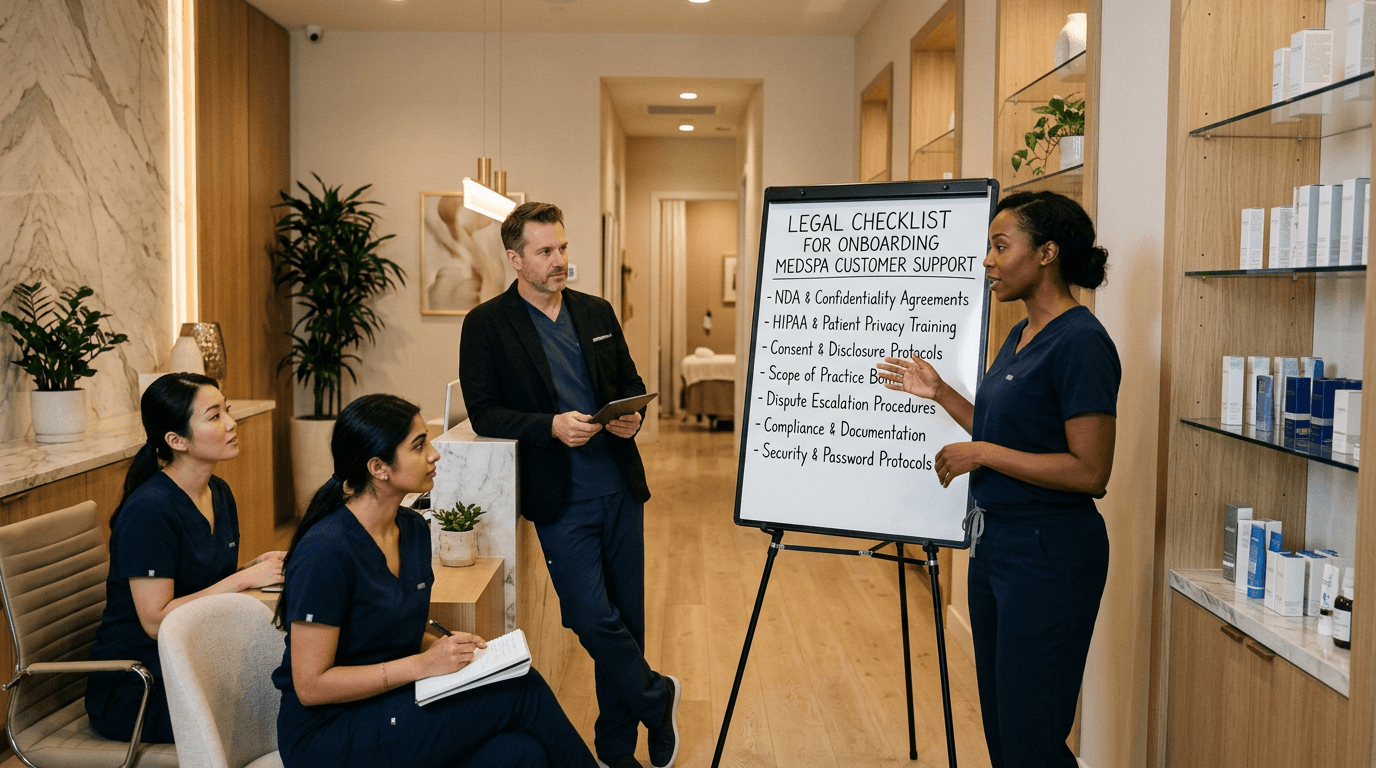
“Hiring a medspa virtual assistant can help medical aesthetic practices manage patient inquiries, appointment scheduling, follow-ups, and administrative responsibilities without expanding their in-house workforce. However, bringing remote customer support staff into daily clinic operations also introduces important legal and compliance responsibilities.
Medspas handle sensitive patient information, including medical histories, treatment records, appointment details, and personal photographs. Whether customer support is handled internally, through an offshore agency, or by a third-party call center, protecting this information must remain a priority.” - Rhane Handisides
Without proper onboarding, remote support employees may accidentally disclose protected health information (PHI), provide unauthorized medical advice, or access records beyond their assigned responsibilities.
A structured onboarding process helps prevent these risks. By establishing clear legal documentation, HIPAA training, communication guidelines, and access controls, medspa owners can build a customer support team that improves operational efficiency while protecting patient privacy.
Understanding the Legal Responsibilities of MedSpa Customer Support Teams
Before onboarding remote or third-party customer support employees, medspa owners must clearly define their responsibilities. Not every task performed at the front desk can be delegated to a non-licensed employee, particularly when medical decisions or clinical recommendations are involved.
Defining the Role of Customer Support in Medical Spa Operations
Customer support teams handle many administrative activities that keep a medspa running efficiently.
These responsibilities may include answering incoming calls, scheduling consultations, confirming appointments, managing general inquiries, coordinating follow-ups, and directing patients to the appropriate clinic personnel.
A virtual assistant for medical spa operations may also help update administrative records, send approved appointment reminders, and manage customer service requests.
However, these responsibilities should be clearly documented. Employees must understand which activities they are authorized to perform and which require approval or intervention from licensed clinical personnel.
Understanding the Difference Between Administrative and Clinical Responsibilities
One of the most important legal considerations when onboarding customer support staff is distinguishing administrative duties from clinical responsibilities.
Administrative tasks generally involve scheduling, communication, appointment coordination, and providing approved information about clinic services.
Clinical responsibilities, on the other hand, involve interpreting symptoms, recommending treatments, assessing medical suitability, and providing individualized medical guidance.
Non-licensed customer support employees should not independently perform clinical activities or make treatment recommendations outside their authorized role.
For example, an assistant may explain how a patient can schedule a consultation for Botox or laser treatments. However, they should not determine whether a patient is medically suitable for a procedure.
Establishing these boundaries protects patients and reduces potential liability for the practice.
Identifying Legal Risks Associated With Patient Communication and Administrative Tasks
Even routine administrative activities can create legal risks when employees handle sensitive patient information.
Sending appointment details to an unauthorized recipient, discussing a patient's treatment history with someone who lacks permission, or sharing before-and-after photographs without appropriate authorization can create privacy concerns.
Other risks include documenting inaccurate information, making unsupported treatment claims, and failing to escalate urgent patient concerns.
Medspa owners should identify these risks before onboarding employees and establish procedures for handling each situation.
Establishing Clear Boundaries to Prevent Unauthorized Clinical Advice
Customer support employees should receive clear instructions about what they can communicate to patients.
They may use approved scripts to explain appointment procedures, general service information, clinic policies, and consultation availability.
However, questions about treatment risks, contraindications, side effects, complications, and medical suitability should be directed to qualified clinical personnel.
A documented escalation process helps employees recognize when a conversation requires clinical involvement rather than attempting to answer questions beyond their qualifications.
Essential Legal Documentation to Prepare Before Onboarding Customer Support Staff
Before granting remote employees access to clinic systems or patient information, medspa owners should prepare the necessary employment and compliance documents.
These documents establish responsibilities, communicate workplace expectations, and provide a framework for protecting confidential information.
Employment Agreements and Job Descriptions
Employment agreements should clearly define the employee's position, responsibilities, compensation arrangements, confidentiality obligations, and applicable employment conditions.
Job descriptions are equally important because they establish the boundaries of administrative responsibilities.
For example, a medspa customer support representative's job description should specify whether they can access appointment records, update administrative information, coordinate patient inquiries, or communicate approved pricing information.
Clearly documented responsibilities reduce confusion and help prevent employees from performing unauthorized tasks.
Confidentiality and Non-Disclosure Agreements
Customer support employees may encounter sensitive business information and patient-related details while performing their duties.
A confidentiality agreement or non-disclosure agreement (NDA) establishes expectations regarding the handling and protection of confidential information.
The agreement should address restrictions on sharing patient information, accessing records for personal reasons, discussing internal business matters, and retaining confidential information after employment ends.
However, an NDA does not replace HIPAA requirements or a Business Associate Agreement when one is legally required.
HIPAA Privacy and Security Acknowledgment Forms
Employees who handle protected health information should receive appropriate HIPAA privacy and security training.
Acknowledgment forms document that employees have received and understood the organization's privacy policies and responsibilities.
These documents may cover patient confidentiality, appropriate information access, password protection, secure communication, and incident reporting.
Medspa owners should retain training records and signed acknowledgments as part of their compliance documentation.
Acceptable Use Policies for Electronic Health Records and Communication Systems
Remote support employees may need access to electronic health records (EHRs), scheduling platforms, business phone systems, and patient communication tools.
An acceptable use policy explains how employees are permitted to use these systems.
It should address password requirements, device security, authorized applications, restrictions on downloading patient information, and procedures for reporting suspicious activity.
The policy should also clarify that employees must never use another person's login credentials or access records without a legitimate work-related reason.
Employee Handbook and Workplace Policy Acknowledgments
An employee handbook provides a central reference for workplace expectations and operational policies.
For medspa customer support teams, it should include attendance requirements, communication standards, confidentiality expectations, escalation procedures, disciplinary policies, and information security guidelines.
Employees should acknowledge receiving and reviewing the handbook before assuming their responsibilities.
HIPAA Compliance Checklist for MedSpa Customer Support Onboarding
HIPAA compliance is particularly important when customer support employees handle patient information on behalf of a covered healthcare provider.
Medspa owners should evaluate how remote employees collect, access, communicate, and protect PHI before granting system permissions.
Understanding Protected Health Information (PHI)
Protected Health Information includes individually identifiable health information maintained or transmitted in connection with healthcare services.
For medspas, this may include patient names linked to treatment information, medical histories, consultation notes, appointment details, and clinical photographs.
Employees should understand that seemingly routine information can become PHI when it identifies an individual and relates to their healthcare.
Training Employees on HIPAA Privacy and Security Requirements
Employees should receive role-appropriate HIPAA training before accessing patient information.
Training should explain the Privacy Rule, Security Rule, permitted uses and disclosures of PHI, minimum necessary standard where applicable, and procedures for reporting suspected incidents.
It should also include practical examples involving phone calls, email communication, messaging platforms, and appointment scheduling.
Establishing Rules for Accessing and Handling Patient Information
Medspa owners should establish clear access policies based on each employee's responsibilities.
Customer support representatives should only access the information necessary to complete their assigned tasks.
For example, an employee responsible for appointment scheduling may need access to scheduling information but may not require unrestricted access to complete medical histories or clinical notes.
Role-based permissions and individual user accounts help enforce these restrictions.
Securing Patient Communication Across Phone, Email, and Messaging Platforms
All communication channels used to handle PHI should be evaluated for appropriate security and compliance safeguards.
Medspa owners should establish approved communication tools, secure authentication requirements, and procedures for verifying patient identities.
Employees should avoid sending sensitive information through personal email accounts, unauthorized messaging applications, or unsecured devices.
Preventing Unauthorized Disclosure of Patient Records and Appointment Details
Customer support staff should understand how to verify identities before discussing patient information.
They should also know how to handle requests from family members, partners, or other individuals who ask about appointments or treatments.
Access should only be provided when permitted under applicable HIPAA rules and supported by the appropriate authorization or other legal basis.
Documenting HIPAA Training and Employee Compliance Acknowledgments
Maintain records showing that employees completed required training and acknowledged applicable privacy and security policies.
Documentation may include training dates, course completion records, signed acknowledgments, and records of additional instruction.
These records help demonstrate that the practice has established and implemented an organized compliance training process.
Patient Consent and Authorization Requirements Customer Support Staff Should Understand
Customer support employees frequently receive questions involving patient records, treatment photographs, and personal information.
They should understand the basic differences between consent, authorization, and permitted disclosures so they can recognize when additional approval is necessary.
Understanding Patient Consent and Authorization Forms
Patient consent generally involves agreement to a particular healthcare activity, while HIPAA authorization is a specific document permitting certain uses or disclosures of PHI that are not otherwise permitted under the Privacy Rule.
Employees should understand that different activities may require different documentation.
They should never assume that consent to receive treatment automatically permits the clinic to use a patient's photographs for marketing.
Recognizing When Written Authorization Is Required Before Disclosing Patient Information
Under HIPAA, certain disclosures require a valid written authorization unless another permitted basis applies.
For example, using identifiable patient photographs for marketing generally requires appropriate authorization.
Customer support staff should know when to pause a request and refer it to the compliance officer or designated manager rather than making assumptions.
Handling Requests for Medical Records and Patient Information
Requests for medical records should follow the practice's established release-of-information procedures.
Employees should verify the requester's identity, determine whether the request is properly authorized, and follow applicable legal requirements and organizational policies.
They should not independently release records simply because someone claims to be a family member or representative.
Managing Photography, Before-and-After Images, and Marketing Permissions
Before-and-after photographs are common in medical aesthetics, but they may contain identifiable health information.
Customer support employees should understand that sharing these images on websites, social media, advertisements, or other marketing materials requires appropriate privacy review and authorization when applicable.
Marketing permission should be documented separately from general treatment consent when required.
Knowing When to Escalate Consent-Related Questions to Clinical or Compliance Teams
When employees are uncertain about consent, authorization, or record disclosure, they should escalate the matter.
A clear escalation process prevents unauthorized disclosures and ensures that sensitive decisions are handled by individuals with the appropriate authority.
Legal Checklists for Patient Communication and Customer Service
Consistent patient communication helps create a professional customer experience while reducing the risk of privacy violations and unauthorized statements.
A structured medspa customer service training program should include approved scripts, communication policies, and escalation procedures for common patient interactions.
Establishing Approved Scripts for Incoming Patient Inquiries
Develop approved scripts for common questions about clinic services, consultations, appointment availability, general pricing, and business policies.
Scripts should provide accurate administrative information without encouraging non-licensed employees to make individualized medical recommendations.
Employees should also be trained to verify patient identities before discussing sensitive information.
Creating Guidelines for Appointment Scheduling and Confirmation
Scheduling guidelines should explain how employees collect patient information, document appointments, and communicate relevant administrative details.
They should also establish procedures for handling cancellations, rescheduling requests, and consultation bookings.
Employees must understand that scheduling a procedure does not mean they have determined the patient's medical eligibility.
Setting Rules for Appointment Reminders and Follow-Up Communications
Appointment reminders should use approved communication channels and disclose only the information necessary for the intended purpose.
Medspa owners should establish policies covering patient communication preferences, identity verification, and opt-out requests where applicable.
Special care should be taken with text messages and emails because notifications may be visible to people other than the intended recipient.
Handling Patient Complaints Without Making Unauthorized Medical or Legal Statements
Customer support employees should listen professionally, document complaints accurately, and follow the clinic's escalation procedures.
They should avoid making promises about medical outcomes, accepting legal responsibility, or dismissing concerns about possible treatment complications.
Complaints involving clinical outcomes, adverse reactions, or potential injuries should be promptly referred to the appropriate clinical or management personnel.
Establishing Procedures for Medical Questions and Clinical Escalations
Every medspa should have a documented process for transferring medical questions to qualified healthcare professionals.
Employees should know which questions require immediate escalation, how to document the interaction, and whom to contact during and outside normal clinic hours.
For urgent symptoms or emergencies, staff should follow the clinic's emergency protocols and applicable instructions rather than attempting to provide medical advice themselves.
Compliance Requirements for Appointment Scheduling, Payments, and Patient Records
Customer support employees handle more than incoming calls and appointment requests. They may also access scheduling platforms, process deposits, communicate payment policies, and update patient records. Each activity introduces potential privacy, security, and financial risks if employees are not properly trained.
For medspa owners, establishing clear administrative procedures helps protect patient information while ensuring that remote support teams follow the same standards as in-house employees.
Protecting Patient Information During Appointment Booking
Appointment scheduling may require collecting personally identifiable information and health-related details. Customer support employees should understand which information they are authorized to request, document, and access.
For example, a patient booking a consultation may need to provide contact details and general appointment preferences. However, employees should avoid collecting unnecessary medical information through unsecured forms or communication channels.
Medspa owners should establish approved booking procedures, identity verification requirements, and access restrictions. A virtual assistant for medical spa operations should only handle the information necessary to complete assigned scheduling responsibilities.
Following Approved Procedures for Deposits, Cancellations, and Refunds
Customer support employees frequently answer questions about consultation fees, treatment deposits, cancellation policies, and refunds.
To prevent misunderstandings and disputes, medspas should provide documented payment and cancellation policies that employees can reference.
Training should explain when deposits are refundable, how cancellation fees are applied, and which situations require management approval.
Employees should never make unauthorized promises about refunds or modify financial arrangements outside their assigned responsibilities.
Understanding Payment Card Security and PCI DSS Responsibilities
Medspas that accept credit and debit card payments must consider Payment Card Industry Data Security Standard (PCI DSS) requirements.
Customer support employees should understand how to handle payment information securely and avoid exposing cardholder data during phone calls, emails, or messaging conversations.
For example, employees should never record full payment card details in general customer service notes or store sensitive payment information in unauthorized spreadsheets.
Practices should use approved payment processors and secure payment workflows. PCI DSS responsibilities depend on the payment environment and the role of the business and its service providers.
Maintaining Accurate Patient Communication and Administrative Records
Accurate documentation helps maintain reliable administrative records and supports effective patient communication.
Employees should record appointment changes, follow-up requests, and relevant customer service interactions according to established clinic procedures.
They should avoid entering personal opinions, unsupported medical statements, or inaccurate information into patient records.
A standardized documentation process also helps managers review customer support activities and identify potential communication problems.
Following Data Retention and Secure Document Disposal Policies
Patient and business records should be retained according to applicable legal requirements and the practice's documented retention policies.
Customer support employees should understand which documents must be preserved, where they should be stored, and how authorized disposal is handled.
Electronic records should be securely deleted when permitted under applicable retention requirements, while physical documents containing sensitive information should be disposed of through approved secure destruction procedures.
Legal and Regulatory Training Every MedSpa Customer Support Employee Needs
A comprehensive medspa customer service training program should cover more than communication skills and scheduling procedures. Employees also need practical knowledge of the legal and regulatory requirements that affect their daily responsibilities.
Training should be appropriate to the employee's role, the practice's operations, and the jurisdictions where the medspa provides services.
HIPAA Privacy and Security Awareness Training
Employees who handle PHI should understand the basic requirements of HIPAA's Privacy, Security, and Breach Notification Rules, as applicable.
Training should cover permitted uses and disclosures, patient confidentiality, secure system access, password protection, and incident reporting.
Employees should also understand the minimum necessary standard when accessing or disclosing PHI, where applicable.
Regular refresher training reinforces these responsibilities and helps employees recognize potential privacy violations.
OSHA and Workplace Safety Awareness
Although remote customer support employees may not work inside the clinic, they should understand workplace safety policies relevant to their positions.
For in-clinic support personnel, training may include hazard communication, emergency procedures, infection prevention, and applicable bloodborne pathogen requirements.
Remote employees should also receive appropriate guidance regarding workstation safety, equipment use, and organizational safety policies.
The specific OSHA training obligations depend on the employee's work environment and assigned duties.
Anti-Discrimination, Harassment Prevention, and Workplace Conduct
Customer support employees represent the medspa when communicating with patients, colleagues, and external partners.
Training should establish expectations for respectful communication, professional conduct, and equal treatment.
Employees should understand policies covering discrimination, harassment, inappropriate behavior, and reporting procedures.
This is particularly important for remote teams working across different locations and employment arrangements.
Consumer Protection and Truthful Marketing Communication
Customer support employees may receive questions about treatment benefits, pricing, promotions, and expected results.
They should be trained to provide accurate, approved information without exaggerating outcomes or making unsupported claims.
For example, employees should not promise that a particular treatment will produce guaranteed results or describe a procedure as risk-free.
Medspa owners should provide approved scripts and marketing guidelines that align with applicable consumer protection and advertising requirements.
Telephone, Text Messaging, and Email Communication Compliance
Patient communication must follow applicable privacy and communication laws.
Depending on the purpose and technology used, requirements may involve HIPAA, the Telephone Consumer Protection Act (TCPA), CAN-SPAM, and applicable state privacy and consumer protection laws.
Employees should understand consent requirements, communication preferences, opt-out requests, identity verification, and approved messaging platforms.
They should also know when a message contains sensitive information and requires additional safeguards.
State-Specific Medical Spa Regulations and Administrative Requirements
Medical spa regulations can vary significantly between states.
Requirements may address medical director responsibilities, delegation and supervision, professional licensing, advertising, patient records, and permitted clinical activities.
Customer support employees should receive training relevant to the administrative responsibilities they perform in each applicable jurisdiction.
Medspa owners should work with qualified legal and compliance professionals to identify state-specific requirements rather than relying on a single generic onboarding policy.
Building a Standardized Legal Onboarding Checklist for MedSpa Customer Support
A standardized onboarding checklist helps ensure that important legal and compliance requirements are completed before employees receive access to sensitive information.
For medspa owners working with remote employees or third-party agencies, a phased onboarding process also makes it easier to verify employee readiness.
Before the First Day: Verify Employment Documents and System Access Requirements
Before an employee begins handling customer support responsibilities, confirm that the necessary employment and compliance documentation is complete.
This may include:
- Signed employment or service agreements.
- Job descriptions and assigned responsibilities.
- Confidentiality and NDA documents.
- Required Business Associate Agreements, where applicable.
- HIPAA privacy and security acknowledgments.
- Acceptable use and information security policies.
- Approved system access requests.
Access should only be granted after the necessary security and authorization requirements have been reviewed.
First Week: Complete Privacy, Security, and Workplace Compliance Training
During the first week, employees should complete foundational compliance training.
Topics should include patient confidentiality, PHI handling, secure communication, password management, workplace conduct, and procedures for reporting potential security incidents.
Employees should also review approved communication scripts and understand which patient questions must be escalated to clinical personnel.
First 30 Days: Evaluate Communication Skills and Policy Understanding
During the first month, managers should evaluate how employees apply their training during actual customer support activities.
Review sample interactions, appointment documentation, identity verification procedures, and adherence to communication guidelines.
Managers should also confirm that employees understand the boundaries between administrative support and clinical responsibilities.
Additional coaching should be provided when employees demonstrate uncertainty or make avoidable mistakes.
First 60 Days: Review Compliance Performance and Administrative Accuracy
At the 60-day milestone, conduct a more detailed review of employee performance.
Evaluate whether employees consistently follow privacy procedures, use approved communication channels, document interactions accurately, and respect access restrictions.
Review any reported incidents, policy violations, or recurring training gaps.
This checkpoint helps identify problems before they become larger operational or compliance concerns.
First 90 Days: Conduct a Formal Compliance and Competency Assessment
The 90-day assessment should determine whether employees understand and consistently follow the practice's administrative and compliance requirements.
Managers can review training records, assessment results, communication samples, and access permissions.
Employees who demonstrate knowledge gaps should receive additional training and supervision.
A formal assessment also creates an opportunity to update individual development plans and identify further training needs.
Managing Data Security and Technology Access During Employee Onboarding
Remote customer support teams need access to specific clinic systems to perform their responsibilities. However, granting unrestricted access creates unnecessary security and privacy risks.
Medspa owners should establish technology controls before allowing employees to access EHR platforms, scheduling systems, payment tools, and patient communication applications.
Applying Role-Based Access Controls to Patient Information
Role-based access control (RBAC) ensures that employees can only access the information necessary for their assigned duties.
For example, a scheduling assistant may need access to appointment availability and basic contact information but may not require access to complete clinical histories.
Access permissions should be documented, approved, and reviewed periodically.
This approach supports the HIPAA Security Rule's access control requirements for covered entities and business associates handling electronic PHI.
Establishing Secure Login and Password Management Practices
Every employee should use an individual account rather than shared login credentials.
Medspas should establish strong authentication requirements, multi-factor authentication where appropriate, and approved password management procedures.
Employees should never share passwords through personal email, messaging applications, or unsecured documents.
These safeguards reduce the risk of unauthorized access and make system activity easier to audit.
Training Employees on Approved Patient Communication Platforms
Before handling patient inquiries, employees should receive instructions on using approved phone systems, email platforms, messaging applications, and scheduling tools.
Training should explain which channels are permitted for different types of communication and how sensitive information must be protected.
Third-party platforms that create, receive, maintain, or transmit PHI on behalf of a covered entity may require appropriate HIPAA safeguards and a Business Associate Agreement.
Preventing Unauthorized Downloads, Screenshots, and Information Sharing
Employees should understand that patient information must not be downloaded, photographed, copied, or shared without proper authorization.
Medspa owners should establish clear restrictions on personal devices, external storage, screenshots, printing, and file transfers.
Where appropriate, technical safeguards can limit downloads, monitor activity, and prevent unauthorized information sharing.
Creating Procedures for Employee Offboarding and Access Revocation
Data security responsibilities continue even when an employee leaves the organization.
Medspa owners should establish an offboarding checklist covering account deactivation, access revocation, equipment return, and the secure handling of confidential information.
For third-party agencies, contracts should also define how access is terminated when an assigned virtual assistant is replaced or removed from the account.
Prompt access revocation helps prevent former employees from accessing patient records or clinic systems after their engagement ends.
Common Legal and Compliance Mistakes When Onboarding MedSpa Customer Support Staff
Even practices with established policies can experience compliance problems when onboarding processes are incomplete or inconsistently enforced.
Recognizing common mistakes helps medspa owners strengthen their procedures before remote customer support teams begin handling patient information.
Allowing Employees to Access Patient Records Without Proper Authorization
One common mistake is granting employees broad system access simply because they need to perform administrative tasks.
Access should be based on legitimate job responsibilities and limited to the information necessary for those duties.
Managers should review permissions regularly and remove unnecessary access as employee responsibilities change.
Treating HIPAA Training as a One-Time Administrative Requirement
HIPAA training should not be treated as a document employees sign once and never revisit.
Employees need continuing education, policy updates, and additional instruction when new systems or responsibilities are introduced.
Regular training helps reinforce privacy expectations and address emerging risks.
Using Unapproved Messaging Applications for Patient Communication
Allowing employees to communicate with patients through personal messaging applications can expose sensitive information.
Medspas should establish approved communication channels and train employees on their proper use.
Convenience should never replace appropriate privacy and security safeguards.
Allowing Customer Support Staff to Provide Medical Advice
Non-licensed customer support employees should not independently diagnose symptoms, recommend treatments, or determine medical suitability.
Their responsibilities should remain within approved administrative boundaries.
Questions involving treatment risks, complications, or clinical decisions must be directed to appropriately qualified healthcare professionals.
Failing to Maintain Training Records and Signed Policy Acknowledgments
Without proper documentation, practices may struggle to demonstrate that employees received required training and understood their responsibilities.
Maintain records of training completion, policy acknowledgments, access approvals, and relevant assessments.
These records also help managers identify employees who need additional instruction.
Overlooking State-Specific Requirements and Regulatory Updates
HIPAA is not the only legal framework that may apply to medspa operations.
State privacy laws, professional licensing rules, medical delegation requirements, consumer protection laws, and communication regulations may impose additional obligations.
Medspa owners should periodically review their compliance procedures with qualified legal counsel to ensure their onboarding requirements remain appropriate as laws and operations change.
How a MedSpa LMS Simplifies Legal Compliance and Employee Onboarding
Managing legal documents, compliance policies, and employee training can become complicated as a medspa grows. The challenge becomes even greater when a practice works with multiple locations, remote customer support employees, or third-party virtual assistant agencies.
A MedSpa Learning Management System (LMS) provides a centralized way to organize training materials, assign mandatory courses, monitor employee progress, and maintain training records.
Instead of relying on scattered documents, email reminders, and manual spreadsheets, medspa owners can use an LMS to establish a more consistent and measurable onboarding process.
Centralizing Compliance Policies, Legal Documents, and Training Materials
A MedSpa LMS allows businesses to organize important training resources in one accessible location.
These resources may include:
- HIPAA privacy and security training materials.
- Patient confidentiality policies.
- Customer communication guidelines.
- Appointment scheduling procedures.
- Payment handling policies.
- Acceptable use and technology security policies.
- Employee handbooks and standard operating procedures (SOPs).
Centralizing these materials helps employees find the information they need without relying on outdated documents or inconsistent instructions.
For example, a newly hired customer support employee can access the clinic's approved appointment scheduling procedures and patient communication guidelines through the same learning platform used for compliance training.
However, an LMS should complement—not replace—formal document management, access controls, and legally required recordkeeping systems. Sensitive patient information should only be stored in systems designed and authorized to handle it.
Automating Mandatory Compliance Training Assignments
Manual training assignments can become difficult to manage, especially when several employees join the organization at different times.
A MedSpa LMS can automate course assignments based on employee roles, departments, and responsibilities.
For example, a customer support employee may automatically receive courses covering:
- HIPAA privacy and security awareness.
- Patient confidentiality.
- Secure appointment scheduling.
- Customer communication standards.
- Administrative documentation.
- Clinical escalation procedures.
Meanwhile, employees with additional responsibilities may receive more specialized training.
Automated assignments help managers establish consistent onboarding requirements and reduce the possibility of employees beginning sensitive tasks before completing the appropriate training.
Tracking Employee Training Completion and Assessment Results
Assigning training is only one part of compliance management. Medspa owners also need to know whether employees have completed their courses and understood the material.
An LMS can track course completion, assessment scores, overdue assignments, and employee learning progress.
For example, managers can review whether a newly hired customer support employee has completed HIPAA awareness training and passed an assessment covering patient confidentiality.
If an employee struggles with a particular topic, managers can assign additional learning materials or schedule coaching sessions.
This creates a more structured way to identify knowledge gaps before they lead to operational or compliance problems.
Maintaining Documented Training Records for Compliance Audits
Training documentation can be important when a medspa needs to demonstrate that employees received appropriate instruction.
A MedSpa LMS can maintain records such as:
- Employee training assignments.
- Course completion dates.
- Assessment results.
- Training acknowledgments.
- Refresher training history.
- Employee-specific learning progress.
These records make it easier for managers to review training activities and prepare supporting documentation when conducting internal audits or responding to compliance inquiries.
However, LMS records should not automatically be treated as proof of complete legal compliance. Medspas must also maintain required policies, incident documentation, access records, and other applicable business records.
Updating Legal and Compliance Training Across Multiple MedSpa Locations
For growing medspa brands, maintaining consistent training across locations can be challenging.
One clinic may update its patient communication procedures while another continues using an outdated version. Without a centralized process, employees may follow different instructions even though they represent the same brand.
An LMS makes it easier to distribute updated policies and assign revised training to affected employees.
For example, when a company updates its patient privacy procedures, managers can publish the revised material and assign it to relevant employees across all participating locations.
Location-specific training can also be organized when state regulations or operational requirements differ.
This helps medspa organizations maintain consistent standards without overlooking local requirements.
Standardizing Customer Support Training for In-House and Remote Employees
Whether a medspa hires an in-house receptionist, a remote customer support specialist, or a medspa virtual assistant, every employee should understand the same fundamental service and compliance expectations.
A centralized LMS can provide standardized courses covering patient communication, appointment management, confidentiality, administrative responsibilities, and escalation procedures.
This is particularly valuable when working with third-party support providers. Rather than assuming that an external employee understands the clinic's policies, managers can assign the same relevant onboarding courses and assessments required of in-house staff.
The result is a more consistent customer experience and a clearer understanding of employee responsibilities, regardless of where the support team works.
Maintaining Legal Compliance After the Initial Onboarding Process
Completing onboarding does not mean an employee will automatically remain compliant throughout their employment.
Regulations change, technology evolves, and employees may take on new responsibilities. Medspas therefore need an ongoing compliance program that reinforces training and reviews how employees handle patient information.
A MedSpa LMS can support this process by making recurring training, assessments, and policy updates easier to manage.
Scheduling Regular Compliance Refresher Training
Employees should receive refresher training based on applicable legal requirements, organizational policies, identified risks, and changes in their responsibilities.
Topics may include HIPAA awareness, patient confidentiality, secure communication, payment handling, and clinical escalation procedures.
For example, a customer support employee who regularly handles patient inquiries may benefit from periodic reviews of identity verification and privacy procedures.
An LMS can help managers schedule recurring assignments and monitor completion without manually contacting every employee.
Reviewing Employee Access Permissions and Security Practices
Employee access requirements can change over time.
An employee who initially handles appointment scheduling may later receive additional responsibilities involving patient records or payment administration.
Managers should periodically review whether those access permissions remain appropriate.
A structured review should consider:
- Whether employees still need access to assigned systems.
- Whether permissions match their current job responsibilities.
- Whether individual accounts and authentication controls remain active.
- Whether unusual access activity requires investigation.
- Whether former employees or reassigned personnel have had unnecessary access removed.
An LMS can provide supporting security awareness training, but actual system permissions must be reviewed and managed through the relevant technology platforms.
Updating Training Materials When Regulations and Policies Change
Compliance training should reflect current organizational policies and applicable legal requirements.
When a medspa updates its privacy procedures, communication guidelines, or administrative workflows, affected employees should receive the revised materials.
For example, a new patient messaging platform may require updated instructions covering secure communication and appropriate handling of sensitive information.
Managers should review existing courses periodically to identify outdated references, incorrect procedures, or missing information.
A centralized learning platform makes it easier to distribute revised content and document employee completion.
Conducting Internal Compliance Audits and Performance Reviews
Regular internal reviews help medspas determine whether employees follow established procedures in their daily work.
Managers can examine appointment documentation, communication samples, access records, training completion, and reported incidents, while ensuring that any review of patient information is properly authorized.
Performance reviews should consider both service quality and compliance behavior.
For example, an employee may be efficient at booking appointments but consistently fail to follow identity verification procedures. This indicates a training or performance gap that requires attention.
Combining operational reviews with compliance assessments helps medspas maintain accountability without treating customer service performance and patient privacy as separate concerns.
Establishing Incident Reporting and Corrective Training Procedures
Employees should know exactly what to do when they suspect a privacy violation, security incident, or policy breach.
Medspas should provide clear reporting procedures that explain:
- Who employees should notify.
- How quickly incidents should be reported.
- What information should be documented.
- Which systems or records may need to be secured.
- Who is responsible for investigating and determining next steps.
Employees should never attempt to conceal incidents or independently decide that a potential privacy breach is insignificant.
When an incident reveals a training gap, managers can assign corrective learning, provide additional supervision, or revise existing procedures.
An LMS can document corrective training assignments and completion, while the organization's designated privacy or security personnel manage the incident investigation and any required notifications.
Summary: Building a Legally Compliant MedSpa Customer Support Team Starts With Structured Onboarding
Hiring customer support employees is an important step in creating a positive patient experience, but medspa owners must also ensure that every employee understands the legal and operational responsibilities of the role.
Whether support is handled by in-house receptionists, remote employees, or a medspa virtual assistant, a structured onboarding process helps establish clear expectations before employees begin handling patient inquiries and administrative tasks.
A reliable onboarding framework should include several essential practices:
- Define administrative and clinical boundaries. Employees must understand which questions they can answer and when they should escalate clinical concerns to qualified professionals.
- Prepare the necessary legal documentation. Employment agreements, confidentiality documents, applicable Business Associate Agreements, and technology policies should be established before granting access to sensitive information.
- Prioritize privacy and security training. Employees need practical guidance on protecting PHI, using approved communication platforms, and following secure information-handling procedures.
- Standardize patient communication. Approved scripts and documented procedures help prevent misleading statements, unauthorized medical advice, and inconsistent customer experiences.
- Establish clear technology access controls. Employees should only access the systems and information necessary for their assigned responsibilities.
- Maintain ongoing compliance training. Refresher courses, policy updates, and regular assessments help reinforce employee knowledge beyond the initial onboarding period.
- Document employee training and performance. Maintaining accurate training records and conducting regular reviews helps managers identify knowledge gaps and demonstrate their training efforts.
A MedSpa LMS can bring these activities together by centralizing learning materials, automating course assignments, tracking employee progress, and maintaining training documentation.
Ultimately, legal compliance should not be treated as a one-time onboarding requirement. It should become part of the medspa's everyday operations and employee development strategy.
By combining clear legal policies, role-specific training, secure technology practices, and ongoing education, medspa owners can build a customer support team that protects patient information while delivering a professional and consistent patient experience.
Frequently Asked Questions About Legal Checklists for MedSpa Customer Support Onboarding
1. What Legal Documents Are Required When Hiring MedSpa Customer Support Staff?
The required documents depend on the employee's role, employment arrangement, and the medspa's location. Common documents include employment agreements, job descriptions, confidentiality and non-disclosure agreements, acceptable use policies, and employee handbook acknowledgments.
If employees or third-party service providers handle protected health information (PHI) on behalf of a HIPAA-covered entity, a Business Associate Agreement (BAA) may also be required. Medspas should consult qualified legal counsel to determine which documents apply to their specific operations.
2. Do MedSpa Receptionists and Customer Support Employees Need HIPAA Training?
Employees who handle PHI for a HIPAA-covered entity should receive training appropriate to their responsibilities. This includes receptionists, appointment coordinators, customer support representatives, and remote assistants who access patient information.
Training should explain patient confidentiality, permitted information sharing, secure communication, system access, and incident reporting. Employees should understand how their everyday activities can affect patient privacy.
3. Can MedSpa Customer Support Staff Access Patient Medical Records?
Yes, but access should be limited to what employees need to perform their assigned responsibilities and must follow applicable privacy and security requirements.
For example, a scheduling employee may need access to appointment information and selected patient details. However, that does not automatically justify access to complete medical histories, clinical notes, or other sensitive records.
Medspa owners should establish role-based access permissions and regularly review employee access to patient information.
4. What HIPAA Rules Should MedSpa Customer Support Employees Understand?
Customer support employees should understand the HIPAA Privacy Rule, Security Rule, and applicable breach notification requirements.
Their training should cover:
- Protecting PHI from unauthorized access and disclosure.
- Following the minimum necessary standard where applicable.
- Using approved communication channels.
- Maintaining secure passwords and individual system accounts.
- Verifying identity before releasing protected information.
- Reporting suspected privacy or security incidents.
- Following organizational procedures for handling patient requests.
Employees should also understand that patient information must not be shared simply because someone claims to be a family member, friend, or authorized representative. Requests must follow the practice's identity verification and disclosure procedures.
5. Can Customer Support Staff Discuss Treatments and Procedures With Patients?
Customer support employees can provide general information using approved scripts and materials, such as treatment descriptions, published pricing, appointment availability, and preparation instructions authorized by the clinic.
However, they should not independently diagnose symptoms, recommend individualized treatments, determine medical eligibility, or provide clinical advice unless they hold the appropriate qualifications and authorization under applicable law.
Questions about treatment risks, contraindications, side effects, complications, and medical suitability should be referred to qualified clinical personnel.
Clear communication boundaries help protect patients and prevent employees from performing responsibilities outside their permitted scope.
6. What Should Be Included in a MedSpa Customer Support Onboarding Checklist?
A comprehensive onboarding checklist should cover the legal, administrative, communication, and technology requirements of the employee's role.
Important items include:
- Signed employment and confidentiality agreements.
- Job descriptions and clearly defined responsibilities.
- Applicable HIPAA training and privacy acknowledgments.
- Patient communication and identity verification procedures.
- Approved appointment scheduling and cancellation policies.
- Payment handling and refund procedures.
- Secure system access and password management.
- Clinical escalation guidelines.
- Employee handbook and acceptable use policy acknowledgments.
- Training assessments and completion records.
The checklist should also include follow-up reviews during the employee's first 30, 60, and 90 days to evaluate performance and reinforce compliance expectations.
7. How Often Should MedSpa Customer Support Employees Receive Compliance Training?
Compliance training should be provided during onboarding and reinforced regularly throughout employment.
The appropriate schedule depends on applicable legal requirements, organizational policies, employee responsibilities, and identified risks. HIPAA requires workforce training as necessary and appropriate to carry out their functions, as well as training when material policy or procedure changes affect their responsibilities.
Medspas should also provide additional training when employees use new technology, receive expanded responsibilities, or demonstrate gaps in their understanding of established procedures.
8. How Should MedSpas Document Employee Compliance Training?
Medspas should maintain organized records showing which employees received training, what topics were covered, and whether required assessments were completed.
Useful records include:
- Employee names and assigned training courses.
- Training completion dates.
- Assessment results.
- Signed policy acknowledgments.
- Refresher training history.
- Corrective training documentation.
- Relevant policy and training material versions.
A centralized recordkeeping process makes it easier for managers to review employee progress and prepare for internal compliance audits.
9. How Can a MedSpa LMS Help Maintain Employee Compliance?
A MedSpa Learning Management System (LMS) simplifies compliance management by organizing training materials, automating course assignments, and tracking employee progress.
Managers can use an LMS to assign role-specific courses covering HIPAA awareness, patient confidentiality, customer communication, payment procedures, and administrative responsibilities.
The platform can also help track completion dates, assessment results, and overdue training assignments.
For medspas with multiple locations or remote customer support employees, an LMS creates a more consistent approach to onboarding and ongoing education. It supports compliance efforts by making training easier to manage and document, although it does not replace legal oversight, technical security controls, or formal compliance management.
10. What Compliance Considerations Apply When Hiring Remote MedSpa Customer Support Staff?
Hiring remote customer support employees introduces additional considerations because patient information may be accessed outside the physical clinic.
Medspas should determine whether the remote employee or service provider qualifies as a business associate under HIPAA and establish the appropriate contractual safeguards, including a BAA when required.
Other important considerations include:
- Restricting access to information based on job responsibilities.
- Using secure devices, accounts, and communication platforms.
- Implementing appropriate authentication and access controls.
- Prohibiting unauthorized downloads and information sharing.
- Establishing procedures for reporting security incidents.
- Reviewing applicable state privacy and employment requirements.
- Confirming that third-party agencies maintain appropriate security and confidentiality practices.
For offshore or international support arrangements, medspas should also obtain legal guidance on cross-border privacy, contractual, and data protection obligations.
How Can V-Assist Help With Legal Checklists for MedSpa Customer Support Onboarding?
Building a compliant customer support team requires more than hiring people with excellent communication skills. Medspa owners also need to ensure that employees understand patient confidentiality, administrative procedures, technology requirements, and the boundaries of their responsibilities.
This is where specialized healthcare virtual assistant support can help.
V-Assist provides virtual assistant support designed to help healthcare and medical aesthetics businesses manage administrative responsibilities more efficiently.
By working with a specialized support team, medspa owners can delegate appropriate non-clinical tasks such as:
- Appointment scheduling and calendar management.
- Patient inquiry handling using clinic-approved scripts.
- Appointment confirmations and administrative follow-ups.
- Customer communication and routine administrative assistance.
- Patient information coordination within authorized access limits.
- Administrative documentation and workflow support.
For medspas considering a remote support arrangement, it is important to establish clear job responsibilities, confidentiality requirements, appropriate agreements, and secure system access before work begins.
V-Assist can help support these administrative workflows while your practice maintains responsibility for clinical decisions, legal compliance, and the policies governing patient information.
Build a More Organized and Reliable MedSpa Support Team With V-Assist
Your customer support team plays an important role in the patient experience. Give your practice the administrative support it needs while keeping responsibilities, communication procedures, and compliance expectations clearly defined.
Ready to improve your medspa's customer support operations? Visit V-Assist to explore specialized virtual assistant support for your healthcare and medical aesthetics business.